
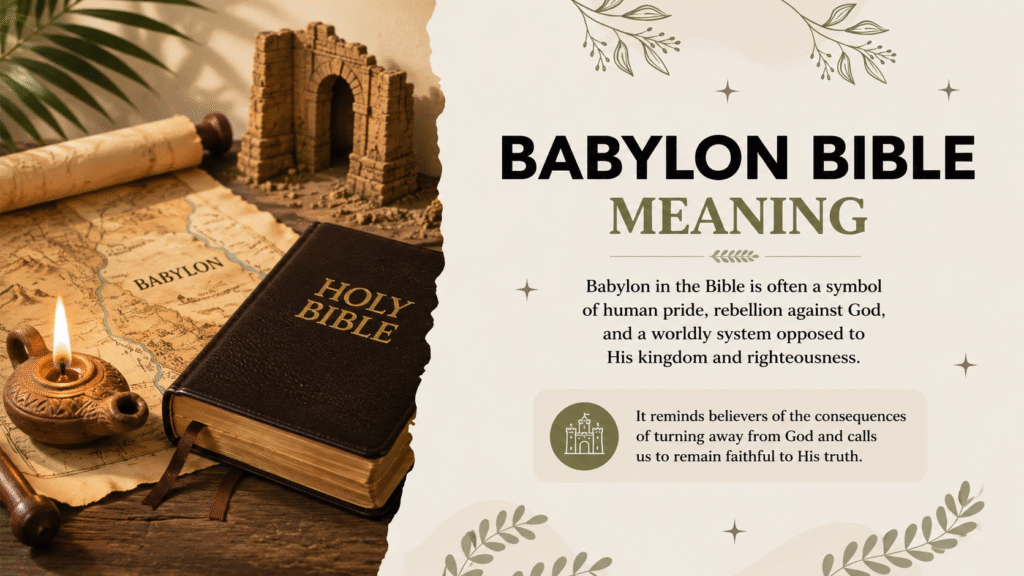
Have you ever read the word Babylon in your Bible and wondered if it means more than just an ancient city? You are not alone. Babylon is one of the most powerful and layered symbols in all of Scripture appearing from the very first chapters of Genesis all the way through the final pages of Revelation. Understanding the Babylon Bible meaning can transform how you read God’s Word, interpret prophetic visions, and even understand the spiritual battles you face every day.
This article unpacks the true biblical meaning of Babylon, its spiritual symbolism, its role in prophecy and dreams, and the practical faith lessons it holds for believers today.
Biblical Meaning of Babylon: From Genesis to Revelation
Where Babylon First Appears in Scripture
Babylon’s story begins in Genesis 10:10, where it is listed as one of the first great cities founded by Nimrod. But its deeper spiritual significance takes root in Genesis 11, with the Tower of Babel. The people of that age attempted to build a tower to reach the heavens — not to honor God, but to glorify themselves. God responded by confusing their language and scattering them across the earth.
The very name Babel is connected to the Hebrew word meaning confusion. That city of Babel eventually grew into Babylon a name synonymous with pride, disorder, and rebellion against divine authority. From the very beginning, Babylon represents what happens when human ambition replaces God-centered living.
Babylon in the Old Testament
By the time of the Old Testament prophets, Babylon had grown into the most powerful empire on earth under King Nebuchadnezzar II. It conquered Jerusalem, destroyed Solomon’s Temple, and took God’s people into captivity around 586 BC. The haunting words of Psalm 137:1 — “By the rivers of Babylon, we sat down and wept” capture the deep grief of that exile.
Prophets like Isaiah (chapters 13–14) and Jeremiah (chapters 50–51) pronounced devastating judgments against Babylon, not simply as a city, but as a spiritual force of pride and godlessness. The historical fall of Babylon in 539 BC at the hands of the Medo-Persian Empire fulfilled many of those prophecies. Yet the Bible makes clear the symbolism did not die with the empire.
Debauchery Meaning in the Bible:
Babylon in the Book of Daniel
The Book of Daniel offers one of the most vivid portraits of Babylon’s spiritual meaning. Daniel and his three friends — Shadrach, Meshach, and Abednego — were taken captive to Babylon. Yet they refused to bow to its values, its idols, or its pressure to conform.
King Nebuchadnezzar’s pride is a centerpiece of Daniel 4. He declared, “Is not this great Babylon that I have built?” God’s response was swift and humbling he was driven from his throne until he acknowledged divine sovereignty. The lesson is unmistakable: pride leads to downfall. Babylon, at its core, is a warning about human arrogance unchecked by reverence for God.
Babylon Bible Meaning: Spiritual Significance and Symbolism
Babylon is far more than a dot on an ancient map. Across Scripture, it functions as a multi-layered spiritual symbol. Here is what it represents:
| Symbol | Biblical Meaning |
|---|---|
| Pride | Human ambition that rejects God’s authority (Genesis 11, Daniel 4) |
| Rebellion | Opposition to God’s moral and spiritual order |
| Idolatry | Worship of power, wealth, and worldly success |
| Confusion | Spiritual disorder caused by turning away from divine truth |
| Corruption | Moral decay at both personal and cultural levels |
| False Security | Trust in human systems instead of God’s promises |
The Spirit of Babylon Today
The spirit of Babylon is not confined to the ancient world. It is alive in any system, culture, or mindset that:
- Elevates self above God
- Chases material wealth at the expense of spiritual health
- Promotes pride, greed, or sexual immorality as virtues
- Silences or persecutes those who hold to biblical truth
Babylon is not just a place — it is a posture of the heart. When comfort, status, or power become our gods, we are spiritually living in Babylon.
Babylon in the Book of Revelation
The most dramatic portrayal of Babylon appears in Revelation 17–18, where it is described as “Mystery Babylon the Great, the Mother of Harlots.” John sees a woman seated on a scarlet beast, drunk with the blood of the saints. This is no longer a literal empire — it is a symbolic vision of a corrupt global system built on religious apostasy, economic exploitation, and violent opposition to God’s people.
Revelation 18 describes Babylon’s sudden fall and the mourning of the merchants and kings who profited from her. Yet in Chapter 19, the saints rejoice. The message is powerful: no worldly empire, no matter how dominant, stands against God forever. Babylon’s fall is inevitable. God’s kingdom is eternal.
Babylon Bible Meaning: Biblical Interpretations in Dreams or Real Life
What Does It Mean to See Babylon in a Dream?
Dreams involving Babylon often carry spiritual weight, though they typically mirror your inner emotional or spiritual state rather than predicting literal events. Here are the most common Babylon dream scenarios and their biblical interpretations:
- Dreaming of being inside Babylon — You may feel surrounded by worldly pressures, temptations, or values that conflict with your faith. This is a call to seek God more intentionally.
- Dreaming of Babylon falling or collapsing — A symbol of hope and transformation. What once held you captive is losing its power over you. Spiritual renewal may be near.
- Dreaming of escaping Babylon — God may be calling you out of a situation, relationship, or mindset that is drawing you away from His purposes.
- Dreaming of being lost in Babylon — A sign of spiritual confusion or drift. Return to prayer, Scripture, and community for grounding.
- Dreaming of Babylon in ruins — Represents the end of something destructive in your life. God’s justice and restoration are at work.
Babylon Symbolism in Real Life
In daily life, Babylon can represent:
- A toxic environment — a workplace, relationship, or cultural setting that pressures you to compromise your values
- Spiritual exile — a season of feeling far from God, much like Israel’s captivity
- Personal pride — an area where self-reliance has replaced trust in God
- A system of deception — media, ideology, or social pressure that promotes falsehood over truth
Like Daniel in ancient Babylon, believers today are called to live in the world without being of it. You can maintain integrity, faithfulness, and spiritual clarity even in the most godless environments.
Practical Lessons & Faith Insights
Babylon’s message to modern believers is both a warning and a source of hope. Here are the most important takeaways:
1. Pride Is the Root of Babylon’s Sin
Every Babylon story — from Babel to Nebuchadnezzar to Revelation 18 — begins with human arrogance. The antidote is humility: acknowledging that God is sovereign and we are His servants, not the other way around.
2. You Can Be Faithful in a Hostile Culture
Daniel’s life is proof that godly living is possible even in the most corrupt surroundings. He prayed three times a day in Babylon (Daniel 6:10). He refused the king’s food. He interpreted dreams by God’s wisdom, not worldly philosophy. Faithfulness is a daily choice, not just a Sunday decision.
3. Every Babylon Eventually Falls
God’s Word is consistent: systems built on pride, injustice, and rebellion do not endure. Whether that Babylon is a corrupt empire, a destructive habit, or a spiritually hollow culture — it will fall. God’s justice is patient but certain.
4. Exile Is Not the End of Your Story
Israel’s captivity in Babylon ended in restoration. God brought His people home. If you are in a spiritual exile right now — feeling distant, lost, or overwhelmed — remember that God’s plans for you are plans of hope (Jeremiah 29:11, written from Babylon).
5. Choose the New Jerusalem Over Babylon
Revelation’s great contrast is between Babylon (the world’s corrupt system) and the New Jerusalem (God’s eternal kingdom). Every believer is ultimately choosing which city to invest in — the temporary glitter of worldly systems or the permanent glory of God’s kingdom.
FAQs
What does Babylon mean in the Bible?
Babylon in the Bible represents pride, rebellion, idolatry, and opposition to God — both as a historical empire and as a lasting spiritual symbol throughout Scripture.
Is Babylon a real place or just symbolic?
Both. Babylon was a real, powerful ancient city in Mesopotamia (modern-day Iraq), but the Bible also uses it as a symbol of any corrupt worldly system that opposes God’s will.
What does the fall of Babylon mean in Revelation?
It signifies God’s final judgment on all corrupt human systems — a powerful assurance that evil, no matter how dominant, is ultimately temporary and subject to divine justice.
What is the spirit of Babylon?
The spirit of Babylon refers to an attitude of greed, pride, self-glorification, and rebellion against God that can exist in individuals, cultures, and institutions in any era.
What does dreaming about Babylon mean spiritually?
Babylon in dreams usually reflects inner spiritual struggles — feelings of being overwhelmed, tempted, or distant from God. It is often a call to return to prayer, Scripture, and faithful living.
How is Babylon connected to the Tower of Babel?
Babel and Babylon refer to the same city at different stages. Babel in Genesis 11 introduced the theme of human pride over God, which Babylon later embodied as a full empire and prophetic symbol.
What can Christians learn from Babylon today?
Christians are called to live like Daniel — faithful, prayerful, and uncompromising — even while surrounded by a culture that mirrors Babylon’s values of pride, materialism, and spiritual rebellion.
Manna in the Bible: Hidden Meaning Revealed
Conclusion
The Babylon Bible meaning is one of the richest threads running through all of Scripture. From the proud tower of Babel to the trembling exile by the rivers, from Nebuchadnezzar’s humbling to John’s apocalyptic vision of her fall — Babylon is God’s ongoing sermon to humanity about the dangers of pride and the certainty of divine justice.
But Babylon’s story is never just a warning. It is also a call. A call to be like Daniel — steady, prayerful, and grounded in God even when the world around you demands compromise. A call to remember that exile is not your final destination. A call to fix your eyes not on the glittering towers of worldly success, but on the New Jerusalem — the city whose builder and architect is God.
Wherever you find yourself today, God’s message is clear: you can live in Babylon without becoming Babylon. Stay faithful. Stay humble. Your story is still in His hands.

Hi! I’m Jenson, the writer behind punslush.com. I craft clever puns and witty wordplay designed to entertain and inspire. Visit punslush.com for a good dose of humor and fun!