
KMS meaning in text boils down to “kill myself,” typed as three quick letters instead of a full sentence. Almost every time you see it, someone’s venting frustration, embarrassment, or pure exhaustion, not making an actual statement of intent.
Here’s the twist nobody warns you about: those same three letters can mean a joke one minute and something worth your attention the next, and the difference lives entirely in the details most people skim right past.
This guide breaks down every real meaning behind the phrase, how it shifts across texting, gaming, and dating apps, and exactly how to tell a throwaway joke from a moment that actually deserves a closer look.
What Does KMS Actually Mean in Text?
Let’s start with the plain answer, because that’s what you came here for.
KMS stands for “kill myself.” That’s the literal expansion. But here’s the thing that trips people up: in the vast majority of cases, nobody typing those three letters means it literally. It functions the same way “I’m dying” or “this is killing me” works in everyday speech. Nobody calls 911 when a coworker says a meeting is “actually going to kill me.” Context tells you it’s an exaggeration.
KMS slang works the same way. It’s a linguistic shortcut for overwhelming frustration, secondhand embarrassment, or comedic exhaustion. Think of it as a pressure-release valve in text form. You type it, you exhale, and you move on with your day.
That said — and this matters — KMS can occasionally signal real distress. The skill isn’t memorizing one fixed meaning. It’s learning to read the room, or in this case, the group chat.
ALSO READ: CFS Meaning: What It Stands For & How People Use It Today 2026
Quick Facts About KMS
Here’s a fast rundown before we go deeper:
| Fact | Detail |
|---|---|
| Full form | “Kill myself” |
| Primary function | Hyperbolic expression of frustration, embarrassment, or exhaustion |
| Rise in mainstream use | Gained heavy traction alongside Gen Z texting culture on Snapchat, Discord, and Twitter/X between 2016 and 2020, and has stayed a fixture of casual online shorthand since |
| Core age demographic | Primarily teens and young adults, though usage has spread to older Millennials in gaming and meme-heavy spaces |
| Where it lives most | Group texts, Discord servers, gaming chats, Instagram comments, and dating app conversations |
| Literal usage rate | A small minority of instances; most linguists and moderators who study chat slang classify it as overwhelmingly hyperbolic |
| Common confusion | Frequently mixed up with KYS (“kill yourself”), which is directed at another person and carries a very different, more hostile weight |
| Not to be confused with | Amazon Key Management Service or Microsoft KMS activation — same acronym, completely unrelated text abbreviation in a tech context |
Keep that table handy. It answers the “what does KMS mean” question in one glance, but the real value of this guide is in the nuance that follows.
Every Real Meaning of KMS — Ranked by How Often You’ll See It
Not every KMS text carries the same weight. Here’s how the actual definition breaks down by frequency, starting with the most common and working toward the rarest.
Hyperbolic Frustration (“I Simply Cannot”)
This is the bread-and-butter common usage of KMS. Someone’s Wi-Fi cuts out mid-video-call. Their professor assigns a paper the night before finals. Their sibling eats the last slice of pizza they’d been saving. KMS.
It’s the texting equivalent of throwing your hands up. Nobody’s in danger. Nobody’s spiraling. It’s just frustration that needs somewhere to go, and three letters do the job faster than typing out a full sentence.
Example text exchange:
Friend: just spilled coffee all over my laptop right before my presentation You: kms 💀
Nobody reading that thinks anyone’s actually in crisis. It’s shorthand for “this is the worst,” nothing more.
Comedic Exaggeration and Irony
Close cousin to frustration, but with a punchline attached. This version leans into humor, often paired with a meme, a screenshot, or a story that’s mildly cringe rather than genuinely upsetting.
Someone might text KMS after:
- Sending a text to the wrong person
- Tripping in front of their crush
- Watching an old, embarrassing photo resurface
- Realizing they’ve been mispronouncing a word for years
This is where KMS slang overlaps heavily with phrases like “I’m deceased” or “this is sending me.” It’s comedic self-deprecation, not distress. The tone is almost always light, often followed by laughing emojis or all lowercase, breezy phrasing that signals “we’re just having fun here.”
Genuine Emotional Overwhelm
Here’s where things shift. Sometimes KMS shows up attached to something heavier — a breakup, a family fight, a rejection letter, a genuinely bad week stacked on another bad week. The words are identical, but the emotional temperature is different.
This is the minority case, but it’s the one that matters most. The interpretation here depends on pattern, not just the phrase itself. A person who’s normally upbeat suddenly using KMS repeatedly, alongside signs of withdrawal or hopelessness, deserves a different response than a friend joking about a coffee spill.
We’ll cover exactly how to spot this shift later in the mental health section, because getting this distinction right actually matters.
Gaming Rage Culture
Gaming slang has its own dialect, and KMS is a fixture of it. Losing a ranked match on the final round. Getting outplayed by a teammate who won’t stop talking. Watching an entire lead evaporate because of one bad call. KMS shows up constantly in multiplayer chat, voice comms, and post-match Discord servers.
Rage moments in online gaming communities produce some of the most casual, throwaway uses of the term you’ll find anywhere. It’s practically punctuation at this point — closer to “ugh” than an actual statement of intent. Competitive gamers use it after missed shots, bad RNG drops, server lag, and toxic teammates, often multiple times in a single session.
Platform-Specific Slang Mutations
Slang doesn’t stay static, and KMS has spawned variations depending on where it’s used:
- KMSL — “kill myself laughing,” a more clearly comedic offshoot
- kmsss — an exaggerated, drawn-out version for emphasis
- “kmsing rn” — verb form, used to describe an ongoing state of frustration or embarrassment
- kms 😭 — paired almost universally with the crying-laughing emoji to signal irony rather than distress
These mutations matter because they show something important: the more playful and stylized the format, the less likely it’s meant literally. A stretched-out “kmsssss” with three emojis reads very differently from a flat, single “kms” sent with no punctuation and no follow-up.
KMS vs. Similar Slang — Know the Difference
Confusing KMS with its slang neighbors is one of the fastest ways to misread a conversation. Here’s a clear breakdown:
| Term | Full Meaning | Directed At | Typical Tone | Severity Level |
|---|---|---|---|---|
| KMS | Kill myself | Self | Frustration, humor, occasional distress | Usually low, situationally high |
| KYS | Kill yourself | Another person | Hostile, harassing | High — often flagged as harassment or bullying |
| KMSL | Kill myself laughing | Self | Purely comedic | Very low |
| I’m dead / deceased | Exaggerated amusement | Self | Comedic | Very low |
| This is sending me | Something is extremely funny | Self | Comedic | Very low |
| IDGAF | I don’t give a f*** | Self | Indifference, detachment | Low, but can signal disengagement in patterns |
The most important distinction on this table is KMS vs. KYS. KMS is self-directed and, in nearly all cases, hyperbolic. KYS, on the other hand, is aimed at someone else, and it’s treated far more seriously by platforms, schools, and workplaces because it functions as a form of harassment. Most social platforms now flag or moderate KYS more aggressively than KMS for exactly this reason.
If you take away one thing from this comparison: who it’s aimed at changes everything.
KMS Across Every Platform — What It Really Looks Like
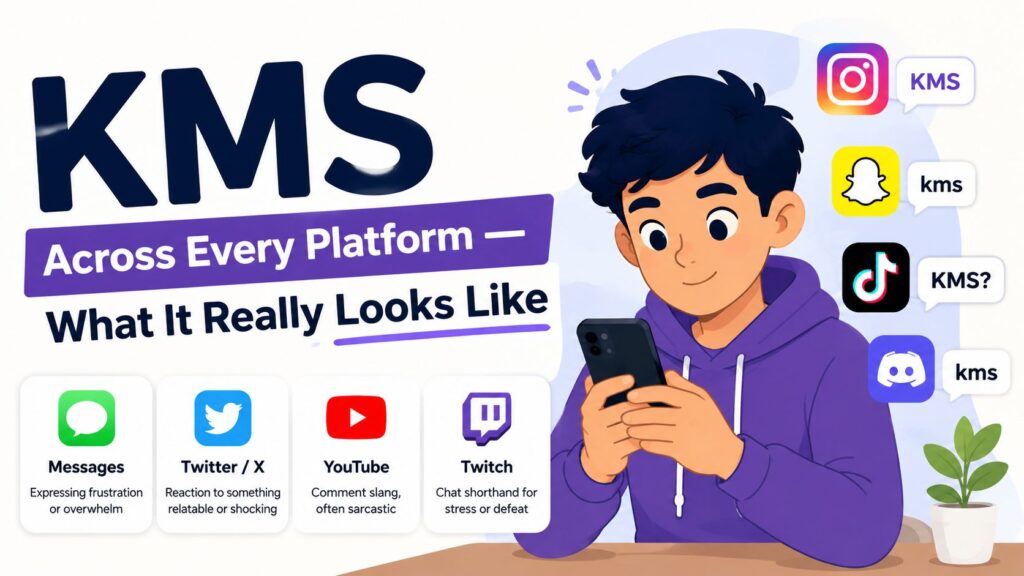
Platform context shapes how KMS gets used almost as much as the words themselves do. Here’s how it plays out across the apps where you’re most likely to encounter it.
Texting Between Friends
This is the most low-stakes environment for KMS. Between close friends, it’s shorthand built on years of shared context. A friend who knows your sense of humor reads “kms” attached to a bad grade completely differently than a stranger would. Familiarity does a lot of the interpretive work here.
Snapchat and BeReal
Ephemeral platforms tend to produce more casual, throwaway uses of KMS. Because Snaps disappear and BeReal posts are meant to capture an unfiltered moment, the slang used alongside them tends to be quick, reactive, and low-weight — closer to a shrug than a statement.
Instagram Comments
In comment sections, KMS often shows up as social media slang attached to relatable content — a meme about Mondays, a video of someone’s plans falling through, a post about a group project gone wrong. It’s public-facing, which usually means it’s calibrated to be light and shareable rather than genuinely heavy.
Dating Apps
This is one of the more nuanced categories. On dating apps, KMS sometimes shows up as dating conversations humor — a kind of dark, self-deprecating flirtation. Someone might type it after admitting an embarrassing habit or reacting to a cringe-worthy dating story. It can also function as a bonding tool over shared bad experiences with modern dating.
Match chat usage tends to be more calculated than group texts between old friends, since both people are still sizing each other up. A pattern of KMS from a new match without any lightness attached, though, is worth noting rather than ignoring outright.
Discord and Gaming Chats
As covered above, gaming community spaces treat KMS almost as filler language. Voice chat, text channels, and post-game recaps are full of it, usually tied directly to in-game frustration. This is the platform where the term is most diluted in meaning, precisely because it’s used so constantly.
Reddit and Twitter/X
On these platforms, KMS often rides alongside memes, quote-tweets, and ironic commentary. It’s closer to internet performance than private communication — used to signal relatability to a wider audience rather than express something personal. Trending slang cycles fast here, and KMS frequently appears folded into jokes, reaction GIFs, and viral threads.
The Workplace — Yes, It Happens
It’s rarer, but workplace Slack and Teams messages do occasionally include KMS, usually after a chaotic meeting, a missed deadline, or an inbox disaster. Professional communication norms mean it shows up far less often than in personal texting, and when it does, it’s almost always meant as dry, exhausted humor between coworkers who already have a casual rapport.
That said, business etiquette still applies. Using it with a manager you don’t know well, in a formal email thread, or in front of clients is a different story entirely — more on that in the final section.
Is KMS Offensive, Flirty, or a Red Flag?
The honest answer: it depends entirely on context. There’s no universal rule that applies across every relationship and every platform. Here are three scenarios that show how differently the same three letters can land.
Scenario one: the close friend after a bad exam. Your friend texts “kms” after bombing a test they studied hard for. You’ve known them for years, and they’re back to normal an hour later, complaining about something else entirely. This is almost certainly hyperbole — frustration with an outlet, nothing more.
Scenario two: a partner who says it after every argument. This is a different pattern entirely. If someone uses KMS as a recurring response specifically during conflict, especially paired with guilt-tripping or shutting down communication, it’s worth addressing directly — not necessarily as a mental health emergency, but as a communication pattern that isn’t healthy for either person.
Scenario three: a stranger online. Someone you don’t know well using KMS repeatedly, without the playful tone that usually accompanies the joke version, deserves more caution. You don’t have the years of context that make interpretation easy, so it’s reasonable to check in rather than assume.
The takeaway: KMS isn’t inherently offensive, and it isn’t inherently a red flag. It’s a mirror — it reflects the relationship, the platform, and the pattern it shows up in.
How to Respond When Someone Texts You KMS
Your response should match the read you’re getting. Here’s how to calibrate it.
Casual and Funny Replies (For Close Friends)
When context makes it obviously a joke, matching the energy usually works best:
- “same tbh”
- “kms together 💀”
- “the group chat is not surviving this story”
- “big mood”
These keep the tone light without dismissing the frustration entirely.
Checking In Without Awkwardness
Sometimes you’re not 100% sure, and you don’t want to overreact or underreact. A light check-in works well here:
- “lol okay but are you actually okay”
- “that bad huh, what happened”
- “wait real talk, you good?”
This keeps the door open without making the conversation feel heavy if it really was just a joke.
When You’re Genuinely Concerned
If the pattern, tone, or timing feels different from usual, be direct and warm rather than vague:
- “Hey, I noticed you’ve said that a few times this week. I want to make sure you’re actually doing okay.”
- “I know this might be nothing, but I care about you, and I want to check in for real.”
- “You don’t have to explain anything right now, but I’m here if you want to talk.”
Directness paired with warmth tends to land better than either ignoring it completely or panicking.
Professional Replies
If a coworker uses it in a work chat, a light, humanizing response usually fits the moment without making it weird:
- “rough one, huh — coffee’s on me tomorrow”
- “that meeting really did us all in”
If it happens repeatedly or seems to carry real weight, a quiet, private check-in is a better move than addressing it in a group channel.
Why People Keep Misreading KMS — The Five Big Mistakes
Most misunderstandings around this term come down to five recurring errors.
Taking It Literally Every Time
Treating every instance as a crisis creates alarm fatigue and can actually make people less likely to reach out when something’s genuinely wrong. If every joke gets treated like an emergency, the real signal gets buried in noise.
Dismissing It Every Single Time
This is the more dangerous mistake, and it deserves more weight than people usually give it. Assuming it’s always a joke means you might miss the rare moment when it isn’t. Warning signs don’t always announce themselves clearly — sometimes they’re wrapped in the same casual language as everything else.
Confusing KMS With KYS or KMSL
These aren’t interchangeable. Mixing them up changes the entire read of a conversation — self-directed hyperbole, harassment directed at someone else, and pure comedic exaggeration are three very different things wearing similar-looking letters.
Ignoring Generational and Cultural Context
A 45-year-old boss and a 16-year-old gamer are not using this word the same way, and treating them identically leads to bad reads in both directions. Gen Z language has absorbed KMS as near-default frustration slang; older users encountering it for the first time often lack that frame of reference entirely.
Platform Blindness
Reading a Discord message with the same rules you’d apply to a text from your mom is a mismatch. Platform-specific slang exists precisely because the same words carry different weight in different spaces. Context isn’t just about who’s talking — it’s about where.
KMS and Mental Health: What to Actually Pay Attention To
This is the part of the conversation most guides skip, or handle so vaguely it’s not actually useful. Let’s be specific instead.
Emotional wellbeing context matters more than the words themselves. A single KMS text, on its own, tells you almost nothing. What actually shifts the read is pattern. Here’s what’s worth paying attention to:
- Frequency: Is this a once-in-a-blue-moon comment, or has it become a near-daily addition to their texts?
- Isolation: Have they pulled back from friends, group chats, or activities they usually enjoy?
- Specificity: Are they being vague and hyperbolic, or have comments gotten more detailed and concrete?
- Mood shifts: Has their overall tone changed — flatter, more withdrawn, less like themselves — alongside the phrase showing up more often?
None of these factors, alone, is a diagnosis. But stacked together, they’re a legitimate signal worth acting on with supportive communication rather than silence.
“The words people use to describe distress often start out as jokes precisely because it feels safer than saying something directly.” — a pattern frequently noted by counselors who work with teens and young adults navigating sensitive language online.
If you’re ever unsure, asking directly is almost always the better move than staying silent out of fear of overreacting. A simple, caring question rarely makes things worse. Silence, on the other hand, can.
If you or someone you know is struggling with thoughts of self-harm, reach out to the 988 Suicide & Crisis Lifeline by calling or texting 988 in the US, available 24/7. International readers can find a full list of crisis lines at findahelpline.com.
This isn’t meant to turn every casual text into a crisis. It’s meant to give you a clear, practical way to tell the difference between the two — which is really the whole point of this guide.
When You Should Never Use KMS
Regardless of how casually the phrase gets tossed around elsewhere, there are contexts where it simply doesn’t belong:
- Professional settings with people you don’t know well, especially in writing that could be forwarded, screenshotted, or taken out of context
- With someone you’re not sure is comfortable with dark humor — not everyone shares the same threshold, and assuming they do can land badly
- Directed at another person, in any form — that crosses into KYS territory, which is a fundamentally different and more serious statement
- Anywhere it could reasonably be read as a genuine crisis signal — a first message to someone new, a moment already loaded with tension, or a conversation where the other person has no context for your usual sense of humor
The practical takeaway: read the room before you type the letters. KMS works because context does the heavy lifting. Strip that context away, and the same three letters can mean something you never intended.
FAQs
Is KMS a bad word?
Not inherently — it’s slang for “kill myself,” but almost always used as exaggeration, not a literal statement. Context and tone determine whether it’s harmless or a genuine concern.
What’s the difference between KMS and KYS?
KMS is self-directed and usually hyperbolic, while KYS is aimed at someone else and treated as harassment on most platforms. The target changes the severity completely.
Should I be worried if someone texts me KMS?
A one-off, joking KMS after a bad day is rarely a concern. Repeated use, withdrawal, or a flatter tone alongside it is worth a direct, caring check-in.
What does KMSL mean compared to KMS?
KMSL means “kill myself laughing” and is purely comedic, with no ambiguity. KMS carries more range, from joking to occasionally genuine distress.
Do social platforms flag or moderate KMS?
Most platforms moderate KYS more aggressively since it targets another person, while KMS is typically left alone unless paired with clear signs of self-harm risk in a post or profile.
conclusion
At the end of the day, KMS meaning in text isn’t fixed. It shifts with the platform, the person, and the moment. Most of the time, it’s just a release valve for stress or a joke between friends. It rarely means what it says on the surface.
Still, the smartest way to read KMS meaning in text is to watch the pattern, not just the words. Check in when something feels off. A little care never hurts, and it might matter more than you think.