
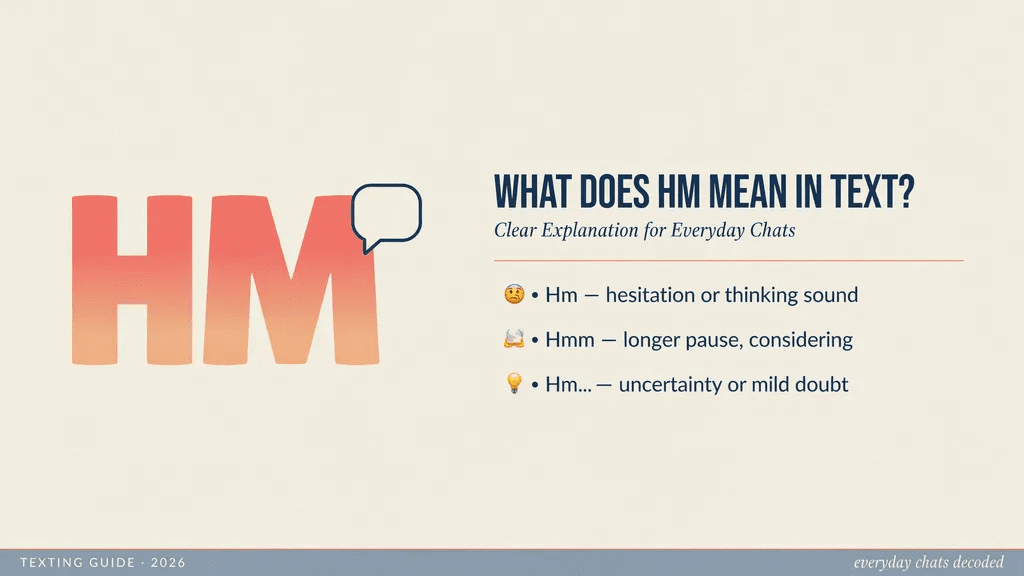
You get a text back. Just two letters: hm. No punctuation, no context, no explanation. The HM meaning in text is surprisingly layered — it’s a phonetic spelling of the thinking sound humans naturally make when processing, hesitating, or feeling skeptical. It’s not an acronym. It’s emotion typed out.
Here’s the thing — those two letters can flip an entire conversation. One “hm” from your crush hits completely differently than the same “hm” from your boss.
Understanding hm meaning in text means reading tone, punctuation, and relationship context all at once. Master that, and you’ll never misread a message again.
What Does HM Mean in Text?
The HM meaning in text isn’t complicated at its core — but it has layers.
HM is a phonetic spelling of the sound “hmm” that people naturally make when they’re thinking, hesitating, or feeling mildly skeptical. It’s not an acronym. It’s not short for anything. It’s an onomatopoeia — a written representation of a real vocal sound.
Think about it. In face-to-face conversation, you’d hear someone say “hmm…” before answering a tricky question. Online messaging took that sound and turned it into typed text. The result? A two-letter response that somehow means six different things depending on context.
Here’s a quick-reference breakdown before diving deeper:
| HM Meaning | Tone | Where You’ll See It |
|---|---|---|
| Thinking / Processing | Neutral | iMessage, WhatsApp |
| Mild Doubt | Skeptical | Twitter/X, Discord |
| Passive Interest | Low energy | Instagram DMs |
| Soft Disagreement | Cautious | Slack, work chats |
| Soft “No” | Polite avoidance | Any platform |
| Quiet Disapproval | Subtle frustration | Close relationships |
Understanding hm meaning in text isn’t about memorizing a definition. It’s about reading communication context — and that’s exactly what this guide teaches you.
ALSO READ: What Does “MB” Mean in Text? A Complete Guide to Its Uses and Interpretations
The Linguistic Root of HM — Why This Sound Exists at All
Long before texting existed, linguists were already studying “hmm.”
In the 1950s, researcher Frieda Goldman-Eisler identified what she called filled pauses — sounds like “uh,” “um,” and “hmm” that people insert while speaking to signal that they haven’t finished their thought yet. These aren’t mistakes or verbal tics. They’re actually functional. A filled pause tells your listener: I’m still here, I’m thinking, don’t interrupt me.
Texting culture eventually needed an equivalent. You can’t hear someone’s “hmm” through a screen. So people started typing it.
At first, the common spelling was “hmm” or even “hmmm.” Then, as texting abbreviations got shorter and thumb-typing became the norm, it compressed further. “Hm” — just two letters — became the dominant form, especially among younger users on high-volume platforms like Snapchat, iMessage, and Discord.
This compression also reflected a broader shift in messaging language: less is more. The fewer keystrokes, the better. A three-letter “hmm” felt like effort. “Hm” felt effortless — which, ironically, became part of its meaning.
“Language doesn’t get simpler over time — it gets more efficient. Digital shorthand is evolution, not laziness.” — Common view in modern sociolinguistics
HM Meaning in Text Based on Context
Here’s where it gets interesting. hm meaning in text isn’t one thing. It’s a shape-shifting chat response that changes meaning based on who’s sending it, when, and what follows it. Let’s break each one down properly.
HM as a Thinking Signal
This is the most common use — and the most benign. Someone uses hm meaning in text when they genuinely need a moment to process before answering.
Example:
“Should we book the trip for July or August?” “Hm… probably July, flights are cheaper.”
Notice the ellipsis after “hm.” That’s a strong signal that a real answer is coming. The “hm” here is the digital equivalent of someone rubbing their chin before speaking. It’s emotional processing in real time.
If someone sends you this kind of HM, relax. They’re engaged — just thinking it through.
HM as Doubt or Disagreement
A solo “hm” with no follow-up? That’s a different animal entirely.
This version signals skepticism. The sender doesn’t believe what you said, or they’re questioning it without wanting to challenge you directly. It’s a hesitation signal loaded with subtext.
Example:
“I definitely locked the door before we left.” “hm.”
That period after “hm” is devastating. It says: Sure you did. This is where HM becomes a tool for expressing doubt while maintaining plausible deniability. The sender can always say “I was just thinking!” — but you know better.
HM as Passive Interest
This one often stings a little. It’s the HM that says “I heard you, but I’m not that interested.”
Example:
“There’s a new Thai place that just opened downtown — want to try it?” “hm, maybe”
Low energy. No enthusiasm. Not a yes, not a no. This is the casual engagement response — the text equivalent of a shrug.
It doesn’t mean the person dislikes you. It might just mean they’re tired, distracted, or genuinely unsure. Context and relationship matter a lot here.
HM as a Soft No (Most People Miss This One)
This is the HM that people misread most often. In many personality types — especially those who avoid direct confrontation — “hm” functions as a polite, socially cushioned rejection.
Example:
“Want to come to my cousin’s birthday thing Saturday?” “hm, I might have plans”
Translation? They’re not coming. The “might” gives them an exit. The “hm” buys them time they don’t intend to use.
Once you recognize this pattern, it shows up everywhere. It’s a core part of texting behavior in relationships where people prefer softening over directness.
ALSO READ: HB Meaning Slang: What It Really Means And How To Use It
HM as Disapproval or Frustration
This is the sharpest version of HM — and punctuation is everything here.
| Variation | Likely Meaning |
|---|---|
| hm? | Curious, wants clarification |
| hm! | Pleasantly surprised |
| hm. | Quiet disapproval or frustration |
| hm… | Still processing, not done thinking |
| HM | Emphasis — stronger reaction than lowercase |
“hm.” after you’ve explained something is a cold response. It signals that the person isn’t satisfied — but they’re too restrained to say so outright. In close relationships especially, this is one to notice.
HM vs HMM — Does the Letter Count Actually Matter?
Short answer: yes, absolutely.
The number of letters you use when typing “hmm” is a prosodic marker — it mimics how long you’d hold that sound in real speech. Longer hold = stronger feeling.
| Spelling | Implied Tone | Energy Level |
|---|---|---|
| HM | Quick thought, mild reaction | Low |
| HMM | Deeper consideration, moderate doubt | Medium |
| HMMM | Strong skepticism, prolonged thinking | High |
| HMMMM | Dramatic effect, playful exaggeration | Over the top |
Think of it like the difference between “ok” and “okaaay.” The length isn’t accidental — it carries emotional nuance in texting that a single spelling can’t capture.
HM vs HMM in practice:
- A friend says “hm” when you suggest a restaurant → mildly unsure
- A friend says “hmmm” when you suggest a restaurant → genuinely skeptical, probably wants to go somewhere else
Small difference. Big impact. This is why understanding HM requires looking at the whole message — not just the letters.
Decoding the Emotional Spectrum Behind HM
HM occupies a unique space in the emotional interpretation of text messages. It’s almost never extreme — you won’t see it in moments of joy, anger, or grief. It lives in the middle ground.
Here’s the emotional range it covers:
Curiosity → Contemplation → Skepticism → Mild Disapproval
What makes HM so interesting from a psychology standpoint is its built-in deniability. When someone sends “hm,” they haven’t committed to any emotion. They can always walk it back. This makes it a low-risk response — and that’s exactly why people reach for it.
In texting psychology, this is called a low-commitment response. It keeps the conversation open without requiring the sender to expose their true feelings. For people who struggle with directness in virtual conversations, “hm” is practically a reflex.
That said, patterns matter more than single instances. One “hm” is almost meaningless in isolation. Three “hm” responses in a row to your ideas or suggestions? That’s a pattern worth noticing.
Is HM Rude? Reading Tone Without Hearing a Voice
Not inherently. But it can land that way.
The problem with HM in text-based communication is what linguists call tone deafness — written text strips out all the vocal cues that tell you how to receive a response. You can’t hear if someone said it warmly or coldly.
Three things push HM from neutral to rude:
- No follow-up. A lone “hm” with nothing after it leaves the other person hanging. That silence is its own statement.
- Punctuation. “Hm.” with a period reads as dismissive. “Hm?” reads as curious. Those tiny marks change everything.
- Response delay + HM. If someone takes 45 minutes to reply and comes back with just “hm,” that combination signals disinterest or frustration — even if neither was intended.
Chat etiquette tip: if you send “hm” often as a habitual response, be aware that people on the receiving end may be reading more into it than you mean. A quick follow-up sentence — even just “still thinking!” — removes all the ambiguity.
The most common source of texting conflict isn’t what people say. It’s what they leave unsaid after two letters.
HM Meaning in Text Between Friends
Among close friends, HM is almost a different language.
When there’s relationship dynamic history and shared context, “hm” becomes shorthand for whole conversations. Your best friend sends “hm” after you tell them about a weird interaction with your coworker? That’s an invitation — tell me everything, right now.
Friends also weaponize HM for playful skepticism. It’s a dry, deadpan reaction that signals: I know you better than that.
Example:
“I totally woke up at 6 AM to go to the gym.” “hm sure”
In close casual chats, this reads as affectionate teasing — not disbelief. The key is the relationship itself. The same “hm sure” from a near-stranger would read completely differently.
Real-world case: Two college roommates developed a rule — if either of them sent “hm?” in response to a plan, it meant I want to go but I’m nervous about it, let’s talk. One word. One shared meaning. That’s how HM evolves in long-term friendships: it picks up private definitions that outsiders can’t decode.
HM Meaning in Romantic Conversations
This is the context where people spiral the most — and sometimes for good reason.
In romantic conversations, HM is genuinely ambiguous in ways that matter. Here’s how to read it by relationship stage:
| Relationship Stage | HM Likely Means |
|---|---|
| First few messages / early dating | Mild hesitation, low investment |
| Getting to know each other | Testing the waters, cautious interest |
| Established dating | Playful, thoughtful — probably fine |
| Long-term relationship | Comfort shorthand, low-stakes |
Early dating reality check: If you get “hm” in response to a date suggestion from someone you’ve texted three times, that’s worth noting. It might mean they’re weighing options. It doesn’t mean they hate you — but it’s not a green light either.
Long-term relationship reality check: Your partner of two years sending “hm” when you suggest pizza for dinner means absolutely nothing. That’s just Tuesday.
The anxiety around HM in relationships is real. But one message is never the full story. Look for patterns. Does this person use “hm” constantly with everyone? Or did they suddenly start sending it to you specifically? That context is everything.
ALSO READ: HY Meaning in Text: What Does “HY” Really Mean in Chats and Online Messages? 2026
HM Meaning in Professional or Work Chats
Here’s where HM gets genuinely tricky.
In professional work chats — Slack, Teams, email — short ambiguous responses carry more professional weight. Nobody wants to misread their manager. Nobody wants to accidentally offend a client.
HM in workplace settings almost always signals one of two things:
- “I need more information before I commit” — the person is thoughtful, not dismissive
- “I have a concern but I’m not raising it directly” — the person is being diplomatic
Example scenario:
Slack message to manager: “I think we should push the launch to next week — the copy isn’t quite ready.” Manager replies: “hm, let’s talk about this.”
That’s not bad, necessarily. But it’s also not enthusiastic agreement. The “let’s talk” saves the conversation — without it, a lone “hm” from a manager would feel genuinely unsettling.
Professional communication tip: In business contexts, if you send HM, always follow it with a sentence. “Hm, let me check on that” is professional. “Hm” with nothing after it looks careless or passive-aggressive in a workplace messaging environment.
Case study — Tech startup team: A product manager at a SaaS company noticed that a junior developer on their team consistently responded to feature requests with “hmm.” After checking in, they discovered the developer was flagging concerns but didn’t feel confident enough to state them outright. The “hmm” was a cry for a safer space to push back. One conversation cleared it up entirely. Understanding text slang in professional settings can surface communication gaps you didn’t know existed.
How to Respond to HM in Text
Don’t panic. Don’t overexplain. And definitely don’t send a five-paragraph response to justify yourself after one “hm.”
Here are three smart strategies depending on your situation:
Strategy 1: Ask an open follow-up question
This is almost always the right move. “What are you thinking?” or “Does that not sound good to you?” invites the other person to share more without putting them on the defensive.
Strategy 2: Offer more context
If the “hm” signals skepticism, give them something to work with. Not a wall of text — just one or two sentences of relevant information that might shift their thinking.
Strategy 3: Match their energy
Sometimes the best reply to “hm” is “hm?” right back. It signals: I noticed that. Want to share what you’re thinking? It’s casual, non-confrontational, and it opens the door.
What not to do:
- Don’t send a defensive paragraph explaining why you’re right
- Don’t ghost the conversation because you’re unsure how to respond
- Don’t assume the worst without checking — common misunderstandings in texting almost always come from filling in blanks with fear instead of facts
Common Misunderstandings About HM
These are the biggest interpretation errors people make — and they cause unnecessary friction in otherwise good relationships.
Misunderstanding #1: HM always means disinterest
It doesn’t. Half the time, it means someone is genuinely processing. Give them a moment before drawing conclusions.
Misunderstanding #2: HM is inherently rude
It isn’t. Tone, punctuation, follow-up, and the relationship itself determine whether “hm” lands as rude or totally neutral.
Misunderstanding #3: All HMs are the same
“hm?” and “hm.” are practically opposites. One wants to know more. The other is quietly unimpressed. Never treat them the same.
Misunderstanding #4: One HM defines the whole relationship
It doesn’t. People have texting habits. Some people send “hm” the way others send “lol” — reflexively, without deep intention. Look at patterns, not single data points.
Misunderstanding #5: HM means no
Sometimes it does. Often it doesn’t. A “hm, maybe” is genuinely on the fence — not a polite rejection. Push back gently and see what you get.
HM Across Different Cultures — It’s Not Universal
One of the most overlooked dimensions of HM meaning in text is how it shifts across global communication contexts.
The “hmm” vocalization exists in nearly every spoken language — but its social weight isn’t the same everywhere.
| Cultural Context | How HM Tends to Read |
|---|---|
| American English texting | Casual, low-stakes, everyday filler |
| British English messaging | Often slightly more skeptical by default |
| South Asian WhatsApp culture | Active listening signal — “I’m here, go on” |
| East Asian digital messaging | Minimal response is culturally comfortable; HM fits naturally |
| Gen Z (globally) | May carry irony or dry humor — not always literal |
| Millennial usage | More likely to mean genuine hesitation |
Language variations matter even within English. A British “hm” in a professional email reads differently than an American “hm” in a Slack message. Cross-cultural interpretation of these tiny expressions is an emerging area in digital communication research.
HM vs Similar Texting Expressions Know the Difference
People often mix up HM with other short reactions. Here’s how they actually differ:
| Expression | Core Meaning | Vibe |
|---|---|---|
| HM | Thinking / mild doubt | Neutral to skeptical |
| MHM | Agreement / affirmation | Positive |
| OH | Realization or surprise | Engaged |
| AH | Understanding / clarity | Warm |
| UGH | Frustration | Negative |
| MEH | Indifference | Flat |
| HUH | Confusion | Disengaged |
The biggest one to watch: MHM vs HM. They look similar. They mean opposite things.
MHM = yes, I agree, I’m with you. HM = I’m uncertain, I’m thinking, or I’m not sure about that.
Getting these two mixed up in text conversation can cause real confusion — especially in romantic communication where someone looking for confirmation might send “mhm” and have it misread as skeptical “hm.”
Frequently Asked Questions
What does HM mean in a text message?
HM is a phonetic expression of the thinking sound “hmm.” It signals hesitation, thought, mild doubt, or a low-key reaction — depending entirely on context and tone.
Is HM rude to send in a text?
Not by default. It only feels rude when sent alone with no follow-up — especially after someone shares something important. Adding even one extra sentence removes all the ambiguity.
What’s the difference between HM and HMM?
“HM” is short and casual — a quick, light reaction. “HMM” suggests deeper thinking or stronger hesitation. The extra letter genuinely changes the weight of the message.
Can HM be flirty?
Yes — when paired with playful emojis like 😏 or a teasing tone, “hm” signals interest and curiosity rather than doubt. Context makes all the difference here.
Should you use HM in professional work chats?
Generally, no. In professional communication, “hm” is usually avoided because it feels unclear and can come across as unprofessional. Always follow it with a full sentence if you use it at work.
conclusion
The HM meaning in text isn’t complicated once you know what to look for. It’s a thinking sound typed out. Two letters that carry hesitation, doubt, or quiet emotion. Context, punctuation, and relationship always decide what it really means.
Don’t overthink a single “hm.” Instead, read the pattern. Check what comes before and after it. The HM meaning in text changes with every conversation. Master that skill and you’ll stop misreading messages — and start communicating smarter every single day.

Hi! I’m Jenson, the writer behind punslush.com. I craft clever puns and witty wordplay designed to entertain and inspire. Visit punslush.com for a good dose of humor and fun!