

WTV meaning in text is simple: it stands for “whatever.” It’s a texting abbreviation used in casual texting, online messaging, and social media platforms to express indifference, flexibility, or dismissal — all depending on the moment.
Three letters. Zero punctuation. Yet somehow, “wtv” can start a fight, end a conversation, or mean absolutely nothing at all. That’s the power of digital communication — and why this tiny word deserves a serious look.
What makes WTV in texting fascinating is its dual personality. One second it’s breezy and harmless. The next, it’s cold and loaded. Knowing which is which changes everything about how you read and respond to it.
ALSO READ: HM meaning in text: Clear Explanation for Everyday Chats 2026
What Does WTV Mean? (The Quick Answer)
WTV stands for “whatever.” That’s the short answer. But the real answer is more layered than that.
Depending on tone, context, and your relationship with the sender, WTV can signal two very different things:
| WTV Tone | What It Communicates | Example |
|---|---|---|
| Neutral / Flexible | “I’m easy, you decide” | “Pizza or tacos?” → “wtv you want” |
| Dismissive / Cold | “I don’t care anymore” | “Are you mad?” → “wtv” |
Same abbreviation. Completely different emotional weight. That’s what makes WTV in texting so easy to misread — and so important to understand.
Quick fact: “Whatever” entered popular culture as a dismissive expression in the 1980s, largely tied to Valley Girl slang in California. Decades later, the internet compressed it into three letters that now travel across billions of messages every day.
The Full Definition — More Than Just “Whatever”
Here’s something most people miss: WTV isn’t a single-emotion word. It’s a chameleon.
In casual texting, WTV usually means flexibility. Someone asks where you want to eat — you say “wtv.” You’re genuinely indifferent. No drama, no subtext.
But in emotional conversations, WTV shifts. It becomes a wall. A shutdown. “I’m done explaining myself.” That’s the dismissive version, and it reads very differently when it shows up mid-argument or after you’ve asked something important.
Even punctuation changes things dramatically:
- “wtv” → casual, breezy, low-effort
- “wtv.” → slightly cold, conversation-ender
- “WTV” → could be frustrated or emphatic
- “wtv!!” → playful, probably joking around
Emotional context in digital communication isn’t just about the words. It’s about everything surrounding them — and WTV is a perfect example of why.
Real Texting Examples
Scenario 1 — Neutral:
Alex: “Which movie do you wanna watch?” Jordan: “wtv you pick, I’m good either way”
Scenario 2 — Dismissive:
Alex: “I was just trying to help.” Jordan: “wtv”
See the difference? Same word. Completely different conversation
Where Did WTV Come From? A Brief History
WTV didn’t appear out of nowhere. It evolved — and that evolution tells you a lot about how texting culture works.
Here’s the rough timeline:
- 1980s: “Whatever” becomes cultural shorthand for dismissal or indifference, popularized in American teen culture.
- 1995–2000: “w/e” appears in early internet chat rooms like AOL Instant Messenger (AIM). Keyboard shortcuts were cool. Actually, they were necessary.
- Early 2000s: SMS messaging explodes. With 160-character limits per text and no smartphones, abbreviations weren’t just stylistic — they were practical. “wtv” fits better than “whatever.”
- 2010s: Smartphones remove the character limit problem but the abbreviations stick. They’ve become part of texting language — shorthand for an entire attitude, not just a word.
- 2015–present: WTV spreads across social media platforms — Instagram captions, TikTok comments, Snapchat replies. It’s everywhere now.
The abbreviation mirrors a broader trend in internet communication: compressing language to move faster, say more with less, and signal belonging to a particular digital culture.
ALSO READ: HB Meaning Slang: What It Really Means And How To Use It
How WTV Is Used Across Different Contexts
In Everyday Text Conversations
This is the most common usage by far. In everyday chat conversations, WTV usually signals casual acceptance.
Common situations where you’ll see it:
- Planning decisions (“wtv restaurant is fine”)
- Low-stakes disagreements (“wtv, doesn’t matter to me”)
- Agreeing without engaging (“wtv you think is best”)
The key thing to remember: in friendly, relaxed casual texting, WTV is almost never rude. It’s just shorthand for “no preference.”
On Social Media — Instagram, TikTok, Snapchat, WhatsApp
Social media slang lives and dies by context. On these platforms, WTV takes on its own personality depending on the space.
Instagram: You’ll spot WTV meaning on Instagram mostly in DMs and comments. In captions, it reads as a cool, nonchalant aesthetic — “posted this look, wtv.” It’s performative indifference. Very on-brand for Instagram culture.
TikTok: TikTok comments use WTV as both dismissal and humor. Someone posts something controversial — “wtv, do what you want.” It’s sarcastic, often ironic, sometimes supportive in a low-effort way.
Snapchat: WTV meaning on Snapchat leans heavily toward quick, casual replies. Snap conversations move fast. WTV fills the gaps when someone doesn’t want to commit to a longer response. It’s the digital equivalent of a shrug.
WhatsApp: In group chats, WTV usually means “I’ll go along with whatever the group decides.” It’s a social lubricant more than a dismissal.
Here’s a platform comparison that makes it easy to see:
| Platform | Typical WTV Usage | Emotional Tone |
|---|---|---|
| iMessage / SMS | Flexible agreement or mild dismissal | Neutral to passive |
| Group consensus, casual approval | Warm or indifferent | |
| Instagram DMs | Nonchalance, cool detachment | Casual, stylistic |
| TikTok Comments | Dismissal, irony, humor | Sarcastic or playful |
| Snapchat | Quick low-effort reply | Very casual |
| Twitter/X | Clapbacks, venting, sass | Often dismissive |
In Dating Apps and Romantic Texting
This is where WTV gets genuinely tricky — and where most people go looking for answers.
WTV meaning from a girl and WTV meaning from a boy are among the most searched variations of this term. Why? Because in dating app messaging, every word carries weight.
Here’s how to read it:
Early conversations on Tinder, Hinge, or Bumble:
- “wtv works for me” → flexible, low-pressure. Usually a green flag.
- “wtv” in response to a direct question → low engagement. Could be a soft brush-off.
Established relationships:
- “wtv” during planning → comfortable and relaxed. Probably means genuinely no preference.
- “wtv” during an argument → emotional withdrawal. Worth addressing.
The golden rule of WTV in dating: never assume. One message doesn’t tell you everything. Look at the pattern.
Case Study: Sarah and Marcus had been texting for two weeks. When Marcus asked where she wanted to go on their first date, Sarah replied “wtv you think is fun!” — flexible, warm, giving him the lead. Two days later, after a miscommunication, she replied to his explanation with just “wtv.” Same word. Completely different energy. Marcus almost didn’t notice — but he did, and he asked if she was okay. That conversation mattered.
In Group Chats and Online Gaming
Group chats are WTV’s natural habitat. When five people need to agree on something, someone always drops a “wtv” — and suddenly the decision gets made.
In online gaming communities and Discord servers, WTV is used constantly:
- “Which map?” → “wtv the team wants”
- “Should we fight or run?” → “wtv, I’ll follow your call”
It’s not disengagement here. It’s deference — trusting the group to lead. That’s a different kind of WTV than the romantic “I’m done” version.
WTV Beyond Texting — Other Fields That Use This Acronym
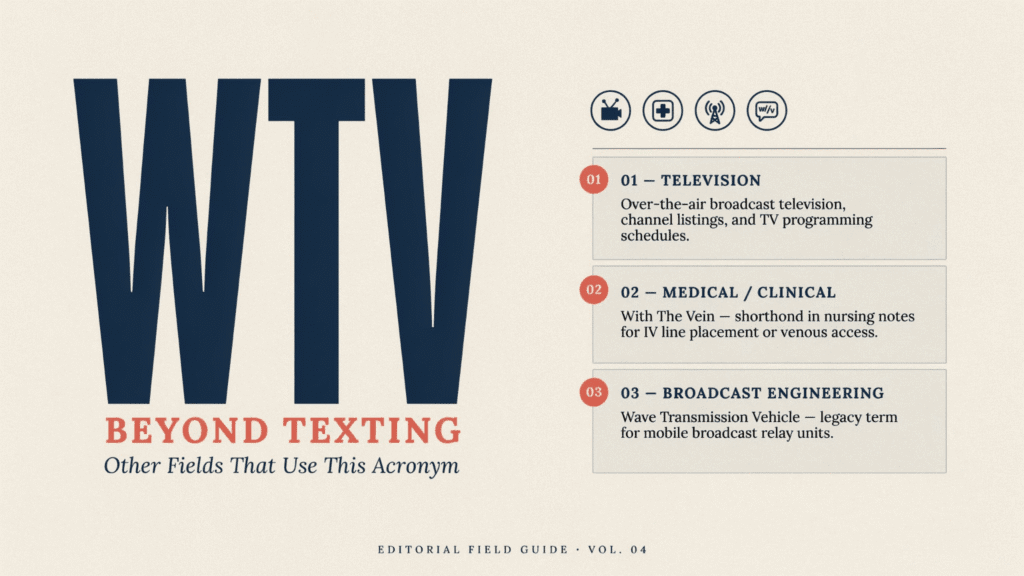
Here’s something most people don’t expect: WTV shows up in completely different fields, with completely different meanings. Context is everything.
WTV in Physics
In certain physics and engineering contexts, WTV can refer to Wave Transmission Velocity — a technical measure of how fast a wave moves through a medium. You won’t see this in your texts. But if you’re reading a physics forum or academic paper and spot WTV, that’s the meaning you’re looking for.
WTV in the Medical Field
In medical field documentation, WTV sometimes appears as shorthand in specific clinical or research contexts, though it’s not a universally standardized abbreviation. The medical community tends to use highly specific abbreviations that vary by institution and specialty. Always cross-reference with the document’s own glossary.
WTV in Aviation and Aircraft Terminology
In aircraft terminology and aviation discussions, WTV occasionally appears in technical manuals. Some aviation contexts use it in relation to weight-to-volume calculations — a completely different domain from online messaging.
The takeaway? If you see WTV and it doesn’t make sense as “whatever,” look at the surrounding context. Professional communication and technical discussions use acronyms differently than your group chat does.
Common Misconceptions About WTV
Let’s clear up the confusion that sends people to search engines in the first place.
❌ Misconception 1: WTV always means the person is angry. Not even close. In most casual communication, WTV is completely neutral. Don’t read anger into it unless the conversation already had tension.
❌ Misconception 2: WTV and IDC mean the same thing. They don’t. “IDC” (I Don’t Care) is sharper, more direct, and often colder. WTV carries more flexibility and ambiguity. IDC closes a door. WTV leaves it ajar.
❌ Misconception 3: Only teenagers use WTV. Adults — including people in their 30s and 40s — use WTV regularly in online conversations. Texting culture doesn’t have an age limit.
❌ Misconception 4: WTV and WTF are the same or related. This is a surprisingly common mix-up. WTF (What The F***) expresses shock or frustration. WTV expresses indifference. They’re not even in the same emotional neighborhood.
❌ Misconception 5: Lowercase “wtv” is more casual than uppercase “WTV.” Generally true — but not a hard rule. All-caps in texting often signals emphasis or frustration, but plenty of people type in all-caps naturally. Don’t over-index on capitalization alone.
WTV vs. Similar Slang — What’s the Difference?
Understanding WTV gets easier when you compare it to its similar terms and alternatives. Here’s your cheat sheet:
| Term | Full Form | Core Meaning | How It Differs from WTV |
|---|---|---|---|
| IDC | I Don’t Care | Strong indifference | More blunt and final than WTV |
| IDK | I Don’t Know | Uncertainty | About knowledge, not attitude |
| NVM | Never Mind | Topic withdrawal | Pulls back from conversation entirely |
| IK | I Know | Acknowledgment | Agreement, not indifference |
| IDGAF | I Don’t Give A F*** | Extreme indifference | Far more intense, sometimes aggressive |
| W/E | Whatever | Same meaning as WTV | Older form, less common now |
| ISTG | I Swear To God | Emphasis or frustration | Emotion-heavy, opposite of WTV’s flatness |
| BRB | Be Right Back | Temporary exit | Completely different — about availability |
| LOL | Laugh Out Loud | Humor/lightness | Positive tone, not indifferent |
The big picture: WTV sits in a unique emotional zone — it’s softer than IDC, less committal than IK, and far less aggressive than IDGAF. It’s the middle ground of indifference, and that’s exactly why it’s so widely used.
How to Respond When Someone Texts You “WTV”
This is what most people actually want to know. So here’s a practical, honest guide.
When It’s Neutral or Casual
They’re genuinely flexible. They trust you to decide. Don’t overthink it.
Best responses:
- “Ok! I’ll pick the place then — does 7pm work?”
- “Cool, I’ll decide. We’re doing Italian.”
- “Perfect, see you at 6.”
Match their energy. They’ve handed you the decision. Take it and move forward.
When It Feels Dismissive or Passive-Aggressive
Here’s where misunderstanding prevention matters most. Don’t fire back with another “wtv” — that spirals fast. Don’t go silent either.
Try these approaches:
- “Hey, you good? You seem off.”
- “I get the feeling something’s wrong — want to talk about it?”
- “Ok I hear you. Can we circle back when you’re ready?”
The goal is to open a door without forcing them through it. Sometimes people text “wtv” because they don’t have the words yet. Give them space, but signal you’re paying attention.
What NOT to say:
- “Fine, wtv then.” (Matches dismissal with dismissal — escalates tension)
- “Why are you being like this?” (Accusatory — shuts people down)
When You’re Genuinely Unsure What They Mean
Ask directly. Seriously. One clear question beats three days of misreading a text.
- “Wait — are you actually fine with this or nah?”
- “Just want to make sure — are you genuinely good or is something up?”
Communication clarity is a skill. Using it here costs nothing and can save an entire relationship from a three-letter misunderstanding.
WTV in Online Dating — Reading the Subtext
Dating app conversations are where WTV causes the most confusion — and the most unnecessary anxiety. Let’s break it down by situation.
First-Date Planning
“wtv works for me” from a new match usually means one of two things:
- They’re genuinely flexible and want you to feel comfortable choosing.
- They’re low-effort and not particularly invested.
How to tell the difference? Look at the rest of the conversation. Are they engaged? Do they ask questions? One “wtv” in a sea of enthusiasm means flexibility. “wtv” as a consistent pattern means low engagement.
Mid-Relationship WTV
In established relationship communication, WTV almost always means “genuinely no preference.” Partners develop shorthand. “wtv babe” is often warmth disguised as indifference.
Watch for the shift. If someone who used to engage suddenly starts defaulting to WTV for everything, that’s worth a gentle conversation — not a confrontation, just a check-in.
WTV as a Soft Rejection
Sometimes “wtv” is a way of saying “I’m not invested in this.” Especially in early dating app messaging where things haven’t clicked yet. If plans are falling through and you’re getting a lot of “wtv,” the subtext is often “I’m not sure about this.”
The Gen Z Dating Reality: This generation communicates differently. Digital slang like WTV, “no cap,” and “lowkey” carries emotional weight that older generations might read as cold. It’s not always. Context and pattern matter more than any single word.
ALSO READ: What Does “MB” Mean in Text? A Complete Guide to Its Uses and Interpretations
Why WTV Matters in the Age of Digital Communication
Language has always evolved. But digital communication has accelerated that evolution dramatically. WTV is a tiny window into something much bigger.
Think about it: mobile communication now handles conversations that once happened face-to-face, over the phone, or in letters. Without vocal tone, facial expressions, or body language, we’ve developed new tools to signal emotion. Punctuation. Capitalization. Emojis. And abbreviations like WTV.
Modern slang like WTV isn’t lazy communication. It’s efficient communication — compressed signals that carry emotional freight for people who share the same texting culture. The challenge is that not everyone reads those signals the same way.
A few things worth knowing:
- Digital natives (people who grew up with smartphones) tend to read WTV as neutral by default.
- Older generations or people less immersed in internet slang often read it as dismissive.
- Cross-generational texting is a real source of miscommunication — and WTV is one of the words caught in the middle.
The real lesson? Context in communication is everything. The same three letters can mean “I love you, you decide” or “I’m done with this conversation” — and knowing which one requires you to understand the person, the platform, and the moment.
Quick-Reference Summary
- WTV = Whatever
- Used in casual texting, social media platforms, online messaging, and more
- Two core tones: neutral flexibility OR dismissive indifference
- Punctuation and capitalization shift the meaning significantly
- Not the same as IDC, IDK, WTF, or NVM — each has its own emotional register
- Platform matters: WTV on TikTok ≠ WTV in a WhatsApp family group
- In dating app conversations, always read the pattern — not just one message
- When in doubt, ask directly — clarity beats assumption every time
FAQs
What does WTV mean in text?
WTV stands for “whatever” in texting. It signals either casual flexibility or emotional dismissal depending on the conversation’s tone.
Is WTV used more by Gen Z or Millennials?
Gen Z dominates WTV usage in 2025, primarily across TikTok, Snapchat, and Instagram DMs — though Millennials use it regularly in casual texting too.
Does WTV mean the same as IDC?
Not exactly. WTV feels softer and more ambiguous than IDC (I Don’t Care), which hits harder and sounds more final and deliberate.
Is WTV considered rude in professional communication?
Yes. WTV is strictly informal slang. Using it in professional communication — emails, work chats, or meetings — comes across as dismissive and unprofessional.
What does WTV mean on Snapchat specifically?
On Snapchat, WTV meaning on Snapchat typically signals a quick, low-effort reply — usually meaning “I’m fine with anything” during fast-moving, casual conversations.
conclusion
Understanding WTV meaning in text isn’t complicated. It means “whatever.” But context transforms those three letters completely. Neutral or dismissive — the difference matters. Read the room. Read the conversation.
Next time “wtv” lands in your messages, don’t panic. WTV meaning in text depends on tone, platform, and relationship. A friend saying “wtv, you pick” is being easy-going. A partner saying “wtv” mid-argument is saying something deeper. Know the difference, respond smartly, and you’ll never misread those three little letters again.

Hi! I’m Jenson, the writer behind punslush.com. I craft clever puns and witty wordplay designed to entertain and inspire. Visit punslush.com for a good dose of humor and fun!