
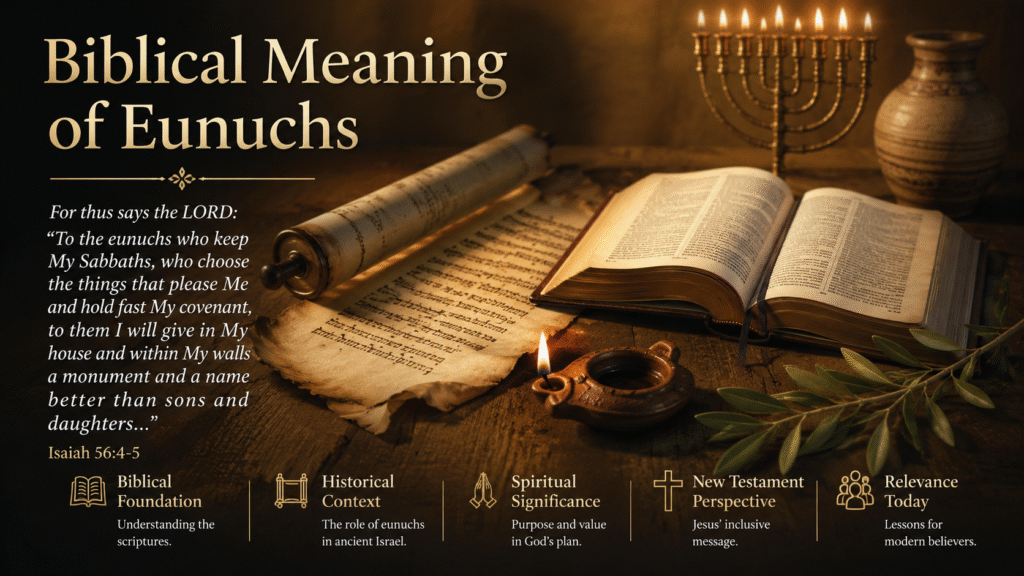
If you’ve been reading through Scripture and stumbled upon the word eunuch, you’re not alone in wondering what it really means. The biblical meaning of eunuchs mentions eunuchs dozens of times across both Testaments in royal courts, in prophecy, and even in the words of Jesus Himself. This guide breaks down everything you need to know: the biblical definition, famous examples, spiritual symbolism, and practical faith lessons for today.
Biblical Meaning of Eunuchs (Bible Meaning Explained)
The word eunuch comes from two original biblical meaning of eunuchs languages:
- Hebrew: saris — appears 45 times in the Old Testament. It carries a dual meaning: (1) a royal official or court officer, and (2) a castrated male servant.
- Greek: eunouchos — used in the New Testament, literally meaning “keeper of the bed-chamber,” and by extension, a castrated or sexually abstinent man.
Interestingly, the Hebrew word saris did not originally imply castration. It was borrowed from the Akkadian term sa resi, meaning “one who is at the king’s head” essentially a high-ranking official. Over time, as Eastern royal courts began castrating servants who guarded women’s quarters (harems), the term gradually became associated with physical emasculation.
So, in short: a eunuch in the Bible refers to a man who was either physically castrated, born without reproductive capacity, held a title of court authority, or voluntarily chose celibacy for spiritual purposes.
2 Meaning in the Bible – Briefly Explained Just For You
The Three Types of Eunuchs According to Jesus (Matthew 19:12)
Jesus gave the clearest biblical classification of eunuchs in Matthew 19:12 (KJV):
“For there are some eunuchs, which were so born from their mother’s womb: and there are some eunuchs, which were made eunuchs of men: and there be eunuchs, which have made themselves eunuchs for the kingdom of heaven’s sake.”
| Type of Eunuch | Description | Biblical Basis |
|---|---|---|
| Born Eunuch | A man born with a physical condition affecting reproduction | Matthew 19:12 |
| Forced Eunuch | Castrated by others, often for court service | Isaiah 39:7; 2 Kings 20:18 |
| Voluntary Eunuch | Chose celibacy to devote themselves fully to God | Matthew 19:12; 1 Corinthians 7:7–9 |
Famous Eunuchs in the Bible
Several well-known biblical figures were eunuchs or at least held the title of saris. Here are the most notable:
1. The Ethiopian Eunuch (Acts 8:27–39)
Perhaps the most famous eunuch in all of Scripture. This man served under Candace, Queen of the Ethiopians, as a man of great authority over her treasury. While reading from the scroll of Isaiah, he encountered Philip the Evangelist, who explained the gospel to him. He was baptized immediately a landmark moment showing that God’s salvation extended to all people, regardless of social or physical status.
2. Daniel and His Friends (Daniel 1:3–6)
Many scholars believe Daniel, Hananiah, Mishael, and Azariah (Shadrach, Meshach, and Abednego) were made eunuchs when taken to Babylon. They served in the inner court of King Nebuchadnezzar a position typically reserved for castrated men. Ashpenaz, the chief eunuch, was placed in charge of them.
3. The Seven Eunuchs of Esther (Esther 1:10–12)
Mehuman, Biztha, Harbona, Bigtha, Abagtha, Zethar, and Karkas these seven served King Xerxes. They were commanded to bring Queen Vashti before the king, and her refusal set the entire story of Esther in motion.
4. Hegai (Esther 2:3, 8, 15)
The king’s eunuch who oversaw the harem and was assigned to care for Esther. His guidance played a significant role in Esther winning the king’s favor.
5. Ebed-Melek (Jeremiah 38:7–13)
A Cushite eunuch who showed extraordinary courage by appealing to King Zedekiah to rescue Jeremiah from a cistern where he had been left to die.
6. Potiphar (Genesis 37:36; 39:1)
Potiphar held the title of saris (officer/eunuch) to Pharaoh. However, since he had a wife, most scholars believe he was a court official in title only not physically castrated.
Meaning of Eunuch in the Bible (KJV)
In the King James Version, the word “eunuch” appears explicitly seven times by name:
- Old Testament: Isaiah 56:3 and Jeremiah 52:25
- New Testament: Acts 8:27, 34, 36, 38, and 39
However, the underlying Hebrew word saris appears 45 times and is translated variously as “officer,” “chamberlain,” or “eunuch” depending on context. The KJV translates it literally when physical castration or a harem role is clearly implied, and uses “officer” when the context is purely administrative.
Castrated Meaning in the Bible
Why were men castrated in biblical times? The practice was rooted in practical and political motivations, not primarily religious ones (though some pagan cults did practice religious castration):
- Harem protection: Castrated men could be trusted to guard the king’s wives and concubines without sexual threat.
- Undivided loyalty: Without a family of their own, eunuchs were expected to be entirely devoted to their master.
- Political punishment: Castration was sometimes used as a form of subjugation over captured enemies or their children.
- Prophecy fulfilled: Isaiah 39:7 and 2 Kings 20:18 prophesied that Hezekiah’s descendants would be made eunuchs in Babylon — a consequence of his pride before the Babylonian envoys.
Under the Mosaic Law, Deuteronomy 23:1 prohibited a man with crushed or severed genitals from entering the assembly of the Lord. However, this ban was later overturned through Isaiah’s prophecy (Isaiah 56:4–5), where God promised eunuchs who kept His covenant an everlasting name within His temple.
Can a Woman Be a Eunuch in the Bible?
Technically, the term “eunuch” in Scripture is male-specific, tied to physical anatomy and the role of court servants in patriarchal ancient societies. There is no direct reference to a “female eunuch” in either the Old or New Testament.
However, spiritually speaking, the principle behind voluntary eunuch-hood dedicating one’s life to God free from the demands of marriage and family absolutely applies to women. Women like Anna the prophetess (Luke 2:36–37), who served God devotedly as a widow in the temple, exemplify the same spirit of consecrated celibacy that Jesus described in Matthew 19.
So while no woman is called a eunuch in Scripture, women can fully embody the same spiritual call to devoted, undivided service to God.
Sheol Bible Meaning (Simple Explanation) 2026
What Is a Eunuch by Birth?
A eunuch by birth (Matthew 19:12) refers to a man born with a physical condition that limits or eliminates reproductive capacity. This includes:
- Primary hypogonadism a condition where the reproductive glands fail to develop properly
- Congenital absence of reproductive organs
- Naturally low or absent sexual drive from birth some scholars believe this also falls under “born that way”
It’s important to note that Jesus mentioned this category without judgment. biblical meaning of eunuchs He simply acknowledged it as one of the three valid states of manhood. Some have attempted to link “born eunuchs” with homosexuality, but Scripture never uses these terms interchangeably, and the contexts are entirely different.
Why Were Eunuchs Castrated in the Bible?
The reasons varied across different empires and time periods:
- Harem security — The most common reason in Assyrian, Babylonian, and Persian courts
- Military administration — Eunuchs often rose to powerful military positions due to their perceived loyalty
- Punishment or conquest — Captured peoples, including Israelite nobles, were sometimes castrated
- Religious custom — Some pagan cults (like followers of Cybele in Syria) castrated their priests as an act of devotion
- Economic factors — Poor families sometimes sold young boys into eunuch service
Female Eunuch in the Bible
As noted above, the biblical meaning of eunuchs does not mention female eunuchs by name or title. The concept is absent from the text. However, female servants and attendants of royalty (like those who served Queen Esther) held comparable roles of trust, loyalty, and dedication.
The spiritual lesson is the same: God honors devoted, faithful service regardless of gender or social role.
Was Paul a Eunuch in the Bible?
This is a fascinating question with strong indirect evidence. Paul was almost certainly a voluntary eunuch in the spiritual sense described by Jesus. Here’s why:
- In 1 Corinthians 7:7–8, Paul writes that he was unmarried and wished others could be as he was, calling his celibacy a “gift from God.”
- In 1 Corinthians 7:32–35, he explains that an unmarried man can give undivided devotion to the Lord the same reasoning Jesus used in Matthew 19:12.
- Under Roman law of the 1st century, celibacy for men aged 25–60 was actually illegal, making Paul’s unmarried state intentional and countercultural.
Paul was not physically castrated. He was a voluntary eunuch a man who chose celibacy to be fully available for the gospel ministry, exactly as Jesus described.
Spiritual Significance and Symbolism of Eunuchs in the Bible
The eunuch carries deep symbolic weight across Scripture:
- The outsider welcomed in: In the ancient world, eunuchs were often social outsiders — barred from full community life. God’s promise in Isaiah 56:5 to give them “an everlasting name, better than sons and daughters” is a powerful reversal. It shows God actively including those society has excluded.
- Symbol of undivided devotion: The voluntary eunuch represents a heart fully surrendered to God, unburdened by earthly obligations.
- A picture of transformation: The Ethiopian eunuch’s baptism in Acts 8 is a symbol of the gospel breaking every boundary — racial, national, and physical.
- Faithfulness in limitation: Many biblical eunuchs, despite their social disadvantages, displayed remarkable loyalty and courage (Ebed-Melek, Daniel, Hegai).
Biblical Interpretations in Dreams or Real Life
Some believers who encounter eunuchs in dreams or reflective life moments may find these symbolic meanings helpful:
- Dreaming of a eunuch can symbolize a call to simplicity, celibacy, or undistracted devotion to God.
- It may represent cutting away distractions stripping down to what truly matters in your walk with God.
- It can also signal a season of spiritual service being called to serve God without the usual ties of family or personal ambition.
- Practically, it may reflect a longing for spiritual acceptance a reminder that God sees and values every person, including those who feel “cut off” from normal life.
Practical Lessons & Faith Insights
What can modern believers learn from the biblical treatment of eunuchs?
- God includes the excluded. From Isaiah’s promise to the Ethiopian’s baptism, Scripture consistently shows God reaching toward those society pushes to the margins.
- Celibacy is a valid calling. Both Jesus and Paul affirmed that living without marriage, for the right reasons, is a gift — not a deficiency.
- Faithfulness matters more than social status. Ebed-Melek saved a prophet. Daniel shaped an empire. Their physical condition never limited their spiritual impact.
- God judges the heart, not the body. The shift from Deuteronomy 23 (exclusion) to Isaiah 56 (inclusion) shows that God’s covenant community is ultimately defined by faithfulness and love, not physical wholeness.
- Every calling is valid. Whether married or single, fully able-bodied or not God has purpose and a place for every person.
Conclusion
The word eunuch in the biblical meaning of eunuchs carries far more depth than most readers realize. From royal courts in Persia to a dusty road in Ethiopia, eunuchs appear at pivotal moments in God’s redemptive story. They remind us that God’s grace has no social requirement, His kingdom has no exclusive entry criteria, and His love extends to every person regardless of their physical condition, marital status, or social standing.
Whether you’re studying the KJV meaning of eunuch, exploring biblical types of eunuchs, or seeking spiritual insight into what these figures represent, the message is consistent: God honors the faithful heart above all else.
FAQs
What does eunuch mean in simple terms?
A eunuch is a man who is castrated, born without reproductive capacity, or who voluntarily gives up marriage to serve God fully.
How many times is eunuch mentioned in the Bible?
The word “eunuch” appears explicitly 7 times in the KJV, but the Hebrew root saris appears 45 times across the Old Testament.
Who is the most famous eunuch in the Bible?
The Ethiopian eunuch of Acts 8 is the most widely recognized, notable for being baptized by Philip and representing the gospel’s reach to all nations.
Did Jesus approve of eunuchs?
Yes. In Matthew 19:12, Jesus acknowledged all three types of eunuchs without condemnation, and even honored voluntary celibacy as a gift for those called to it.
Were Daniel and his friends eunuchs?
Most biblical scholars believe yes — they served in the Babylonian inner court under the chief eunuch Ashpenaz, a role that typically required castration.
What does Isaiah say about eunuchs?
Isaiah 56:4–5 promises eunuchs who keep God’s covenant an everlasting name within His temple — a beautiful reversal of the earlier Mosaic exclusion.
Is celibacy the same as being a voluntary eunuch?
Effectively, yes. Jesus used the term “eunuch” metaphorically to describe those who choose celibacy for the sake of God’s kingdom, which Paul also practiced and taught.
Can eunuchs be saved according to the Bible?
Absolutely. The Ethiopian eunuch’s baptism (Acts 8) and God’s promise in Isaiah 56 both confirm that physical condition has no bearing on a person’s standing before God.

Hi! I’m Jenson, the writer behind punslush.com. I craft clever puns and witty wordplay designed to entertain and inspire. Visit punslush.com for a good dose of humor and fun!