
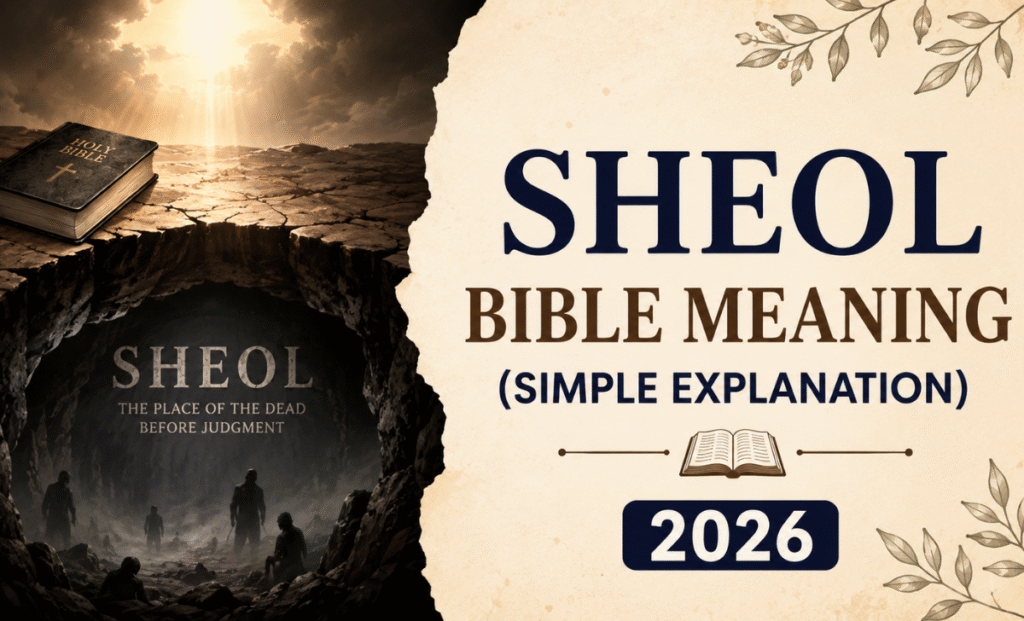
Have you ever read the word Sheol in your Bible and wondered what sheol bible meaning? You are not alone. Thousands of Christians and spiritual seekers search for clarity on this ancient Hebrew term every day. Sheol sounds mysterious and it is. But once you understand its biblical roots, its symbolism, and what it means for your faith today, the fear surrounding it gives way to something far more powerful: hope.
In this complete guide, you will discover the Sheol Bible meaning, its spiritual significance, how Bible translations handle it differently, and practical faith lessons it holds for believers in 2026.
Biblical Meaning of Sheol
What Is Sheol Bible Meaning?
Sheol is a Hebrew word that appears 66 times throughout the Old Testament. At its most basic level, it refers to the realm of the dead the place where souls go after physical death. Scholars and Bible translators have long debated the single best English word for it. Some translations render it as “the grave,” others as “the pit,” and still others preserve it as the proper noun Sheol to honor its unique theological weight.
According to Hebrew tradition, Sheol believed to be a realm located beneath the earth. It is a shadowy underworld that stood as the direct opposite of the living world above. Where the earth was bright, Sheol was dark. Where the living had physical bodies, the dead in Sheol existed as faint shadows known in Hebrew poetic literature as rephaim (shades).
Sheol’s First Appearances in Scripture
The earliest mentions of Sheol in the Bible carry a tone of finality and grief. In Genesis 37:35, the patriarch Jacob cries out that he will go down to Sheol mourning for his son Joseph, whom he believes to be dead. This sets the emotional tone: Sheol is the unavoidable destination of every human being, righteous or wicked alike.
Key early references include:
- Genesis 37:35: Jacob mourns that he will go to Sheol
- Genesis 42:38: Jacob fears his gray hairs will be brought to Sheol in sorrow
- Numbers 16:30: The earth “opens its mouth” to swallow rebels down into Sheol
How Many Times Sheol Mentioned?
| Fact | Detail |
|---|---|
| Total occurrences in Hebrew Bible | 66 times |
| First mention | Genesis 37:35 |
| Hebrew synonyms | Abaddon (ruin), Shahath (corruption), Bor (pit) |
| Greek equivalent (Septuagint) | Hades |
| New Testament equivalent | Hades (Greek) |
Sheol Bible Meaning: Spiritual Significance and Symbolism
Biblical scholars identify at least five distinct ways the word Sheol functions across the Hebrew scriptures:
- The unseen realm of the dead: the general state of death for all people, good and bad
- The grave: sometimes referring to the literal place of burial
- A place of punishment: used poetically for the wicked’s ultimate reckoning
- A symbolic metaphor: representing deep suffering, despair, or spiritual darkness
- The place from the righteous are saved: Sheol as the enemy God rescues his people from
Context is everything. The same word can shift meaning from passage to passage, which is why reading Sheol in its surrounding verses is essential for accurate interpretation.
Who Goes to Sheol?
One of the most striking features of Sheol in the Old Testament is that everyone goes there the righteous and the unrighteous alike. Jacob expected to go to Sheol (Genesis 37:35). The wicked men of Korah’s company swallowed into Sheol alive (Numbers 16:30–33). The Psalms speak of both godly and ungodly souls descending there.
This is a key distinction from the New Testament concept of hell (Gehenna). Which reserved specifically for the wicked after final judgment. Sheol in the Old Testament functions more like a universal waiting place a shadowy intermediate state before God’s ultimate plan for resurrection and judgment is complete.
Sheol in the Prophets and Psalms
The prophet Isaiah personified Sheol as a creature with an insatiable hunger, always opening wider to swallow more souls (Isaiah 5:14). He also spoke of proud rulers being brought down to the deepest parts of Sheol (Isaiah 14:15). Where they would be stripped of all earthly power.
Job called Sheol his “home” in moments of deep anguish, longing for death to end his suffering (Job 17:13). His words reflect the raw despair that Sheol symbolizes a place of no return, no light, and no praise of God.
The Psalms offer both lament and hope. Psalm 88 paints Sheol as a pit of darkness and forgotten souls. But Psalm 49:15 strikes a contrasting note of faith: “God will redeem my soul from the power of Sheol, for He will receive me.” This verse hints at a resurrection hope that blossoms fully in the New Testament.
Ezra Meaning in Bible: Powerful Truth About “Helper
Sheol Bible Meaning: Biblical Interpretations in Dreams or Real Life
What Does It Mean If You Dream of Sheol or the Grave?
Spiritual dreams involving Sheol, pits, dark valleys, or the realm of the dead can carry meaningful messages for the believer. Here are common symbolic interpretations grounded in biblical imagery:
- A dark pit or descending underground: May represent a season of spiritual trial, depression, or feeling distant from God. Like the Psalmists who cried out from the depths, this is an invitation to seek God more urgently.
- Being rescued from a grave or pit : A powerful symbol of resurrection, renewed purpose, or God’s intervention in a desperate situation (Psalm 30:3).
- Seeing the dead or departed: May symbolize unresolved grief, a call to confront mortality, or a reminder of the brevity of life.
- Walking through darkness without fear: Echoes Psalm 23:4 and may signal that God is guiding you through a difficult transition.
Sheol as a Symbol in Everyday Faith
Even outside of dreams, the concept of Sheol speaks to real-life spiritual experiences:
- Seasons of spiritual dryness: Feeling spiritually “buried” or cut off from God’s presence mirrors the language of Sheol in the Psalms.
- Grief and loss: The biblical writers used Sheol language honestly in mourning. Your grief is not faithlessness; it is deeply human.
- Near-death experiences or serious illness: Many believers describe such moments as an encounter with their own mortality exactly what Sheol forces us to confront.
Sheol vs. Hell vs. Hades: Key Differences
Many people confuse Sheol with hell. Here is a clear comparison:
| Term | Language | Meaning | Who Goes There |
|---|---|---|---|
| Sheol | Hebrew (OT) | Realm of the dead / the grave | All the dead (righteous & wicked) |
| Hades | Greek (NT/LXX) | Underworld; translated from Sheol | The dead in the intermediate state |
| Gehenna | Greek/Aramaic (NT) | Lake of fire; place of final punishment | The wicked after final judgment |
| Paradise | Greek (NT) | Place of comfort for the righteous dead | Believers who die in Christ |
Understanding these distinctions prevents serious theological confusion. When the King James Bible translated Sheol as “hell” in the Old Testament, it created the impression that hell and the grave were the same place — a misreading that still lingers today.
Practical Lessons & Faith Insights
Sheol is not merely an ancient theological puzzle. It carries living spiritual lessons for every believer:
1. Sheol Reminds Us That Life Is Precious and Brief
Every mention of Sheol in Scripture underscores the temporary nature of earthly life. This is not meant to produce fear, but to encourage urgency in loving well, seeking God now, and living with eternal purpose.
2. God’s Power Reaches Even Sheol
Perhaps the most comforting truth in all of Sheol’s biblical appearances is this: God is Lord even there. Psalm 139:8 declares, “If I make my bed in Sheol, You are there.” No depth of despair, suffering, or even death places a soul beyond God’s reach.
3. Sheol Points to the Hope of Resurrection
The Old Testament hints of rescue from Sheol (Psalm 49:15; Hosea 13:14) find their ultimate fulfillment in Jesus Christ. The Apostle Peter, quoting Psalm 16:10 in Acts 2:27, declares that Christ’s soul was not left in Sheol death could not hold him. Because He rose, believers have a living hope beyond the grave.
4. Suffering Is Not Abandonment
When Job and the Psalmists cried out from the depths of Sheol-like suffering, God did not silence them. He included their cries in Scripture. Your dark seasons are not evidence of God’s absence, they may be the very place He meets you most deeply.
5. Faith Invites Honest Confrontation With Mortality
Unlike cultures that avoid the topic of death, the Bible speaks openly about Sheol. Believers are invited to face death honestly, not with dread, but with confidence in the resurrection and in God’s promises.
Bible Thumper Meaning: What God Wants You to Know
Conclusion
The Sheol Bible meaning is richer and more nuanced than most people realize. It is not simply “hell” in the modern sense, nor is it a neutral non-existence. Sheol is the ancient Hebrew way of describing the realm of the dead a shadowy, subterranean state that all people enter at death, but from which God is fully capable of redeeming His people.
From Jacob’s grief-stricken cry in Genesis to Isaiah’s dramatic personification, from Job’s anguish to the Psalmist’s defiant hope, Sheol runs through the Old Testament as a constant reminder of human mortality and divine sovereignty. And in Jesus Christ, the New Testament gives the final answer: He descended, He conquered, and He rose and because of that, believers need never fear the power of Sheol again.
Let Sheol not be a word that frightens you, but one that deepens your faith, sharpens your gratitude, and anchors your hope in the God who holds the keys of death and life.
FAQs
What does Sheol mean in simple terms?
Sheol is the Hebrew word for the realm of the dead the place where people believed all souls went after death in the Old Testamentand it is often translated as “the grave” or “the pit.”
Is Sheol the same as hell?
Not exactly. Sheol is a general realm for all the dead, while hell (Gehenna) refers specifically to the place of eternal punishment for the wicked after God’s final judgment.
How many times Sheol mentioned in the Bible?
Sheol appears 66 times in the Hebrew Old Testament across books like Genesis, Psalms, Proverbs, Job, and Isaiah.
Do righteous people go to Sheol?
Yes, in the Old Testament both the righteous and wicked go to Sheol. However, God promises to redeem the souls of the righteous from its power (Psalm 49:15).
What is the difference between Sheol and Hades?
Sheol is the Hebrew term used in the Old Testament, while Hades is its Greek equivalent used in the New Testament and the Septuagint. By the time of Jesus, people understood Hades as having separate compartments for the righteous and the wicked.
Did Jesus go to Sheol?
According to Acts 2:27 (quoting Psalm 16:10), God did not leave Jesus’ soul in Sheol after His death. He rose from the dead, conquering the realm of death entirely.
What does Sheol symbolize spiritually?
Spiritually, Sheol can represent seasons of deep suffering, spiritual darkness, or distance from God but always with the reminder that God’s power and love reach even there.
Is Sheol a permanent place?
According to Revelation 20:13–14, Death and Hades (Sheol’s equivalent) will give up their dead at the final resurrection, and God will then cast them into the lake of fire, showing that Sheol is an intermediate, not eternal, state.

Hi! I’m Jenson, the writer behind punslush.com. I craft clever puns and witty wordplay designed to entertain and inspire. Visit punslush.com for a good dose of humor and fun!