
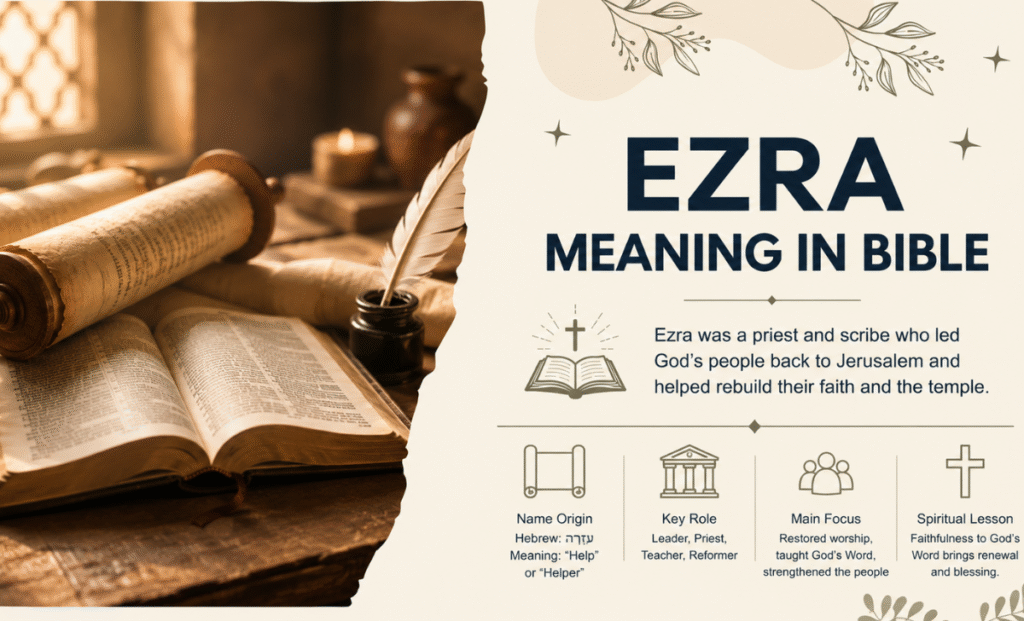
If you’ve ever wondered what the name ezra meaning in bible truly means, you’re not alone. Millions of people search for the Ezra meaning in Bible every year and for good reason. The name carries a deep spiritual weight that goes far beyond its simple dictionary definition. Whether you’re studying Scripture, choosing a baby name, or exploring your faith, understanding Ezra’s meaning can open a door to powerful biblical truths about divine help, restoration, and the faithfulness of God.
Ezra Meaning in Hebrew
The name Ezra comes directly from the Hebrew word עֶזְרָא (ezra), meaning “help” or “helper.” It derives from the Hebrew root verb azar (עָזַר), which means to help, to support, or to aid. This root appears dozens of times throughout the Old Testament, often in the context of God being a helper to His people.
The name is also considered a shortened form of Azaryahu (עֲזַרְיָהוּ), which means “Yahweh helps” pointing even more directly to God as the ultimate source of divine assistance.
The same root word (ezer) is used in Genesis 2:18, where God says He will make a “helper” suitable for Adam. It also echoes in Psalm 121:2: “My help comes from the LORD, the Maker of heaven and earth.”
When we understand the Ezra meaning in Hebrew, we are not talking about ordinary human help. We are talking about the kind of help that only God can provide steady, faithful, and complete.
Ezra Meaning in Greek
In the Greek translation of the Old Testament, known as the Septuagint (LXX), the name Ezra appears as Ésdrās (Ἔσδρας), which became Esdras in Latin. The name traveled from Hebrew roots through Greek and Latin without losing its core meaning.
The Ezra meaning in Greek still connects to the same spiritual idea: divine support and assistance. Whether written in Hebrew letters or Greek script, the name points to the same truth God is our helper.
222 Bible Meaning: What Is God Telling You?
Ezra Meaning in Bible Verse
While no single verse directly defines the name “Ezra,” two key passages capture its essence perfectly:
Ezra 7:10: “For Ezra had devoted himself to the study and observance of the Law of the LORD, and to teaching its decrees and laws in Israel.”
Ezra 7:28 : “The gracious hand of the LORD my God was on me.”
These verses show us the Ezra meaning in Bible verse: a man whose name meant “helper” and who lived it out helping Israel return to God through Scripture, prayer, and repentance. His name was not just a label. It was a calling.
Who Was Ezra in the Bible and What Did He Do?
Ezra was a Jewish priest and scribe who lived during the fifth century BCE, in the early period of the Second Temple. He is the central figure of the Book of Ezra in the Old Testament.
Here is a quick overview of who Ezra was and what he accomplished:
| Role | Description |
|---|---|
| Priest | A descendant of Aaron through the line of Seraiah, the last High Priest of Solomon’s Temple |
| Scribe | A skilled scholar of the Torah, trained in both Hebrew and Aramaic |
| Leader | Led a large group of Jewish exiles from Babylon back to Jerusalem around 458 BCE |
| Reformer | Called the nation to repentance and restored proper worship |
| Teacher | Publicly read and explained the Law of Moses to the returned exiles |
After 70 years of Babylonian captivity, the Jewish people were spiritually broken. The temple had been partially rebuilt, but the people’s hearts had drifted far from God. Ezra’s mission was not to build walls that was Nehemiah’s task. Ezra’s mission was to rebuild faith.
He gathered the people, read the Law of God aloud, led them in confession of their sins, and helped restore the covenant relationship between Israel and the LORD.
Ezra Significance in the Bible
The significance of Ezra in the Bible cannot be overstated. Some Jewish scholars and early Christian writers called him “the second Moses” and “the father of Judaism.” Here is why:
- He is traditionally credited with compiling and editing large portions of the Old Testament canon, including the Books of Chronicles and possibly Malachi.
- He established the Great Assembly (Knesset HaGedolah), a council of 120 scholars and prophets that later became the forerunner of the Sanhedrin.
- He introduced practices still central to Jewish life today, including weekly Torah readings in synagogues.
- He demonstrated that spiritual renewal is always possible — even after catastrophic national failure.
His life proves that one faithful person, armed with God’s Word and God’s grace, can transform an entire community.
Characteristics of Ezra in the Bible
What kind of man was Ezra? Several defining traits emerge from the biblical text:
- Devotion to Scripture: Ezra dedicated his life to studying, practicing, and teaching God’s Law (Ezra 7:10). He never separated knowledge from obedience.
- Deep Humility: When he discovered Israel’s sin of intermarriage with foreign nations, he tore his robe, fell on his knees, and wept before God (Ezra 9:3–5).
- Intercessory Prayer: He regularly prayed on behalf of the people, confessing corporate sin as if it were his own.
- Courage: He boldly confronted sin even when it was uncomfortable and unpopular.
- Dependence on God: Ezra trusted entirely in God’s provision during the dangerous journey from Babylon to Jerusalem (Ezra 8:22–23).
- Spirit-led Authority: He carried a deep, calm authority that came not from political power but from spiritual integrity.
Jordan Meaning in the Bible: What the Name Truly Represents
Facts About Ezra in the Bible
| Fact | Detail |
|---|---|
| Full Name Meaning | Shortened form of Azaryahu “Yahweh helps” |
| Lineage | Descended from Aaron → Phinehas → Seraiah |
| Time Period | Fifth century BCE (around 458 BCE) |
| King He Served Under | Artaxerxes I of Persia |
| Language Skills | Fluent in both Hebrew and Aramaic |
| Books Associated With | Ezra, Nehemiah, 1 & 2 Chronicles, possibly Malachi |
| Key Contribution | Restored the Torah and spiritual order in post-exilic Jerusalem |
Was Ezra a Prophet?
This is one of the most searched questions about Ezra, and the answer is nuanced.
Ezra was officially a priest and a scribe not a traditional prophet in the way Isaiah or Jeremiah were. He did not receive direct divine revelations to deliver specific prophetic messages to the nation.
However, he carried powerful prophetic authority through his handling of Scripture. He worked alongside the prophets Haggai and Zechariah, who ministered in Jerusalem during the same era. In apocalyptic Jewish literature especially 4 Ezra he is depicted as a visionary who receives divine revelation and converses with angels.
Some Jewish traditions also hold that Ezra may have written under the pen name Malachi (“My Messenger”), which would make him a prophetic voice after all.
The simplest answer: Ezra was not a classic prophet, but he carried prophetic weight as a man deeply trusted by God to speak Scripture faithfully.
How Did Ezra Die in the Bible?
The Bible itself does not record Ezra’s death. Scripture gives us his ministry and legacy but goes silent on the circumstances of his passing itself a reminder that what matters most is not how a person dies, but how they live.
According to the Jewish historian Josephus, Ezra died as an old man and was buried in a magnificent manner in Jerusalem. Another ancient tradition holds that Ezra died at the age of 120 years the same age as Moses either in Babylonia or on a journey to meet with Artaxerxes.
A tomb believed to be Ezra’s is said to rest on the banks of the Tigris River near its junction with the Euphrates, and has long served as a place of pilgrimage.
Ezra Meaning in Bible Malayalam
For Malayalam-speaking Christians in Kerala and across South India, the name Ezra carries the same foundational meaning: “സഹായം” (sahayam) help or assistance.
The spiritual significance does not change across languages. In the Malayalam Bible tradition, Ezra represents the same truth: God is faithful to help His people when they return to His Word. The story of Ezra resonates deeply in Indian Christian communities, where spiritual revival and Scripture-centered teaching are highly valued.
Ezra Meaning in Telugu Bible
In the Telugu Bible, widely read across Andhra Pradesh and Telangana, the name Ezra translates to “సహాయము” (sahaayamu) meaning help or support.
Telugu-speaking believers reading the Book of Ezra encounter the same compelling figure: a man whose very name proclaimed God’s help, and whose life demonstrated it. The Ezra meaning in Telugu Bible reinforces the universal biblical truth that God is our helper in every season of life.
Ezra Name Meaning in Bible
To summarize the Ezra name meaning in Bible in one clear statement:
Ezra means “help” or “helper” pointing to God’s faithful guidance, divine support, and the promise of spiritual restoration for all who return to Him.
The name is not merely historical. It is a living declaration. When you read the name Ezra, you are reading a testimony: that God helps, that God restores, and that God never abandons His people.
Spiritual Message of Ezra
What does the life of Ezra say to us today?
1. God’s Word is the foundation of renewal. Ezra did not restore Israel through political strategy or military strength. He restored it through the public reading and teaching of Scripture. For anyone walking through a spiritual dry season, Ezra’s message is clear: return to the Word.
2. Prayer and confession open the door to restoration. Ezra’s prayer in chapter 9 is one of the most moving examples of intercessory repentance in Scripture. He wept not just for his own sin, but for his community’s. This kind of humble intercession is what shifts spiritual atmospheres.
3. God uses ordinary people with extraordinary dedication. Ezra was not a military hero or a king. He was a scribe — a student of the text. Yet God used his faithful devotion to reshape an entire nation. Your calling may be quieter than you expect, but no less significant.
4. Help is always available. The name Ezra is a promise. Just as God was the helper of Israel in exile, He remains the helper of every person who comes to Him with an honest heart. Psalm 46:1 says: “God is our refuge and strength, an ever-present help in trouble.”
Bible Thumper Meaning: What God Wants You to Know
Conclusion
The Ezra meaning in Bible is layered with beauty, depth, and purpose. From its Hebrew root ezer meaning divine help and support to the remarkable life story of the man who bore that name, every dimension of Ezra points to one truth: God help those who come back to Him.
Whether you are exploring this name for personal faith reasons, academic study, or baby naming, you are touching something ancient and alive. Ezra’s name has echoed through thousands of years of Jewish and Christian faith because the message never grows old God is our helper, our restorer, and our strength.
If the name Ezra speaks to your heart, receive it as an invitation. The same gracious hand that was on Ezra (Ezra 7:28) is extended toward you today.
FAQs
What does Ezra mean in the Bible?
Ezra means “help” or “helper,” from the Hebrew root ezer often used in Scripture to describe God’s assistance to His people.
Is Ezra a Hebrew or Arabic name?
Ezra is primarily a Hebrew name. In Arabic and Islamic tradition, the equivalent figure is known as Uzair (عزير), mentioned in the Quran.
What is Ezra’s role in the Bible?
Ezra was a priest and scribe who led Jewish exiles back from Babylon and restored Torah teaching and worship in Jerusalem.
Was Ezra a prophet or a priest?
Ezra was officially a priest and scribe, though he is associated with prophetic authority in Jewish tradition and some apocalyptic writings.
What language did Ezra write in?
Ezra was skilled in both Hebrew and Aramaic; parts of the Book of Ezra (4:8–6:18 and 7:12–26) are written entirely in Aramaic.
Who were Ezra’s ancestors?
Ezra descended from Aaron through the line of the high priest Seraiah, placing him within Israel’s priestly aristocracy.
What does the name Ezra mean for a baby?
As a baby name, Ezra means “helper” carrying connotations of strength, faithfulness, and divine support. A beautiful biblical choice for any child.
Is Ezra mentioned in the New Testament?
No, Ezra is not directly mentioned in the New Testament, but his work of restoring Scripture and worship laid critical groundwork for the faith tradition Jesus was born into.

Hi! I’m Jenson, the writer behind punslush.com. I craft clever puns and witty wordplay designed to entertain and inspire. Visit punslush.com for a good dose of humor and fun!