
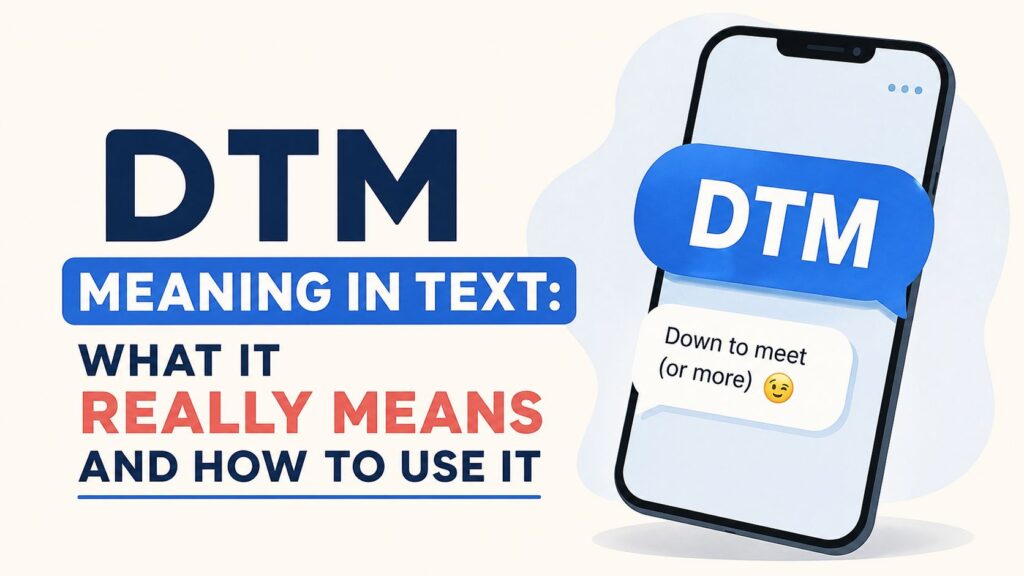
DTM meaning in text refers to a texting acronym with four legitimate definitions: “Doing Too Much,” “Dead To Me,” “Don’t Text Me,” and “Down To Meet.” The correct meaning shifts based on the platform, the relationship between the two people, and the tone surrounding it.
Three letters, four possible meanings, and zero context clues on their own — that’s the trap DTM sets for anyone scrolling through a confusing text or comment section.
This guide breaks down every real definition, shows exactly how to decode which one applies, and walks through actual chat examples across Snapchat, TikTok, dating apps, and group chats, so you never misread it again.
Quick Answer Box
Here’s the short version, for anyone in a hurry.
DTM most commonly means “Doing Too Much.” It’s used to describe someone who’s overreacting, overdoing it, or putting in way more effort than a situation calls for. Depending on the platform and the conversation, though, DTM can also mean “Dead To Me,” “Don’t Text Me,” or “Down To Meet.”
| Meaning | Tone | Most Common Setting |
|---|---|---|
| Doing Too Much | Playful, teasing, sometimes critical | TikTok, Instagram, group chats |
| Dead To Me | Harsh, final | One-on-one texts, breakups, fallouts |
| Don’t Text Me | Blunt, boundary-setting | Texting, Snapchat |
| Down To Meet | Casual, inviting | Dating apps, social plans |
The correct read depends almost entirely on context. Who sent it, what came before it, and where the conversation is happening all matter more than the letters themselves. We’ll get into exactly how to figure that out in a minute.
What Does DTM Mean in Text?
Let’s slow down and look at each definition individually, because lumping them together is where most confusion starts. There isn’t one single, universal DTM. There are four real ones, and they don’t overlap much in meaning or tone.
Doing Too Much
This is the big one. If you see DTM used as a reaction, a caption, or a comment under something dramatic, it almost certainly means doing too much. It’s the internet’s shorthand for calling out excessive behavior — someone being extra, exaggerating, or making a mountain out of a molehill.
Think of it as a lighter, faster version of saying “you’re overreacting” or “that was a bit much.” It’s judgmental, sure, but usually more amused than angry.
Dead To Me
This one carries real weight. When DTM means “dead to me,” it’s a statement of finality — the sender is done, and they want you to know it. There’s no ambiguity here once you understand the context: this version shows up after an argument, a betrayal, or a serious falling-out, not in casual banter.
Don’t Text Me
Blunt and to the point. This version is a boundary, not an insult. Someone using DTM to mean “don’t text me” is usually asking for space, ending a conversation, or setting a clear limit. It’s common after an argument or when someone’s simply tired of the back-and-forth.
ALSO READ: PU Meaning in Text The 2026 Guide to This Confusing Slang Everyone Misreads
Down To Meet
The odd one out — and the friendliest by far. In dating and social contexts, DTM can mean “down to meet,“ as in, someone’s open to meeting up in person. You’ll see this most on dating apps or in texts arranging plans, where brevity matters and everyone already knows the shorthand.
Quick Tip: If DTM shows up right after someone suggests hanging out or matches with you on a dating app, it’s almost never “dead to me.” Context does the heavy lifting here.
Where DTM Comes From
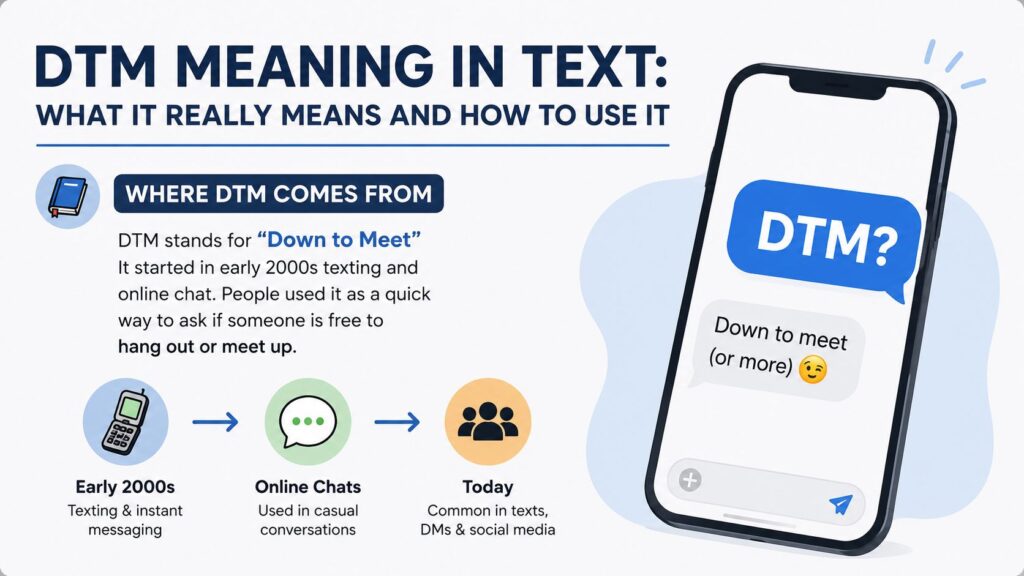
Slang doesn’t appear out of nowhere. It evolves because people need faster ways to react, judge, or communicate emotion without typing a full sentence. DTM is a textbook example of that pattern.
The “doing too much” meaning traces back to internet call-out culture — the kind of commentary that thrives on Twitter threads, TikTok comment sections, and Instagram replies, where people love pointing out when someone’s being overly dramatic or putting in unnecessary effort. As social media commentary got faster and pithier, full phrases got compressed into acronyms, and DTM stuck because it’s short, punchy, and instantly recognizable once you know it.
The “down to meet” version likely grew separately, out of dating culture, where efficient, low-effort communication is the norm. Nobody wants to type out “are you interested in meeting up” when three letters do the job.
Meanwhile, “dead to me” and “don’t text me” evolved more organically through everyday texting, where people compress emotionally loaded phrases into something quick to type during a heated moment. It’s the same reason “IDC” replaced “I don’t care” — brevity wins when emotions are running high.
Here’s the thing about internet slang: it rarely spreads in a straight line. It bends and multiplies inside different online communities before merging into the mainstream, which is exactly why DTM ended up with four separate lives instead of one clean definition.
There’s also a practical reason acronyms like DTM catch on in the first place: character limits and typing speed. Long before smartphones had predictive text and voice-to-text, texting on a numeric keypad meant every extra letter cost real time. Compressing “doing too much” into three keystrokes wasn’t just cute — it was efficient. That habit carried over even after typing got faster, because by then the shorthand had become its own kind of identity marker. Using DTM instead of spelling it out signals that you’re fluent in a certain kind of online conversation.
It’s also worth noting that DTM isn’t an isolated case. Texting acronyms and chat abbreviations almost always start inside a specific community — a friend group, a fandom, a gaming server — before spreading outward. TikTok and Instagram, in particular, act like accelerants. A single viral comment using DTM in a specific way can expose millions of people to that meaning within days, which helps explain why “doing too much” outpaced the other definitions in raw popularity, even though “dead to me” and “down to meet” arguably came first in their own respective communities.
Language researchers who study internet culture often point out that acronyms with multiple meanings tend to survive longer than single-meaning ones, precisely because they stay useful across more situations. A word that only means one thing gets replaced quickly once it feels stale. A word that flexes — like DTM — sticks around because it keeps finding new relevance.
How to Tell Which Meaning Someone Means
This is the part that actually matters. Knowing all four definitions doesn’t help much if you can’t tell which one’s in play. So here’s a simple way to think it through.
Ask yourself these four questions, in order:
- Who sent it? A close friend, a romantic interest, or someone you just met on a dating app all carry different odds.
- What happened right before it? DTM rarely appears out of nowhere. It’s almost always a reaction to something specific.
- Where did it show up? Platform matters more than people realize.
- What’s the tone of the surrounding message? Punctuation, emojis, and capitalization all shift meaning fast.
A quick decision guide:
- If it follows a story about someone overreacting or being dramatic → Doing Too Much
- If it follows an argument, betrayal, or serious conflict → Dead To Me
- If it’s a standalone reply with no warmth, especially after repeated messages → Don’t Text Me
- If it follows plans, a dating match, or an invitation → Down To Meet
A short case study to make this concrete:
Imagine your friend sends a screenshot of someone’s six-paragraph text after a single date, followed by “DTM 😭.” That’s not “dead to me” — the crying-laughing emoji and the context (an over-the-top reaction) point straight to “doing too much.” Now imagine a different scenario: you’ve texted someone three times after an unanswered message, and they finally reply with just “DTM.” No emoji, no punctuation, no warmth. That’s almost certainly “don’t text me.”
Same three letters. Completely different message. That’s the whole game with DTM — the acronym never carries the meaning by itself. The situation around it does.
A few extra signals worth watching for:
- Response speed. A DTM that comes back instantly, within seconds of your message, often carries more heat behind it — more likely “don’t text me” or “dead to me.” A DTM that shows up after a natural pause in conversation is more likely playful.
- Message length before it. If DTM follows a long, detailed story, it’s almost always commentary on that story — “doing too much.” If it follows a short, cold exchange, it’s more likely a boundary statement.
- Capitalization. “DTM.” in all caps with a period reads harsher than “dtm lol” in lowercase with a laugh attached. Small formatting choices carry real emotional weight in text.
Why Context Carries So Much Weight in Texting
Text messages strip away tone of voice, facial expression, and body language — the three things humans rely on most to read emotional intent. That’s part of why slang like DTM can feel confusing at first: you’re missing most of the information a face-to-face conversation would give you for free.
This is also why online communication develops its own set of substitute signals. Emojis, punctuation, capitalization, and response timing all step in to do the job that tone of voice usually handles. Once you start reading those signals alongside the actual words, decoding something like DTM gets a lot easier — you’re not just reading three letters, you’re reading the whole shape of the conversation around them.
DTM Meaning by Platform
Where DTM shows up changes the odds of which meaning applies. Here’s how it tends to break down across digital platforms.
On Snapchat and Texting
In direct texting and Snapchat, DTM leans toward the more personal meanings — “dead to me” or “don’t text me.” These are one-on-one spaces where people are more likely to be communicating a boundary or expressing frustration directly at the other person.
On TikTok and Instagram Comments
On TikTok and Instagram, especially in comment sections, DTM overwhelmingly means “doing too much.” These platforms thrive on reaction culture — people commenting on videos, outfits, relationship drama, or over-the-top content — so the judgmental, call-out version of DTM fits naturally here.
On Dating Apps
This is where “down to meet” almost exclusively lives. Dating app conversations are built around efficiency: swipe, chat briefly, gauge interest, arrange to meet. DTM slots right into that rhythm as a fast way to signal interest in taking things offline.
On Discord and Group Chats
In Discord and other group chat spaces, DTM can go either way depending on the group’s culture, but “doing too much” tends to dominate, especially in gaming or fandom communities where teasing and exaggeration are part of the everyday banter.
Platform cheat sheet:
| Platform | Most Likely Meaning |
|---|---|
| Snapchat / Texting | Dead To Me or Don’t Text Me |
| TikTok / Instagram comments | Doing Too Much |
| Dating apps | Down To Meet |
| Discord / group chats | Doing Too Much |
Why Platform Changes the Meaning So Much
It might seem strange that the same three letters shift meaning depending on where you see them, but this actually lines up with how most messaging apps and social apps shape communication in general. Snapchat and one-on-one texting are private, personal spaces — the stakes of a message feel higher because it’s just you and one other person. That’s exactly the environment where a serious phrase like “dead to me” or a blunt boundary like “don’t text me” tends to live.
TikTok and Instagram comments, by contrast, are public performance spaces. People aren’t usually messaging one specific person; they’re reacting for an audience. That’s a much more natural home for the lighter, funnier “doing too much” meaning, since it works as a punchline as much as a statement.
Dating apps sit somewhere in between — semi-personal, but built around efficiency and quick decision-making. “Down to meet” thrives there because the entire point of the platform is moving a conversation toward a real-world outcome as fast as possible.
Discord and other group chat spaces vary the most, because they’re shaped entirely by the personality of the specific server or friend group. A close-knit gaming Discord might use DTM constantly as a running joke, while a more formal community server might barely use it at all. When in doubt in these spaces, scroll back a few messages before reacting to a fresh DTM — the server’s own history usually tells you exactly how it’s typically used.
DTM in Real Conversations — Examples
Reading definitions only gets you so far. Here’s how DTM actually shows up in real conversations, so you can spot the pattern for yourself.
Doing Too Much:
Friend 1: “She made a 12-slide PowerPoint to break up with her boyfriend.” Friend 2: “DTM 😭 that’s insane.”
Comment on a video: “Bro cried over losing a video game 💀 DTM.”
Dead To Me:
Text 1: “I can’t believe you told everyone what I said in confidence.” Text 2: “We’re done. DTM.”
Group chat: “After what he did at the party, he’s DTM to me now.”
Don’t Text Me:
Text 1: “Hey, you never replied lol” Text 1 (again): “??” Text 2: “DTM.”
Down To Meet:
Dating app match: “You seem cool, I’m DTM if you’re around this weekend.” Text between friends: “There’s a pop-up market downtown Saturday, you DTM?”
Notice how none of these message samples need extra explanation once you see the surrounding conversation. That’s the whole point — DTM borrows its meaning from context, not the other way around.
A few more conversation snippets, across different tones:
Sibling text: “Mom made a whole seating chart for a 6-person dinner.” → “DTM as always lol”
Breakup follow-up: “I saw you two together yesterday.” → “Doesn’t matter anymore. You’re DTM.”
Group project chat: “He color-coded the entire spreadsheet for a two-page report.” → “DTM 😭 respect though”
Dating app opener: “This weekend’s actually pretty open for me, you DTM if something comes up?”
Case Study: The Same Acronym, Two Very Different Outcomes
To really see how much context matters, look at these two nearly identical exchanges side by side.
Exchange A:
“Ugh, she cried during the trailer for a kids’ movie.” “DTM 😂”
Here, DTM lands as harmless teasing. Nobody’s hurt, nobody’s offended — it’s just a shorthand way of saying “that’s a big reaction to a small thing.”
Exchange B:
“You lied to me about where you were last night.” “DTM.”
Same acronym, completely different emotional register. There’s no laughing emoji, no lightness in the setup — this is a boundary being drawn, possibly the end of a relationship. Reading DTM the same way in both cases would be a mistake, and it’s a mistake people make constantly when they only know one definition of the term.
When to Use DTM (and When Not To)
DTM is casual through and through, which means knowing when it fits — and when it doesn’t — matters just as much as knowing what it means.
Good times to use it:
- Reacting to something dramatic among friends
- Casual banter in group chats or comment sections
- Signaling interest in meeting up on a dating app
- Setting a quick, informal boundary with someone you know well
Times to avoid it:
- Professional or work-related messages, where it can come across as unclear or unprofessional
- Conversations with someone who might not know internet slang, like older relatives or new acquaintances outside your usual circles
- Situations where clarity actually matters more than brevity, like resolving a serious misunderstanding
Better alternatives if you want to be crystal clear:
- Instead of “DTM” (doing too much): “That felt like a lot” or “a bit dramatic, no?”
- Instead of “DTM” (dead to me): “I don’t want to talk to you anymore” or “I’m done with this”
- Instead of “DTM” (don’t text me): “Please stop messaging me” or “I need space”
- Instead of “DTM” (down to meet): “I’d like to meet up” or “Are you free to hang out?”
Slang is great for speed and tone, but it’s a poor choice whenever there’s a real chance of being misread.
How to Respond to DTM
Your reply should match whichever meaning is actually in play. Here’s how to handle each one.
If someone means “Doing Too Much”:
This is usually lighthearted, so a playful reply works well:
- “I know, right? Way too much.”
- “Someone needs to sit down 💀”
- “Not the PowerPoint presentation.”
If someone means “Dead To Me”:
This is a serious statement, so treat it that way. If it’s directed at you, don’t respond with jokes or slang — a direct, honest reply matters more here:
- “I understand you’re upset. Can we talk about what happened?”
- “I’m sorry. I’d like the chance to make this right.”
If someone means “Don’t Text Me”:
Respect the boundary. Don’t push back, don’t send more messages trying to explain — just acknowledge it and step back:
- “Understood, I won’t message again.”
- Simply stop texting. Sometimes no reply is the most respectful reply.
If someone means “Down To Meet”:
Keep it easy and casual, matching their energy:
- “Yeah, I’m down. What time works?”
- “Sounds good, let’s figure out details.”
A quick etiquette note: message etiquette around slang like DTM comes down to reading the emotional weight of the moment. Casual DTM deserves a casual response. Serious DTM deserves a real one.
DTM vs. Similar Slang
DTM isn’t the only acronym floating around with multiple meanings, and it’s easy to confuse it with similar-looking terms. Here’s a quick comparison.
| Term | Meaning | How It Differs From DTM |
|---|---|---|
| DTF | A sexually explicit term used mainly on dating apps | Frequently confused with “Down to Meet” but far more explicit — do not use interchangeably |
| Extra | Being over-the-top or dramatic | Similar in spirit to “Doing Too Much,” but used as a standalone adjective, not an acronym |
| TMI | Too Much Information | Refers to oversharing personal details, not overreacting or over-effort |
| IDGAF | I Don’t Give A F*** | Expresses indifference, unlike DTM’s more situational, judgmental tone |
The most important mix-up to know: DTM (“down to meet”) and DTF are not the same thing, even though they can appear in similar dating-app contexts. Using the wrong one can send a very different message than intended, so it’s worth double-checking which one you actually mean to type.
Common Mix-Ups
A few misunderstandings come up again and again with DTM, so it’s worth clearing them up directly.
Mix-up #1: Assuming DTM always means something harsh. Most of the time, DTM is closer to a joke than an insult. The “dead to me” meaning gets outsized attention because it’s dramatic, but statistically, “doing too much” is the far more common everyday use.
Mix-up #2: Confusing “Down to Meet” with “DTF.” As covered above, these are entirely different in tone and content. One’s an invitation to hang out. The other is explicit. Mixing them up in the wrong conversation can lead to a genuinely awkward moment.
Mix-up #3: Reading DTM the same way across every platform. A DTM in a TikTok comment section and a DTM in a private text carry different weight. Treating every instance the same way is how misunderstandings happen in the first place.
Mix-up #4: Assuming everyone knows what DTM means. Slang isn’t universal. Younger, terminally-online audiences pick these acronyms up quickly, but plenty of people — coworkers, older relatives, new acquaintances — won’t recognize it at all. When in doubt, spell it out.
Who Actually Uses DTM
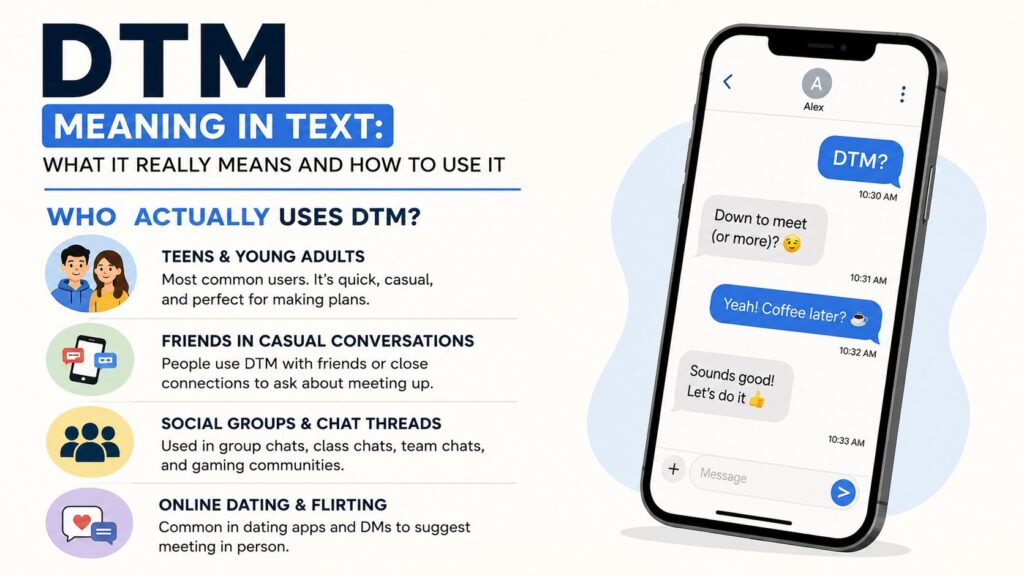
DTM skews heavily toward younger users — mostly teens and people in their twenties who spend a lot of time on TikTok, Instagram, and Snapchat, where fast-moving slang gets recycled constantly. That doesn’t mean older users never use it, but recognition drops off noticeably outside that core group.
This matters practically. If you’re texting a close friend your own age, DTM will almost always land the way you intend it. If you’re messaging a coworker, a parent, or someone outside your usual online circles, there’s a real chance the acronym just won’t register — and you’ll end up having to explain it anyway, which defeats the purpose of using shorthand in the first place.
A useful rule of thumb: the more online someone is, the more likely they’ll instantly understand which of the four meanings you’re going for based on context alone. The less online someone is, the more you should lean on full sentences instead.
It’s also worth noting that slang like this moves in cycles. An acronym can be everywhere for a year or two, fade out, and occasionally resurface once a new platform or trend brings it back into circulation. DTM has shown real staying power compared to a lot of short-lived internet slang, largely because it’s flexible enough to fit so many different situations rather than being tied to one specific joke or meme that eventually gets old.
ALSO READ: Tried and True Meaning Explained with Examples
Variations You Might See
DTM doesn’t always show up in its plain, three-letter form. A few common variations carry the exact same meanings, just dressed up slightly differently:
- “dtm” (lowercase) — functionally identical, just softer in tone
- “DTM.” (with a period) — tends to read as more final or serious, especially for the “dead to me” or “don’t text me” meanings
- “dtmmm” (stretched out) — usually emphasizes the “doing too much” meaning, adding extra drama for comedic effect
- “literal DTM” — an intensified version, often paired with a screenshot or story, used to underline just how over-the-top something was
None of these change the core acronym meanings — they just adjust the emotional volume.
faqs
1. What does DTM mean in a text message?
DTM most commonly means “Doing Too Much.” Depending on context, it can also mean “Dead To Me,” “Don’t Text Me,” or “Down To Meet.”
2. What platform is DTM used on the most?
It’s most common on TikTok and Instagram comments, where it usually means “Doing Too Much.” On dating apps, it typically means “Down To Meet.”
3. Is DTM the same as DTF?
No. DTM (Down To Meet) is a casual invite to hang out. DTF is a separate, sexually explicit acronym — they’re easily confused but shouldn’t be used interchangeably.
4. Is DTM appropriate to use at work?
No. It’s casual internet slang best kept for texting and social media with friends, not professional or work-related messages.
5. How can I tell which DTM meaning someone intends?
Check who sent it, what was said right before it, and the tone (emojis, punctuation). Context, not the letters themselves, tells you the real meaning.
conclusion
DTM meaning in text isn’t just one thing. It can mean “Doing Too Much,” “Dead To Me,” “Don’t Text Me,” or “Down To Meet.” The right meaning depends on who sent it and where. Once you know all four, those three letters stop feeling confusing.
Context is the real key to DTM meaning in text. Look at the message before it. Check the tone. Notice the platform. A DTM on TikTok often means teasing. A DTM in a private text can mean something serious. Read the situation, not just the letters, and the meaning becomes clear fast.