sfw meaning stands for “Safe For Work,” a label used to mark content that’s appropriate to view in a professional or public setting. It signals that whatever you’re about to open contains no nudity, no graphic violence, and no explicit language, making it safe for a desk, a shared screen, or a crowded train.
One wrong click at the wrong moment can turn an ordinary Tuesday into an HR meeting. That’s the quiet power behind two letters most people never think twice about.
Beyond a simple green light, SFW represents an entire system of trust built into forums, social platforms, and office culture alike. Learning how it works protects your accounts, your reputation, and your job.
What Does SFW Mean?
SFW stands for “Safe For Work.” It’s a label people use to flag content that’s appropriate to view in a professional or public setting — no nudity, no graphic violence, no explicit language, nothing that would make a coworker (or your boss) raise an eyebrow if they walked by your screen.
Think of it as a green light. If something is tagged SFW, you can generally open it at your desk, in a shared office, or on a public train without worrying about who might glance over your shoulder.
The opposite term, NSFW (“Not Safe For Work”), flags content that’s explicit, graphic, or otherwise inappropriate for a professional environment. Together, these two tags form one of the most widely recognized content labels on the internet.
Here’s the quick version, if you only remember one thing:
SFW = appropriate to view anywhere, including at work. NSFW = save it for later, and definitely not at your desk.
The term shows up constantly in casual conversation too. Someone might text a friend “SFW?” before opening a link, essentially asking, “Is this something I can open right now without getting in trouble?”
Where the Term SFW Came From
SFW didn’t start as corporate jargon. It grew out of internet forum culture in the early 2000s, back when message boards and imageboards were the dominant way people shared photos, memes, and links.
Back then, a huge chunk of internet users browsed forums during work hours (some things never change). Forum communities quickly realized they needed a shorthand way to flag content that was risky to open on a work computer, especially with IT departments starting to monitor browsing activity. SFW and NSFW tags became the informal traffic signals of the early web.
A few things drove the term’s popularity:
- Workplace internet monitoring became common. As companies installed content filters and browsing logs in the early 2000s, employees needed a fast way to know what was safe to click.
- Forums and imageboards needed self-moderation tools. Sites like early Something Awful threads and later 4chan boards used SFW/NSFW tags to separate general discussion from explicit content.
- Shared computers were the norm. Family computers, office computers, and library terminals meant people were far more likely to view content in front of others, so the stakes for opening something inappropriate were higher.
By the mid-2000s, SFW had spread well beyond niche forums. Blogs, early social media platforms, and eventually mainstream sites like Reddit adopted the label as a built-in tagging system. Today it’s baked into platform infrastructure rather than being a purely informal community habit.
ALSO READ: DTM Meaning in Text: What It Really Means And How To Use It
SFW vs. NSFW: What’s the Real Difference?
On the surface, the difference seems obvious: safe content versus explicit content. But the line isn’t always as clean as it sounds, and that’s exactly where most confusion (and most workplace mistakes) happens.
What Makes Content “Safe”
Generally, content earns an SFW label when it meets these conditions:
- No nudity or sexual content. This includes suggestive poses, not just explicit imagery.
- No graphic violence or gore. Cartoon violence and mild action content usually still qualify as SFW.
- No explicit language. Profanity-heavy content often gets flagged even without visual issues.
- No content that targets or demeans people. Hate speech and harassment content isn’t SFW, regardless of visual explicitness.
- Nothing that would embarrass you if a coworker saw your screen. This is the practical, real-world test most people actually use.
What Pushes Content Into NSFW Territory
Content usually crosses into NSFW territory when it includes:
- Nudity or sexual content, whether real, illustrated, or animated
- Graphic violence, including blood, injury, or death depicted realistically
- Disturbing or shocking imagery, even without sexual content
- Heavy profanity or slurs
- Drug use depicted explicitly, depending on platform policy
Gray-Area Content
This is where things get genuinely tricky, and it’s the part most guides skip. A lot of content sits in a gray zone that different platforms and different people classify differently:
| Content Type | Common Classification | Why It’s Debated |
|---|---|---|
| Artistic or classical nudity (museum paintings, sculptures) | Often SFW | Cultural and artistic context softens the nudity |
| Swimsuit or fitness photos | Usually SFW, sometimes flagged | Depends on pose and platform sensitivity |
| Medical imagery (surgery photos, anatomy) | Platform-dependent | Educational intent versus graphic content |
| Cartoon or anime violence | Usually SFW unless graphic | Stylized violence reads differently than realistic gore |
| Suggestive humor or innuendo | Usually SFW | No explicit content, but tone can push it toward NSFW |
The takeaway: when content sits in a gray area, the safest move is to treat it as NSFW until proven otherwise. It costs you nothing to hesitate before opening something at your desk, but it can cost you plenty if you guess wrong.
It also helps to remember that context shapes classification just as much as the content itself. A shirtless photo posted in a fitness community reads very differently than the same photo posted in a dating context, even though the image itself hasn’t changed. Platforms increasingly train their moderation systems to weigh surrounding context — captions, hashtags, account history — alongside the raw image or video, which is part of why the same piece of content can get treated differently depending on where and how it’s shared.
Related Terms You’ll See Alongside SFW
SFW rarely travels alone. Once you start paying attention, you’ll notice a whole family of labels that work alongside it.
NSFW and Other Content Warnings
- NSFW (Not Safe For Work): The direct counterpart to SFW, covering sexual or explicit content
- NSFL (Not Safe For Life): A more intense warning reserved for deeply disturbing content — think graphic injury, death, or content that’s traumatic regardless of setting
- CW (Content Warning): A general-purpose flag used before discussing sensitive topics like abuse, self-harm, or trauma
- TW (Trigger Warning): Similar to CW, but specifically aimed at content that might trigger a strong emotional or psychological reaction in someone with related lived experience
- Spoiler tags: Not about explicit content at all, but about protecting plot details for movies, shows, or games
How These Labels Differ in Severity
Here’s a simple way to rank these labels by intensity, from mildest to most severe:
- Spoiler tag — protects plot details, no explicit content involved
- SFW — the baseline, generally appropriate content
- CW/TW — flags emotionally sensitive topics, not necessarily explicit
- NSFW — flags explicit or graphic content
- NSFL — flags the most disturbing, potentially traumatic content
Understanding this hierarchy matters because mixing up these labels causes real confusion. Tagging something NSFL when it’s really just mildly suggestive undersells genuinely disturbing content elsewhere, and that erodes trust in the labeling system as a whole.
How SFW Is Used on Different Platforms
Every major platform has built its own version of the SFW/NSFW tagging system, and the rules genuinely differ from one site to the next. Knowing these differences helps you avoid platform consequences like shadowbans or account strikes.
Reddit’s SFW/NSFW Tagging System
Reddit has one of the most mature tagging systems on the internet. It works on two levels:
- Subreddit-level tagging: Entire communities can be marked NSFW, which hides them from search results for logged-out users and requires an account setting change to view.
- Post-level tagging: Individual posts within an otherwise SFW subreddit can be flagged NSFW by moderators or the poster themselves.
Reddit also uses a “Spoiler” tag separately from NSFW, and some subreddits add their own custom flags for gore or violence beyond the standard system.
SFW on Twitter/X and Content Warnings
X (formerly Twitter) uses a setting called “Sensitive Content,” which functions similarly to an NSFW tag. Users can mark their own posts as containing sensitive material, and other users must opt in through their account settings to view flagged content by default. This is technically an opt-in system rather than a simple label, which makes it different from Reddit’s structure.
SFW on Discord and Server Settings
Discord handles this at the channel level rather than the platform level. Server admins can mark individual channels as age-restricted, which:
- Hides the channel from users without age verification enabled
- Blocks the channel from appearing in Discord’s server discovery feature
- Requires users to confirm they’re 18+ before viewing
This is a stricter system than a simple SFW/NSFW text tag because it’s enforced through Discord’s actual platform architecture, not just community trust.
SFW on TikTok and Instagram
TikTok and Instagram take a different approach entirely. Neither platform relies heavily on user-applied SFW/NSFW tags. Instead, they enforce comhttps://punslush.com/munity guidelines through automated content moderation and human review teams. Content that violates these guidelines gets removed or restricted rather than simply labeled.
That said, creators on these platforms still use informal SFW language in captions or comments, especially when linking out to other platforms with looser content rules.
SFW in Group Chats and Messaging Apps
Slack, Microsoft Teams, and WhatsApp don’t have formal SFW tagging built into their platforms. Instead, workplace etiquette fills the gap. Many teams establish informal norms, like using a specific emoji or the word “SFW” in a message before sharing a link, especially in channels that mix work and casual conversation.
How to Label and Tag SFW Content Correctly
Correct tagging isn’t just about following rules. It protects you from account penalties and protects other users from seeing content they didn’t consent to view.
Platform-Specific Tagging Steps
On Reddit:
- Open your post before submitting
- Look for the “Mark as NSFW” toggle beneath the post editor
- Toggle it on if your content contains explicit material
- For subreddit-wide tagging, go to Mod Tools > Community Settings > check “NSFW community”
On X (Twitter):
- Go to Settings and Privacy > Content Preferences
- Enable “Mark media you post as sensitive”
- This automatically flags future posts containing sensitive media
On Discord:
- Right-click the channel and select “Edit Channel”
- Toggle “Age-Restricted Channel” under the Overview tab
- Save changes
Common Tagging Mistakes That Get Content Flagged
- Forgetting to tag gray-area content, assuming it’s obviously fine when the platform’s algorithm disagrees
- Under-tagging to avoid reduced visibility, since NSFW content often gets deprioritized in feeds and search results
- Using the wrong severity label, like marking genuinely disturbing content as simply NSFW instead of NSFL
- Relying on file names alone, without using the platform’s actual tagging tools
- Assuming platform-to-platform consistency, when content that’s SFW on one platform may be flagged as NSFW on another due to differing content guidelines
A quick, practical habit worth building: name your files and thumbnails clearly before sharing them. If you’re sending a batch of images through email or a shared drive, adding “SFW_” or “NSFW_” as a filename prefix gives anyone opening the folder an immediate heads-up, even outside of a platform’s built-in tagging system.
SFW in the Actual Workplace
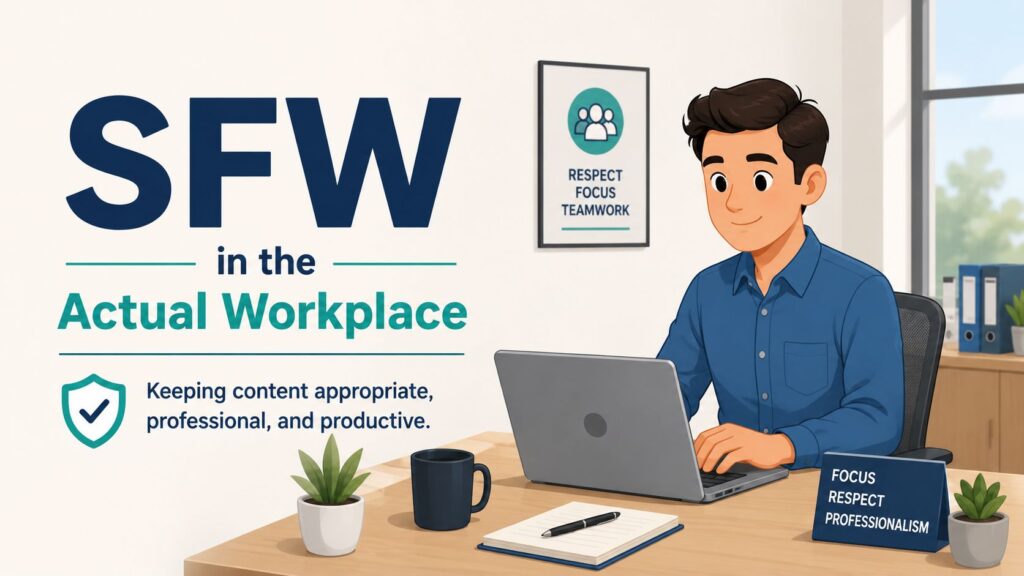
This is where the term stops being internet slang and starts having real professional consequences.
How Companies Define Acceptable Content
Most companies define appropriate content through an acceptable use policy (AUP), a formal document that outlines what employees can and cannot access, share, or view using company devices and networks. These policies typically cover:
- Websites and content categories blocked by IT filters
- Rules around personal device use on company Wi-Fi
- Guidelines for sharing content in internal chat tools
- Consequences for policy violations
Most acceptable use policies get introduced during onboarding and then largely forgotten, which is exactly why violations happen so often. Employees sign the document on day one, never look at it again, and slowly drift into habits shaped more by their team’s informal culture than the actual written policy. That gap between what’s written and what’s practiced is where most disciplinary cases start. A healthy team culture treats the written policy as the floor, not the ceiling, and reinforces it through everyday workplace etiquette rather than relying on the document alone.
IT Filters, HR Policy, and Compliance Basics
Company IT departments often use content filtering software that automatically blocks categories of websites, including adult content, gambling sites, and sometimes even social media during work hours. These filters exist for a few practical reasons:
- Legal liability protection, since companies can be held responsible for a hostile work environment created by inappropriate content
- Productivity management
- Network security, since many blocked categories also correlate with higher malware risk
- Compliance requirements, especially in regulated industries like finance and healthcare
HR policy typically works alongside IT filtering rather than replacing it. Even if a filter doesn’t catch something, HR policy still applies, and violations discovered through other means (a coworker complaint, a screen someone noticed) can trigger the same disciplinary process.
Legal Exposure Tied to Shared Content
Here’s a fact that surprises a lot of people: sharing inappropriate content at work isn’t just a matter of personal embarrassment. It can create genuine legal exposure for both the employee and the company.
Under workplace harassment law in the United States, a hostile work environment can be established when unwelcome conduct — including sharing explicit or offensive material — is severe or pervasive enough to affect someone’s ability to do their job. This means:
- A single serious incident can sometimes be enough to trigger a formal complaint, depending on the severity
- Companies can face liability if they knew about a pattern of inappropriate content sharing and failed to act
- Employees can face personal liability in some harassment lawsuits, not just their employer
“The workplace doesn’t need a written policy explicitly banning something for it to count as harassment. If it creates a hostile environment, that’s enough.” — a standard explanation used in HR compliance training materials
This is exactly why HR policy and employee conduct guidelines exist separately from IT filtering. A filter can block a website. It can’t stop someone from forwarding an inappropriate meme through a personal messaging app screenshot.
Sharing Content at Work Without Getting in Trouble
A few practical rules of thumb keep you safely inside the lines of workplace etiquette:
- Never assume a private chat stays private. Screenshots exist, and IT departments can access company communication tools.
- Avoid sharing anything gray-area, even as a joke. Humor doesn’t protect you legally or professionally.
- Use personal devices and personal accounts for anything even slightly questionable, and even then, be cautious about what you access on company Wi-Fi.
- When in doubt, don’t send it at all. This single habit prevents the vast majority of workplace content incidents.
How to Use “SFW” in a Sentence
Since the term shows up so often in casual writing, here are some real examples of how people naturally use it:
- “Is this link SFW? I’m about to open it on my work laptop.”
- “Heads up, that video isn’t SFW — save it for later.”
- “This meme is totally SFW, you can send it in the team channel.”
- “Just a warning, some of these photos aren’t SFW.”
- “I only follow SFW accounts on my main social media profile.”
Notice the pattern: SFW almost always functions as an adjective describing whether content is appropriate for a professional or public setting.
What Happens When Content Is Mislabeled
Mislabeling isn’t a small mistake. It carries real workplace consequences and real platform consequences, and both can escalate quickly.
Platform Consequences
- Shadowbanning, where your content gets quietly deprioritized in feeds without formal notice
- Account strikes or suspensions, especially on platforms with three-strike policies
- Permanent bans for repeated violations, particularly on platforms with strict community guidelines around explicit content
- Demonetization, for creators relying on ad revenue, since most ad platforms refuse to serve ads alongside unlabeled NSFW content
- Reduced discoverability, since many platforms algorithmically limit the reach of flagged content even when it’s correctly tagged
Workplace Consequences
- Verbal or written warnings, typically the first step in a progressive discipline process
- Formal HR investigation, especially if a coworker files a complaint
- Termination, for serious or repeated violations
- Legal action, in cases where shared content contributes to a documented hostile work environment
- Reputational damage, which can follow someone into future job references
A useful mental model: treat every piece of content you share at work as if it could be reviewed by HR, IT, and a lawyer at the same time. It sounds dramatic, but it’s a genuinely accurate description of the worst-case chain of events.
Best Practices for Posting and Sharing Content
When in Doubt, Label It
If you’re ever unsure whether something qualifies as SFW, the safest default is simple: label it as NSFW. Over-labeling costs you a small amount of reach or a minor inconvenience. Under-labeling can cost you your account, your job, or both.
Reading Group/Channel Rules Before Posting
Every community, server, and workplace channel has its own specific expectations layered on top of general platform rules. Before posting in a new space:
- Check pinned messages or channel descriptions for explicit content rules
- Look at recent posts to get a feel for the community’s tolerance level
- When joining a new Discord server or Slack workspace, read the rules channel in full before posting anything borderline
ALSO READ: Tried and True Meaning Explained with Examples
Using Browser Extensions and Filters for Extra Safety at Work
Beyond company-mandated IT filters, individual employees can add their own layer of protection:
- Browser extensions that block adult content categories as a personal safeguard
- SafeSearch settings enabled at the browser or search engine level
- Content filtering apps for shared or public computers
- Separate browser profiles for work versus personal browsing, reducing the chance of accidentally opening the wrong tab during a screen share
None of these tools replace good judgment, but they act as a helpful backstop for the moments when judgment slips, like clicking a link too quickly during a busy morning or forgetting a screen share is still active. Building small habits around content labels and personal filters takes the pressure off remembering every rule perfectly in the moment.
FAQs
What does SFW actually stand for?
SFW stands for “Safe For Work,” meaning content that’s appropriate to view in professional or public settings.
Does Reddit still use the SFW/NSFW tagging system in 2026?
Yes. Reddit marks profiles as Not Safe for Work when someone participates in an NSFW community or when profile content is flagged as mature, requiring viewers to confirm they’re over 18. NSFW-marked accounts also can’t run Reddit ads.
Is SFW content ever fully free of gray areas on platforms like Reddit?
Not entirely. NSFW-designated communities on Reddit permit legal adult content as long as it doesn’t break other platform rules, so classification still depends heavily on community-level context.
Can a brand-safe SFW label affect advertising eligibility?
Yes. Reddit’s brand safety standards block explicit sexual content, most nudity, and graphic violence from standard ad creative, so NSFW-flagged accounts or posts lose ad access entirely.
Is NSFL still treated as more severe than NSFW?
Yes, that hierarchy hasn’t changed. NSFL (Not Safe For Life) still flags content more disturbing than typical NSFW material, like graphic injury or death, regardless of platform.
conclusion
SFW meaning comes down to one simple idea: know before you click. Understanding SFW meaning helps you avoid awkward moments at work and keeps your accounts safe from bans or strikes. It’s a small habit with a big payoff.
Every platform treats SFW meaning a little differently, but the core rule stays the same. When you’re unsure, label it as NSFW instead. Grasping SFW meaning takes just a minute, but it protects your job, your reputation, and your online presence for years to come.