
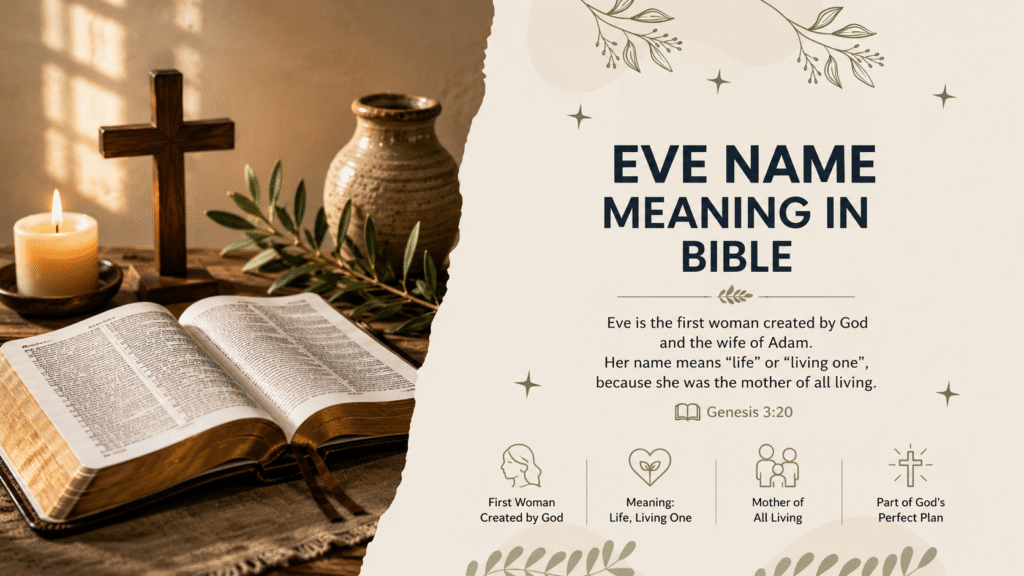
Few names carry the spiritual and historical weight that Eve does. She stands at the very beginning of human history the first woman, the first wife, and the first mother. Yet many people, even lifelong believers, have never explored the deeper layers behind her name. What does the name eve name meaning in bible Where does it come from? And what does it teach us today?
This guide covers everything: the Hebrew origin, spiritual significance, character traits, practical lessons, and much more.
Who Is Eve in the Bible?
Eve is the first woman ever created, introduced in the Book of Genesis. She was formed by God from one of Adam’s ribs as his companion and counterpart described in Scripture as a “helper suitable for him” (Genesis 2:18). Her story spans the first four chapters of Genesis.
She is the wife of Adam, the mother of Cain, Abel, and Seth, and through her descendants, the mother of all humanity. The name Eve appears four times in the Bible: Genesis 3:20, Genesis 4:1, 2 Corinthians 11:3, and 1 Timothy 2:13.
Meek Meaning in the Bible: What It Really Means (Not What You Think!)
Eve Name Meaning: Biblical Meaning of the Name Eve
The name Eve traces directly back to the Hebrew name חַוָּה (Chavah or Chava), which scholars connect to two closely related Hebrew roots:
| Hebrew Root | Pronunciation | Meaning |
|---|---|---|
| חָיָה (chayah) | khaw-YAH | “to live” or “to give life” |
| חָוָה (hawah) | khaw-VAH | “to breathe” |
| חַי (chai) | KHAI | “life” |
In Genesis 3:20, Adam names his wife and gives the reason: “because she was the mother of all living.” The Hebrew phrase used is em kol chai mother of all living. It is one of the most significant name-explanations in all of Scripture.
The English name “Eve” came through the Latin Eva, which itself derived from the Hebrew Chavah. So when we say “Eve,” we are using an anglicized form of a name that fundamentally means life, living, or living one.
Adam and Eve Hebrew Meaning
Understanding both names together reveals God’s design for humanity:
- Adam (אָדָם / Adamah) — comes from the Hebrew word for “ground” or “earth.” He was formed from the dust of the ground (Genesis 2:7), making his name a direct reference to his physical origin.
- Eve (חַוָּה / Chavah) — comes from the Hebrew root meaning “life” or “to breathe.” She was the one through whom all human life would come.
Together, their names tell the story of humanity: from the earth, came life. Adam was shaped from the ground; Eve was given the calling to fill the earth with living souls. Their names are not coincidences they are theological statements.
Another Name for Eve in the Bible
Before Adam named her eve name meaning in bible she was referred to by a different designation. In Genesis 2:23, Adam called her Ishshah (אִשָּׁה), meaning “woman,” because she was taken out of Ish (“man”). This was not a personal name but a relational identity defining her connection to Adam and her shared humanity with him.
The name “Chava” (Chavah) is the original Hebrew personal name. In Islamic tradition, she is called Hawwa, preserving the same Semitic root. The Catholic Church has honored both Adam and Eve as saints, with their feast traditionally observed on December 24.
So to summarize:
- Ishshah — her first title, meaning “woman” (Genesis 2:23)
- Chavah / Chava — her Hebrew personal name, meaning “life” (Genesis 3:20)
- Eve — the English form via Latin Eva
- Hawwa — the Arabic/Islamic equivalent
Spiritual Meaning of Eve
On a spiritual level, the eve name meaning in bible carries profound symbolism that stretches beyond biology. Here is what Eve represents in the spiritual landscape of Scripture:
1. The Source of Life Eve’s name points to God as the ultimate giver of life. She was named not because she possessed life on her own, but because God placed within her the capacity to carry, birth, and sustain it.
2. God’s Provision and Grace Eve was created in response to a need — it was “not good for man to be alone” (Genesis 2:18). Her very existence is a picture of God’s grace meeting human need.
3. Hope After the Fall Even after sin entered through the garden, God did not erase Eve’s identity or calling. He promised that her offspring would crush the serpent’s head (Genesis 3:15) a prophetic shadow of the coming Messiah, Jesus Christ. Eve’s life, even in brokenness, pointed forward to redemption.
4. Partnership and Equality Eve was not formed from Adam’s head (to rule over him) nor from his feet (to be beneath him), but from his side — a symbol of equality and companionship in God’s design.
Spiritual Significance and Symbolism of the Name Eve
The name Eve carries a rich symbolic weight across Scripture and Christian theology:
- Life and Creation — She is the living embodiment of God’s creative work continuing on earth.
- Motherhood — As “mother of all living,” she represents nurturing, sacrifice, and the passing of life across generations.
- Free Will — Her choice in the garden represents humanity’s capacity to choose, and the weight those choices carry.
- Redemption — Though associated with the fall, Eve is also the first person to hear the proto-gospel (Genesis 3:15), making her name connected to hope.
- New Beginnings — In the New Testament, Mary is often called the “New Eve” in Christian theology, because just as Eve’s disobedience opened the door to sin, Mary’s obedience opened the door to salvation.
Facts About Eve in the Bible
Here are key facts grounded in Scripture:
- Eve was the second human created, formed after Adam (Genesis 2:21–22)
- She was made from Adam’s rib, signifying closeness and equality
- She was the first woman to be deceived by Satan (2 Corinthians 11:3)
- She was the first person to bear children (Genesis 4:1)
- Her children include Cain, Abel, Seth, and unnamed sons and daughters (Genesis 5:4)
- The name “Eve” appears four times in the entire Bible
- She received the first messianic promise in Scripture (Genesis 3:15)
- The Catholic Church recognizes Adam and Eve as saints, with a feast on December 24
Characteristics of Eve in the Bible
Eve’s story, though brief in text, reveals a layered and human personality:
Curiosity When confronted by the serpent, eve name meaning in bible engaged thoughtfully. She examined the fruit, considered its appeal, and reasoned through the temptation. Curiosity is not sinful but it must be grounded in God’s truth.
Relational Influence After eating the fruit, Eve gave it to Adam. This shows the powerful influence people have over those closest to them. Our choices rarely affect only ourselves.
Awareness of Need Even after the fall, Eve demonstrated an awareness of God’s involvement in her life. When Cain was born, she declared, “With the help of the Lord I have brought forth a man” (Genesis 4:1) an acknowledgment of divine partnership.
Resilience Eve faced expulsion, grief (the murder of Abel), and the weight of knowing her choice had consequences for all of humanity. Yet she continued to bear life and live within God’s plan.
What Can We Learn from Eve in the Bible?
Eve’s story contains some of the most relevant spiritual lessons for modern believers:
- Obedience matters more than curiosity. God’s boundaries exist for our protection, not to limit us. When we step outside them, consequences follow.
- Deception is subtle. The serpent didn’t attack Eve with obvious lies. He twisted the truth slightly enough to sound reasonable. Discernment is essential for every believer.
- Our choices affect others. Eve’s decision didn’t stay private. It reshaped all of human history. Every choice we make has a ripple effect on those around us.
- God’s mercy outlasts our mistakes. After the fall, God didn’t abandon Adam and Eve. He clothed them, spoke to them, and set a redemptive plan in motion. His grace is always greater than human failure.
- Identity is given by God, not determined by failure. Eve remained the “mother of all living” even after she sinned. God’s calling on her life didn’t vanish with her mistake.
Biblical Interpretations of Eve in Dreams or Real Life
In biblical symbolism and Christian interpretive tradition, encountering the name or figure of Eve whether in a dream, a study, or a season of reflection may carry meaningful spiritual significance:
- Dreaming of Eve is often interpreted as a call to examine one’s choices, particularly decisions being made under pressure or temptation.
- The name Eve appearing in a meaningful context may point to a season of new life, new beginnings, or a calling toward nurturing others.
- Reflection on Eve’s story can be a spiritual prompt to return to foundational truths to listen to God’s voice above all others.
As with all biblical symbolism, these interpretations are best discerned through prayer, Scripture, and spiritual community rather than taken as prescriptive doctrine.
Practical Lessons and Faith Insights from Eve’s Name
The name Eve life is more than historical. It carries active spiritual meaning:
- If your name is Eve or Eva, you carry a name that speaks of life, purpose, and divine design. The biblical heritage of your name is one of resilience, hope, and redemptive calling.
- As believers, the story of Eve teaches us that every human life has value because all life flows from the one God named Chavah called forth.
- In daily faith, the lesson of eve name meaning in bible is this: stay rooted in God’s word, choose wisely, and know that even when we fall, God’s redemptive plan keeps moving forward.
Meek Meaning in the Bible: What It Really Means (Not What You Think!)
FAQs
What does the name Eve mean in Hebrew?
Eve comes from the Hebrew Chavah (חַוָּה), meaning “life,” “living, or “to breathe.” It is directly tied to the Hebrew words chai (life) and chayah (to live).
What is the spiritual meaning of the name Eve?
Spiritually, Eve symbolizes life, divine purpose, human free will, and hope. Her name points to God as the source of all living things.
Who gave Eve her name?
Adam named her Eve after the fall (Genesis 3:20), saying she was the “mother of all living.”
What was Eve’s first name in the Bible?
Before being named Eve, she was called Ishshah, meaning “woman” (Genesis 2:23) — a relational title, not a personal name.
Is Eve the same as Chava or Hawwa?
Yes. Chava (Hebrew) and Hawwa (Arabic) are the same name, all meaning “life” or “living.” Eve is the English form via Latin Eva.
What does Eve represent in Christianity?
In Christian theology, Eve represents both humanity’s fall and the first recipient of the messianic promise in Genesis 3:15. She is also the typological forerunner of Mary, the “New Eve.”
What can believers learn from Eve today?
Eve teaches us to obey God’s word above all voices, to recognize subtle deception, and to trust that God’s grace covers our failures and restores our calling.
Conclusion
The name eve name meaning in bible is not simply a historical label. It is a declaration life exists because God intended it. From the Hebrew Chavah to the English Eve, humanity every form of this name carries the same essential truth: she was, and remains in Scripture, the mother of all living.
Her story is one of beauty, failure, grace, and redemption. She was formed with purpose, fell through deception, and yet continued to bring life into the world walking forward inside a God-given calling she never lost. Whether you carry this name, study it, or simply encounter it in Scripture, the meaning remains rich and relevant: life, given by God, sustained by grace, and always moving toward redemption.

Hi! I’m Jenson, the writer behind punslush.com. I craft clever puns and witty wordplay designed to entertain and inspire. Visit punslush.com for a good dose of humor and fun!