
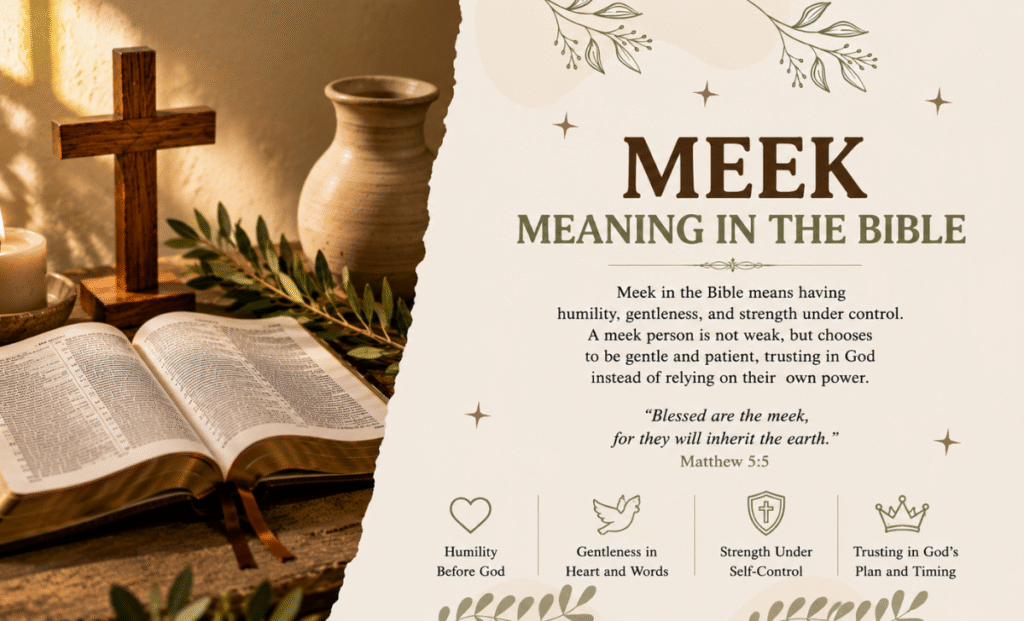
Let’s learn about meek meaning in the bible. Most people hear the word “meek” and picture someone timid, spineless, or easily pushed around. But if that’s what you’ve always assumed, the Bible is about to surprise you. Biblical meekness is one of the most misunderstood virtues in all of Scripture and understanding its true meaning can completely transform how you live your faith.
In this article, we’ll explore the real definition of meekness in the Bible, trace it through Hebrew and Greek roots, look at powerful examples, and discover why Jesus said the meek will inherit the earth.
Definition of Meekness in the Bible KJV
In the King James Version (KJV), the word “meek” appears as a translation of the Hebrew word anav (עָנָו) in the Old Testament. The KJV Dictionary defines it this way:
Meek (adjective): Mild of temper; soft; gentle; not easily provoked or irritated; yielding; given to forbearance under injuries.
In its deeper, evangelical sense, the KJV defines meekness as humility and submission to the divine will not proud, not self-sufficient, not quick to complain against God’s dealings. This is the spirit behind Matthew 5:5: “Blessed are the meek, for they shall inherit the earth.”
Importantly, the KJV also notes: “Meekness is a grace which Jesus alone inculcated, and which no ancient philosopher seems to have understood or recommended.” This is a striking statement meekness as a virtue is distinctly Christian.
Genesis Meaning in the Bible: A Simple Guide (2026)
Meek Definition Greek (New Testament Meaning)
The New Testament Greek word for meek is praus (πραΰς) — Strong’s G4239. It appears four times in the New Testament and carries rich meaning that our modern English word “meek” fails to capture.
| Greek Term | Pronunciation | Part of Speech | KJV Translation |
|---|---|---|---|
| praus (πραΰς) | prah-oos | Adjective | Meek |
| prautes (πραΰτης) | prah-oo-tace | Noun | Meekness |
In classical Greek, praus described a domesticated or trained animal particularly a horse that had been broken and brought under control. The animal retained all of its strength and power, but that power was now disciplined and directed by its master.
That image is everything. Meekness is not the absence of strength — it is strength under control. A meek person has the capacity to retaliate, to force their way, to defend themselves with full force. But they choose restraint, patience, and submission to God’s authority instead.
Aristotle described praotes (the noun form) as the calm midpoint between uncontrolled rage and passive indifference — a temper that is neither hot nor cold, but steady. This quality was admired among leaders and respected men in the ancient world.
In the New Testament, praus is the same word Jesus uses when He says: “Learn from me, for I am gentle (praus) and humble in heart” (Matthew 11:29). It is also listed as a fruit of the Holy Spirit (Galatians 5:23) and commanded in Colossians 3:12, Ephesians 4:2, and Titus 3:2.
Meaning of Meekness in Daily Life
Biblical meekness looks different from what culture rewards. The world celebrates assertiveness, self-promotion, and getting what you deserve. Meekness says: trust God enough to let go of control.
Here’s how meekness compares to what people often confuse it with:
| Quality | Weakness | Meekness |
|---|---|---|
| Source | Lack of ability | Controlled strength |
| Response to conflict | Avoids out of fear | Faces with patience and grace |
| Foundation | Insecurity | Security in God |
| Power | Has none | Has it but yields it |
| Goal | Self-protection | God’s glory |
In daily life, a meek meaning in the bible person does not need to win every argument, demand recognition, or retaliate when wronged. They respond to hardship with a quiet steadiness because they trust that God is their defender. As Psalm 37:11 promises, “the meek shall inherit the earth and delight themselves in the abundance of peace.”
Blessed Are the Meek Meaning in the Bible
Matthew 5:5 — “Blessed are the meek, for they shall inherit the earth” — is the third Beatitude from Jesus’ Sermon on the Mount. It is rooted directly in Psalm 37:11 and carries both present and future dimensions.
Present: The meek person experiences rest, peace, and freedom from the anxiety of self-defense. They roll their burdens onto the Lord (Psalm 37:5) and wait quietly for Him, not fretting over those who prosper through wickedness.
Future: The promise of inheriting the earth is an eschatological guarantee — a reversal of the world’s order. In a culture that honored power and force, Jesus declared that the truly powerful are those whose strength is surrendered to God.
This was counter-cultural then and remains so today. The world says fight for your place. Jesus says the meek will be given theirs.
What Does 333 Mean in the Bible? (Hidden Truth)
Examples of Meekness in the Bible
Moses
Numbers 12:3 records one of the most direct statements in Scripture: “Now Moses was a very humble (meek) man, more humble than anyone else on the face of the earth.” This is remarkable given that Moses had already led Israel out of Egypt, confronted Pharaoh, and parted the Red Sea. He was not timid — he was a man of extraordinary courage and authority. Yet his meekness lay in his complete reliance on God’s power rather than his own. When his siblings challenged his leadership, Moses did not retaliate. He trusted God to vindicate him — and God did.
Jesus Christ
Jesus is the supreme model of biblical meekness. He described Himself as “gentle (praus) and humble in heart” (Matthew 11:29). Though He held the power to call down legions of angels, He submitted to false accusations, physical torture, and crucifixion without retaliation. In Matthew 21:5, His triumphal entry into Jerusalem — riding on a donkey — was prophesied in Zechariah 9:9 as the arrival of a king who is “lowly, riding on a donkey.” That is not weakness; it is perfect power in perfect submission to the Father’s plan.
David
David was a warrior king, a giant-slayer, a man after God’s own heart — and a man of remarkable meekness. When Shimei cursed and threw stones at him during his flight from Absalom, David refused to allow his men to execute the man (2 Samuel 16:10–12). He said: “Perhaps the Lord will look on my misery and repay me with good for the cursing I am receiving today.” That is meekness — power choosing grace over revenge, trusting God with the outcome.
Benefits of Meekness in the Bible
Scripture attaches powerful promises specifically to those who walk in meekness:
- Inheritance of the earth — Matthew 5:5
- Fresh joy in the Lord — Isaiah 29:19: “The meek shall obtain fresh joy in the Lord”
- God’s personal guidance — Psalm 25:9: “He guides the meek in what is right”
- God’s sustaining care — Psalm 147:6: “The Lord lifts up the humble (meek)”
- Vindication — Psalm 76:9: God rises to save all the meek of the earth
- Spiritual nourishment — Psalm 22:26: “The meek shall eat and be satisfied”
- The fruit of the Spirit — Galatians 5:23 lists meekness (gentleness) as evidence of a Spirit-filled life
These are not vague spiritual rewards — they are specific, concrete, and repeated throughout both Testaments.
Spiritual Symbolism of Meekness
In Scripture, meekness is often symbolized through images of yielding:
- The yoke — Jesus uses the image of a yoke in Matthew 11:28–30. A yoked animal is powerful but directed. To take Christ’s yoke is to place your strength under His guidance.
- The lamb — Isaiah 53:7 describes the suffering Messiah as a lamb led silently to slaughter — the ultimate picture of meekness in obedience to God’s sovereign plan.
- The donkey — Christ’s entry into Jerusalem on a young donkey (Matthew 21) is a symbol of humble kingship, contrasted with warhorses ridden by conquering emperors.
Each of these images holds the same truth: meekness is not passive. It is purposeful submission — strength that knows where it comes from and trusts where it is going.
Meekness in Dreams or Spiritual Reflection
In spiritual reflection and dream interpretation traditions, meekness often surfaces as a symbol of inner transformation and surrendered control. Dreams or visions involving a tamed animal (especially a horse), a gentle touch in conflict, or choosing silence when you had the power to speak have been interpreted by many spiritual commentators as a call to cultivate the meek spirit described in Scripture.
If meekness has been on your heart or appearing in your devotional life, it may be an invitation to examine where you are relying on self-effort rather than trusting God’s defense. True meekness, as Desiring God theologian John Piper notes, begins with trusting that God is for you — and that trust changes everything.
How to Grow in Meekness
Meekness is not a personality type — it is a fruit of the Spirit (Galatians 5:23), which means it grows through relationship with God, not through willpower alone. Here are practical, Scripture-grounded ways to cultivate it:
- Root your identity in God, not outcomes. Meekness flows from security. When you know God is your defender, you don’t need to fight every battle yourself.
- Practice slow anger. Proverbs 16:32 says: “He who is slow to anger is better than the mighty, and he who rules his spirit than he who captures a city.”
- Submit to God’s Word, even when it’s uncomfortable. Meekness toward God means accepting His dealings without complaint or resistance.
- Serve without recognition. True meekness doesn’t demand credit. Choose acts of service that no one will applaud.
- Respond to criticism with openness. James 3:17 says wisdom from above is “open to reason” — a hallmark of the meek and wise.
- Pray specifically. Ask God to reveal where pride is masquerading as strength in your life.
Conclusion
The world has gotten meekness wrong for centuries. It is not timidity, passivity, weakness, or a lack of backbone. Biblical meekness is controlled strength — power submitted to God, wielded for others, and rooted in deep trust that He is in charge.
Moses led a nation. David slew giants. Jesus raised the dead. And all three are described in Scripture as meek. That alone should reframe everything.
If you want to grow in meekness, start where every biblical example starts: surrender your need to defend yourself, and let God be God. The earth, after all, belongs to those who do.
Meaning of Worship in the Bible (Simple & Powerful) 2026
FAQs
What does “meek” mean in simple terms in the Bible?
In the Bible, meek means having controlled strength — being gentle, patient, and humble, not because you’re weak, but because you choose to trust God over self.
Is meekness the same as weakness?
No. Weakness is the absence of power; meekness is power under discipline. A meek person can fight back but chooses not to, trusting God to vindicate them.
What is the Greek word for meek in the New Testament?
The Greek word is praus (πραΰς), Strong’s G4239, meaning mild and humble — often used to describe a trained horse whose strength is now under the master’s control.
Why did Jesus say “Blessed are the meek”?
Jesus declared the meek blessed because their trust in God — rather than in their own power — positions them to receive God’s promises, including inheriting the earth (Matthew 5:5).
Who is the best example of meekness in the Bible?
Jesus Christ is the greatest example (Matthew 11:29), followed closely by Moses (Numbers 12:3) and David (2 Samuel 16:10–12). Each had great power but chose humble submission to God.
Is meekness a fruit of the Spirit?
Yes. Galatians 5:23 lists meekness (gentleness) as one of the nine fruits of the Holy Spirit, meaning it develops naturally in the life of a Spirit-filled believer.
How do I become more meek as a Christian?
Grow in meekness by trusting God as your defender, practicing slow anger, serving others without recognition, and regularly submitting your plans and pride to His Word and will.
What does “the meek shall inherit the earth” mean?
It means those who humbly trust God — rather than seizing life by force — will ultimately receive everything God has promised. It is a reversal of the world’s power structure, fulfilled both spiritually now and completely in the age to come.

Hi! I’m Jenson, the writer behind punslush.com. I craft clever puns and witty wordplay designed to entertain and inspire. Visit punslush.com for a good dose of humor and fun!