
fyi meaning in text stands for “For Your Information,” a simple text abbreviation people use to share a fact, update, or heads-up without expecting a reply. It’s one of the most common pieces of internet slang still in everyday use, showing up in texts, emails, and Slack messages alike.
Three little letters, and somehow they’ve outlasted almost every other piece of texting slang out there. That staying power isn’t an accident.
FYI works because it does one job cleanly: it flags information as worth knowing, nothing more. Depending on tone and context, it can feel friendly, neutral, or even a little sharp, which makes knowing how to use it correctly genuinely useful.
What Does FYI Mean?
FYI stands for “For Your Information.” It’s a text abbreviation used to introduce a piece of information the sender thinks you should know, but that doesn’t require a response or immediate action.
Here’s the simplest way to think about it: FYI is a flag. It tells the reader, “Here’s something worth knowing,” without demanding anything back. That’s the whole FYI definition in a nutshell.
A quick example:
“FYI, the meeting got moved to 3 PM.”
No question, no request. Just information, passed along.
You’ll find FYI in texts, emails, Slack messages, social media captions, and even spoken conversation. It’s one of the most common pieces of internet slang still standing today, and unlike a lot of trendy acronyms, it hasn’t faded out. If anything, it’s become more useful as our communication has shifted to shorter, faster formats.
Quick facts about FYI:
| Detail | Information |
|---|---|
| Full form | For Your Information |
| Type | Messaging acronym / text abbreviation |
| Tone | Neutral to informal (context-dependent) |
| Common in | Texting, email, Slack, social media |
| Requires a reply? | Usually no |
| Origin | Business memo language, pre-dates modern texting |
Where Did FYI Come From?
FYI didn’t start as internet slang. It actually predates SMS language, email, and even the personal computer.
The FYI abbreviation has roots in mid-20th-century office memos. Before instant messaging existed, businesses relied on internal paper memos to pass along updates between departments. Writing “For Your Information” at the top of a memo was a fast way to signal: this doesn’t need action, just awareness. Over time, that got shortened to FYI, and the habit stuck.
When email took over office communication in the 1990s, FYI came along with it. It became a standard subject-line and opening-line phrase in workplace communication, especially for forwarded messages and status updates. From there, it made the natural jump into texting and chat apps once mobile messaging exploded in the 2000s.
That’s part of why FYI feels different from a lot of texting acronyms like “LOL” or “BRB.” It didn’t start as slang, it started as a professional shorthand. It just happens to work everywhere now.
ALSO READ: ISO Meaning: Definition, Uses, and Popular Contexts Explained
How to Use FYI Correctly
Using FYI correctly comes down to three things: placement, punctuation, and purpose.
Placement: FYI almost always goes at the beginning of a sentence or message, though it can also stand alone before more context.
- “FYI, I’ll be running late.”
- “FYI: the store closes at 8, not 9.”
- “FYI — the invoice attached already includes tax.”
Punctuation: Most people follow FYI with a comma or a colon, though in casual texting, punctuation often gets dropped entirely.
- Formal: “FYI, the report is attached.”
- Casual: “fyi im running late”
Capitalization: In professional writing, FYI is typically capitalized. In texting, lowercase “fyi” is extremely common and doesn’t read as incorrect, just informal.
Purpose: FYI should introduce information, not a request. This is one of the most misunderstood parts of proper FYI usage — more on that mistake later.
A few quick rules to keep in mind when writing FYI:
- Use it to share, not to ask.
- Keep the information that follows short and clear.
- Match the punctuation style to your audience (formal email vs. casual text).
- Don’t stack it with other urgency markers unless it’s genuinely urgent.
Is FYI Formal or Informal?
This is where a lot of people get tripped up, because FYI actually works in both formal and informal settings. The tone shifts depending on where and how you use it.
In Casual Conversation
Between friends or family, FYI is relaxed. It often shows up lowercase, without punctuation, and folded into a casual sentence.
- “fyi dinner’s at 7”
- “FYI I’m not driving tonight lol”
Here, it’s just a quick heads-up. Nobody’s reading formality into it.
In Professional/Work Settings
In professional email and office emails, FYI is a staple of business writing. It’s used to forward updates, loop in a colleague, or flag something without requiring action.
- “FYI, I’ve CC’d the vendor on this thread.”
- “FYI, the deadline moved to Friday per the client’s request.”
In this context, FYI is efficient and expected. It’s part of standard team communication, especially in email chains and Slack messages where quick context matters more than full sentences.
The bottom line: FYI isn’t strictly formal or informal. It adapts to the room it’s in, which is part of why it’s lasted so long.
FYI in Different Contexts
FYI shows up almost everywhere digital conversation happens, but it behaves a little differently depending on the platform.
In Texting and Chat Apps
In FYI meaning in texting, the abbreviation is often shortened even further in tone, if not in letters. Texts tend to drop punctuation and formality altogether.
Examples:
“fyi the wifi password changed, it’s on the fridge”
“FYI I might be 10 mins late, traffic is bad”
Texting is where FYI feels most like texting shorthand — quick, low-effort, and purely functional.
In Email
FYI in email tends to be more structured. It often appears at the start of a forwarded message or as a lead-in to an attached document.
Example 1:
Subject: FYI – Updated Contract Terms “Hi team, FYI, the client requested a few changes to section 4. Updated file attached.”
Example 2:
“FYI, I’m forwarding this from the finance department. No action needed on your end, just wanted you looped in.”
This is email etiquette at its most practical: FYI signals “read this when you can,” not “respond right now.”
In Social Media Captions/Comments
FYI on social media and in comments tends to be blunt, sometimes even a little sassy. It’s part of everyday social media slang.
Examples:
“FYI this recipe takes way longer than the video makes it look 😅”
“fyi I did NOT approve this photo of me lol”
On social platforms, FYI often adds a conversational, slightly cheeky tone rather than a purely neutral one.
Does FYI Sound Rude?
Short answer: it depends entirely on context, punctuation, and what follows it. FYI itself is neutral. The tone around it does all the work.
Friendly Tone
“FYI, I grabbed you a coffee too! It’s on the counter.”
Warm, helpful, no edge to it at all.
Neutral Tone
“FYI, the report is due Thursday, not Wednesday.”
Just a fact. No emotional weight either way.
Passive-Aggressive Tone
“FYI, I already told you this yesterday.”
Same three letters, completely different feeling. Add a curt follow-up, drop the pleasantries, or use it as a “gotcha,” and FYI starts to sound like a jab instead of a heads-up.
As one communication coach put it during a workplace training session: “It’s never the acronym that’s rude. It’s the sentence riding along with it.”
That’s really the key insight here. Passive aggressive FYI messages usually have a sharp or clipped sentence attached, often pointing out something the other person “should have known.” Strip that away, and FYI is as neutral as it gets.
When to Use FYI (and When Not To)
Knowing when FYI fits, and when it doesn’t, is the real skill here.
Situations Where It Works
- Sharing a schedule change: “FYI, the call moved to 2 PM.”
- Passing along a useful detail: “FYI, parking is free after 6.”
- Looping someone in on an email: “FYI, adding Sarah to this thread.”
- Giving a heads-up with no urgency: “FYI, I’ll be out of office Friday.”
In all these cases, FYI works because it’s genuinely informational and doesn’t need a reply.
Situations Where It Backfires
- Asking a question: “FYI, are you coming tonight?” — this isn’t information, it’s a question. FYI doesn’t belong here at all.
- Delivering bad or emotional news: “FYI, we’re not moving forward with your application.” — this needs empathy, not shorthand.
- Sensitive personal topics: Using FYI to bring up something emotionally loaded can feel cold or dismissive.
- Overly frequent use: Starting every other message with FYI makes it lose meaning and can come across as robotic.
A simple test: if what follows FYI is a fact someone needs, it works. If it’s a feeling, a question, or a request, skip it.
FYI vs. BTW vs. ASAP
These three get mixed up constantly, but they serve completely different purposes. Here’s an abbreviation comparison to clear it up.
| Term | Full Meaning | Purpose | Tone | Example |
|---|---|---|---|---|
| FYI | For Your Information | Shares info, no action needed | Neutral | “FYI, the store’s closed today.” |
| BTW | By The Way | Adds a side note or shifts topic | Casual | “BTW, did you get my last text?” |
| ASAP | As Soon As Possible | Signals urgency, requests fast action | Urgent | “Need this ASAP, please.” |
FYI = For Your Information
Used to share something the recipient should know. No urgency, no request.
BTW = By The Way
Used to introduce a side comment or shift the subject slightly. It’s more conversational than FYI and often used mid-conversation rather than as an opener.
“BTW, I loved that restaurant you recommended.”
Main Difference
FYI shares a fact. BTW shifts topics or adds a casual aside. Neither one demands a response, but they serve different conversational jobs — FYI informs, BTW redirects.
FYI vs. ASAP
This comparison is more about tone than function.
- FYI = calm, informational, no urgency.
- ASAP = urgent, action-required, time-sensitive.
Using them together, like “FYI, need this ASAP,” actually creates a slight contradiction, since FYI signals no urgency while ASAP signals high urgency. It works in real speech because people use FYI here loosely to mean “just so you know,” but it’s worth understanding they don’t naturally pair.
Similar Abbreviations Worth Knowing
FYI isn’t alone. Here are a few other common texting acronyms and chat terms you’ll run into constantly:
- TBH – To Be Honest. Used to introduce a candid opinion.
- IMO – In My Opinion. Signals a personal take, not a fact.
- NVM – Never Mind. Cancels or dismisses a previous point.
- JFYI – Just For Your Information. A slightly more emphatic version of FYI.
- BRB – Be Right Back. Signals a short pause in conversation.
Knowing these similar texting abbreviations helps you read tone faster and respond appropriately, since each one carries its own implied expectation (or lack of one).
Do You Need to Reply to an FYI Message?
In most cases, no. FYI is designed specifically so the recipient doesn’t feel obligated to respond. It’s information, not a conversation starter.
That said, a few exceptions apply:
- If the FYI includes a deadline or action item buried inside it, a short acknowledgment (“Got it, thanks!”) is polite.
- In professional settings, replying “Noted” or “Thanks for the heads-up” shows you actually read it.
- If the FYI affects plans you’ve already made, a reply helps avoid confusion.
Outside of those cases, silence is a totally acceptable response to an FYI. That’s the point of using it.
How Businesses and Teams Use FYI
How businesses use FYI says a lot about why it’s stuck around in professional spaces. In fast-moving workplace shorthand, FYI keeps communication efficient without sacrificing clarity.
Common business uses include:
- CC’ing a colleague on an email thread just to keep them informed, with “FYI” in the subject line or opening line.
- Slack updates where a manager shares a policy change without opening it up for debate.
- Status updates in project management tools, flagging progress without requiring a response.
- Meeting notes distributed with “FYI” to signal read-only information versus action items.
Consider a typical case: a marketing team using Slack to coordinate a product launch. A team communication channel might get a message like:
“FYI, legal approved the campaign copy, no changes needed. Moving to design next.”
That single line tells the whole team status without triggering ten replies asking “wait, what happened with legal?” It’s business acronyms doing exactly what they’re meant to do: compress information into something scannable.
This is also why FYI plays so well in professional collaboration tools. When teams are juggling dozens of messages a day, a clear FYI tag helps people mentally sort “read now” from “read when you get a chance.”
Common Mistakes People Make With FYI
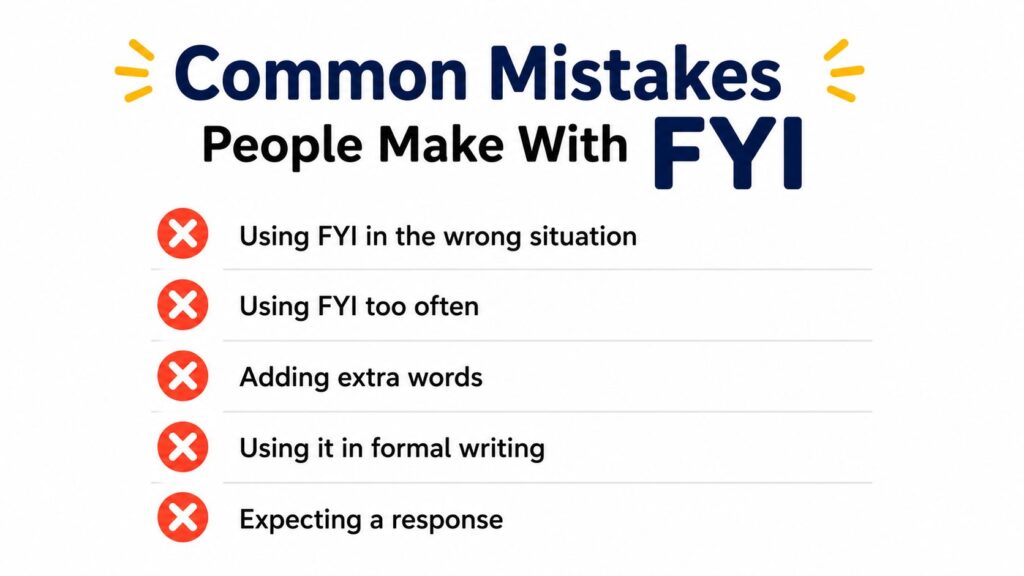
Even though FYI feels simple, it’s easy to misuse. Here are the most frequent communication errors people make with it.
Using It for Questions
FYI is for statements, not questions. “FYI, are you free tonight?” doesn’t make sense, because FYI implies you’re the one sharing info, not asking for it. Fix: drop FYI entirely and just ask the question directly.
Overusing It
Starting every single message with FYI drains it of meaning fast. If everything is “FYI,” nothing stands out as genuinely worth flagging. Use it selectively, for things that actually need pointing out.
ALSO READ: WYLL Meaning in Text: 10 Smartest Ways to Reply in 2026
Using It in Sensitive or Emotional Conversations
FYI is blunt by design. That bluntness works great for logistics, but it falls flat, or worse, comes across as cold, when delivering news that involves feelings, conflict, or big life changes. Save the softer language for those moments instead.
Here’s a quick reference table of email mistakes and texting etiquette slip-ups related to FYI:
| Mistake | Why It’s a Problem | Better Approach |
|---|---|---|
| Using FYI for a question | Confuses the reader, no info is actually shared | Ask the question directly |
| Overusing FYI | Loses impact, feels repetitive | Reserve it for genuinely new info |
| Using FYI for bad news | Feels cold or dismissive | Use softer, more personal language |
| Skipping context after FYI | Leaves the reader guessing | Always follow with a clear, specific detail |
FYI: Quick Recap
- FYI means “For Your Information” — a way to share something without requiring a response.
- It works in texting, email, Slack, and social media, adjusting tone based on the platform.
- FYI itself isn’t rude, but the sentence attached to it can shift the tone friendly, neutral, or sharp.
- It’s best used for facts, updates, and logistics, not questions or emotional topics.
- FYI vs. BTW: FYI shares info, BTW adds a side comment.
- FYI vs. ASAP: FYI is calm, ASAP is urgent, and pairing them creates mixed signals.
- In business settings, FYI keeps workplace communication efficient and clear.
At the end of the day, FYI has stuck around for decades because it does one job really well: passing along information without adding pressure. Use it thoughtfully, keep it specific, and it’ll keep working exactly the way it’s supposed to.
FAQs
Is FYI capitalized in texting?
Not necessarily. Lowercase “fyi” is common and accepted in casual texting, while capitalized “FYI” is standard in formal emails and business writing.
Can FYI be used to start a question?
No, FYI is meant to introduce information, not a question. If you’re asking something, drop the FYI and just ask directly.
Is FYI considered rude?
FYI itself is neutral. Rudeness usually comes from the tone of the sentence that follows it, not the abbreviation.
What’s the difference between FYI and BTW?
FYI shares a piece of information, while BTW (By The Way) introduces a side comment or shifts the topic slightly.
Do you need to reply to an FYI message?
Usually not. FYI is designed to inform without requiring a response, unless it includes a deadline or action item.
conclusion
Quick heads-up: “Apna Keyword Likhy” translates to “write your own keyword” — it looks like a placeholder that got left in instead of your actual target keyword. I’ve written the conclusion using FYI meaning in text (the keyword you’ve used throughout the article) so it stays consistent. Let me know if you meant a different keyword and I’ll swap it in.
FYI is small, but it does a big job in everyday communication. Understanding the FYI meaning in text helps you share updates clearly, without sounding pushy or demanding a reply. It works in texts, emails, and even social media posts.
Once you know the FYI meaning in text, using it feels natural. Keep it simple, use it for facts, and skip it for questions or emotional topics. That’s really all it takes to get it right every time.