
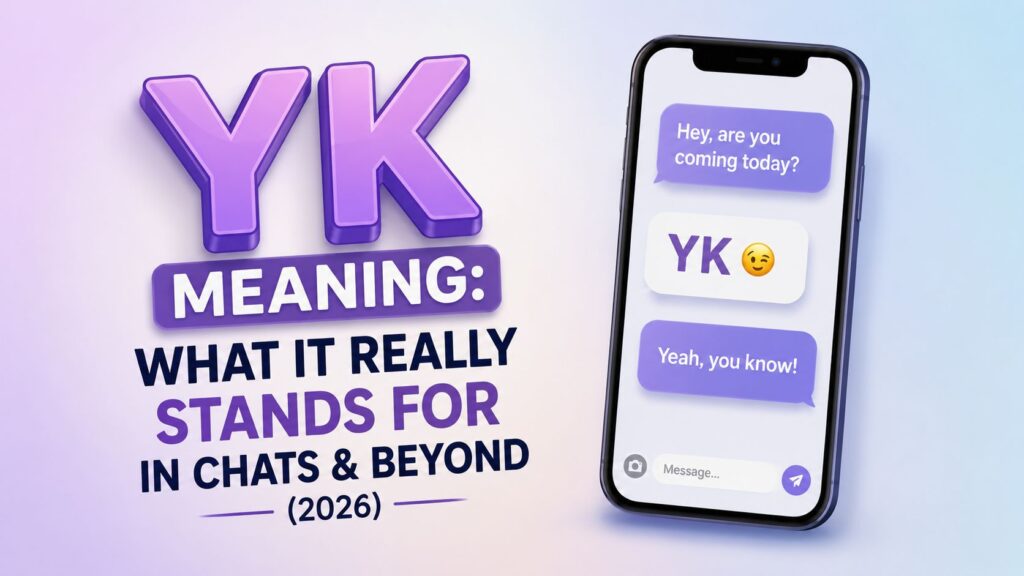
YK meaning is simple: it stands for “you know.” People drop it into texts, captions, and comments to soften a statement or add a casual tone. It works like a quiet nudge, telling the reader they already get the point.
Here’s the fun part. This tiny two-letter word carries more personality than most people realize. It shows up in flirty dating app messages, gaming chats, and viral TikTok captions alike, and it somehow fits every mood without changing shape.
Once you understand YK meaning, you’ll spot it everywhere, and you’ll start noticing how much it shapes tone in everyday conversation. It’s flexible, it’s low-key, and it’s become one of texting culture’s quiet staples.
Key Takeaways
- YK abbreviation almost always means “you know,” not “you’re kidding” (that’s a much rarer, context-dependent read).
- Placement matters. YK at the end of a sentence reads as a conversational cue; YK mid-sentence often works as a discourse marker, similar to how people use “like” in everyday speech.
- YK slang shows up everywhere: Instagram, TikTok, Snapchat, Discord, WhatsApp, and X (Twitter) all use it the same basic way, with small platform-specific twists.
- On dating apps like Tinder, Bumble, and Hinge, YK often signals a relaxed, low-pressure tone, but it can also come off as vague or evasive.
- Skip YK in formal writing, professional emails, and business communication. It reads as too casual for office messaging or client messages.
- YK isn’t going anywhere in 2026. Short, flexible fillers like this tend to outlast flashier slang because they map onto a natural language habit people already had before texting existed.
YK Meaning & Definition
The Core Meaning — “You Know”
At its root, YK meaning is simple: it’s the phrase “you know,” trimmed down to two letters for speed. Someone types it when they want to check in on listener awareness, confirm mutual agreement, or just soften a statement.
Think about how often people say “you know” out loud without meaning anything literal by it. A friend might text, “he’s always late yk,” and they’re not asking whether you have information about his lateness. They’re just tacking on a verbal habit that says, we’re on the same page here. That’s the heart of what YK stands for.
Linguists actually have a name for this kind of phrase: a conversational cue that carries social weight without carrying much literal content. It doesn’t add new facts to a sentence. Instead, it manages the relationship between speaker and listener, quietly checking that both people are tracking the same idea. That’s why YK shows up so often in emotional or opinion-based texts, and much less often in messages that are purely about scheduling or logistics. When someone is sharing a feeling, they instinctively reach for phrases that build rapport; when they’re just confirming a meeting time, there’s no emotional weight to soften, so the filler rarely appears.
It also helps to compare YK against a phrase that carries zero ambiguity, like “FYI.” FYI always means the same thing regardless of where you put it. YK doesn’t work that way. Its meaning bends around tone, punctuation, and relationship context, which makes it a more flexible tool but also a slightly trickier one to define with total precision.
ALSO READ: Sigma Meaning Slang: What It Really Means in Modern Conversations (2026)
How Tone and Punctuation Change the Meaning
Punctuation does a lot of heavy lifting with this chat abbreviation. Add a question mark, and YK becomes an actual question. Drop it at the end of a sentence with no punctuation, and it reads more like a shrug.
YK as a Statement vs. YK as a Question
- As a statement: “I just wasn’t feeling it yk” — here, YK works like a period with extra warmth. The sender isn’t asking anything; they’re inviting agreement.
- As a question: “you get what I’m saying, yk?” — this version genuinely checks whether the other person follows. It’s closer to “does that make sense?”
The difference sounds small in writing, but in a real dating conversation or a group chat, it changes how you’re expected to respond. One version wants a reaction. The other doesn’t need one at all.
Mid-Sentence YK vs. End-of-Sentence YK
Where YK lands in a sentence changes its job entirely.
| Position | Function | Example |
|---|---|---|
| Start of sentence | Softens what’s coming | “yk, I actually liked that movie” |
| Mid-sentence | Discourse marker, buys thinking time | “it’s just, yk, complicated right now” |
| End of sentence | Filler, invites agreement | “she never texts back yk” |
Mid-sentence YK behaves a lot like “like” or “I mean” in spoken conversation. It’s not adding information. It’s giving the speaker a half-second to organize their next thought while keeping the message flowing naturally.
There’s a reason this pattern feels so familiar even to people who’ve never thought about it consciously. Spoken conversation is full of small pauses, hedges, and connector words that hold sentences together while the speaker figures out what to say next. Texting strips out tone of voice, facial expression, and timing, so writers instinctively reach for little markers like YK to recreate some of that missing texture. It’s less about saving keystrokes and more about making a flat block of text feel like an actual voice.
Where YK Came From
The Roots of “You Know” in Spoken English
Long before texting existed, “you know” was already a fixture of casual spoken English. Linguists classify it as a discourse marker — a small phrase that doesn’t change the literal meaning of a sentence but manages the flow of conversation.
Sarah Blake, a linguist who studies conversational speech patterns, once described it this way: “Fillers like ‘you know’ aren’t sloppy language. They’re social glue. They tell the listener the speaker assumes some common ground already exists between them.”
That framing matters here. YK isn’t some meaningless internet invention. It’s a digital shortcut for a habit that’s been baked into casual English for decades. Texting didn’t create the phrase; it just compressed it.
Researchers who study discourse markers have found that phrases like “you know” appear in spoken English across nearly every English-speaking region, though frequency varies by dialect and social setting. Some studies estimate that fillers of this type show up multiple times per minute in relaxed, unscripted conversation. That’s a striking number, and it explains why the written version caught on so fast once texting became a primary way people communicated. The verbal habit was already universal; the internet just gave it a keyboard shortcut.
It’s also worth noting that “you know” existed as a full phrase in casual writing long before smartphones. Personal letters, diary entries, and even transcribed interviews from decades past show the same pattern: a speaker inserting “you know” to soften an opinion or check for agreement. YK didn’t invent this behavior. It simply gave an old habit a two-letter costume suited for a faster, more compressed medium.
From SMS Character Limits to Modern Shorthand
Early text messages had strict character limits, and every letter cost something in terms of time and effort. That constraint pushed people toward abbreviations: LOL, BRB, TTYL, and eventually YK.
Even after character limits disappeared with smartphones, the habit stuck. Online shorthand had already become part of how people communicated, so shrinking “you know” down to YK kept happening simply because it felt faster and more natural than typing it out.
How YK Spread Through Social Platforms
As social platforms grew, online platforms built entire cultures around fast, informal typing. Twitter’s original 140-character limit pushed abbreviations hard. TikTok comment sections rewarded quick, punchy replies. Discord servers, built for real-time chat during gaming sessions, normalized shorthand even further.
YK rode that wave alongside other internet slang terms. It didn’t need a viral moment or a meme to spread; it just slotted into existing texting habits because it mirrored something people already said out loud.
That’s actually a meaningful distinction if you compare YK to slang that did need a viral spark. Terms tied to a specific show, song, or meme tend to spike fast and fade just as quickly once the cultural moment passes. YK never had that kind of launch, and that’s exactly why it never had that kind of expiration date either. It spread quietly, one conversation at a time, across online platforms that had nothing in common except a shared need for fast, low-effort typing.
How YK Is Used in Real Conversations
Casual Texting Between Friends
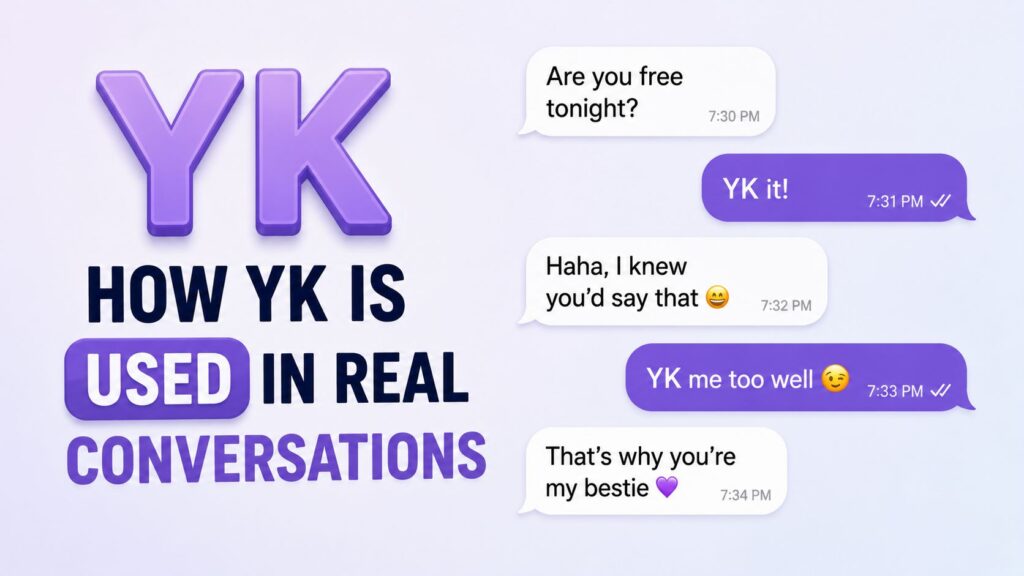
This is where YK shows up the most. In text messaging between friends, it works as connective tissue between thoughts, adding warmth without adding length.
ALSO READ: What Does HMU Mean? Simple Guide with Examples
Example exchange:
Friend 1: ugh work was rough today Friend 2: yk how it is on mondays Friend 1: fr, I just wanna sleep
Notice how “yk how it is on mondays” doesn’t ask for confirmation. It’s a shared shrug, a way of saying we both get it without spelling anything out.
Social Media Captions & Comments
On social media, YK often works differently than it does in private messages. Captions use it to sound relatable rather than to communicate anything specific.
Instagram caption example: “not the whole outfit falling apart 5 minutes in yk 😭”
TikTok comment example: “the way she said that with a straight face yk 💀”
Snapchat caption example: “just a random tuesday yk”
In each case, YK adds a conversational, almost self-deprecating tone. It signals that the poster isn’t taking themselves too seriously, which fits the throwaway, low-stakes nature of caption culture.
Gaming and Group Chats
Gaming communication moves fast, and multiplayer chat rewards short messages over long ones. Inside Discord servers and in-game messaging, YK often shows up as quick commentary during matches.
Example: “that ambush was actually clean yk”
Here, players don’t have time for full sentences mid-match. YK lets someone react and move on without breaking the pace of the game. It works the same way in group chats outside of gaming, where multiple people are typing at once and nobody wants to write a paragraph.
Workplace and Semi-Formal Chats (and Why to Avoid It There)
This is where things get tricky. In work chats, especially with people you’re not close with, YK can read as underprepared or overly casual.
Compare these two messages:
- ❌ “the deadline moved, yk, so we should be fine” (vague, assumes shared context that may not exist)
- ✅ “the deadline moved to Friday, which gives us more room” (clear, specific, no guesswork required)
The problem isn’t that YK is rude. It’s that business communication depends on precision, and YK relies on the listener already knowing something. In a workplace setting, you can’t always guarantee that shared knowledge exists, so the phrase can leave people confused instead of reassured.
Case study: A marketing coordinator once sent a client this message: “the campaign numbers are a bit off yk, we’ll adjust next week.” The client had no prior context for what “off” meant or why, and the vague phrasing led to a follow-up call just to clarify what should’ve been a two-line email. The fix was simple: naming the actual metric, explaining the cause, and stating the adjustment plan. That single change turned a confusing message into a clear one, and it’s a good illustration of why academic writing and corporate writing both avoid conversational shorthand. Precision protects everyone’s time.
Real Examples of YK in Context
Texting Examples
- “she said she’s coming but yk how that goes” (implies past unreliability without spelling it out)
- “not gonna lie, yk, I kinda expected that” (softens an opinion)
- “it’s giving main character energy yk?” (asks for agreement)
- “yk what, let’s just order pizza” (transitions into a new idea)
- “he’s sweet yk, just not my type” (balances a compliment with a boundary)
Comment Section Examples
- On a cooking video: “the way she added salt without measuring yk 😭”
- On a fashion post: “thrifted fits just hit different yk”
- On a sports clip: “that was a foul, yk, no cap”
Dating App Examples
- “not really looking for anything serious rn yk?”
- “you seem chill, yk, we should grab coffee sometime”
- “I don’t love small talk yk, so tell me something random about you”
YK on Dating Apps
What It Signals in a Dating Conversation
Inside online dating, YK often does double duty. It softens vulnerable statements, and it signals a laid-back personality at the same time.
Someone writing “not looking for anything too serious yk” isn’t just stating a preference. They’re framing that preference casually, almost apologetically, in a way that invites the other person to respond without pressure.
Example Openers and Replies
| Platform | Example Message | What It Signals |
|---|---|---|
| Tinder | “your dog is cuter than you, yk, no offense” | Playful teasing |
| Bumble | “I’m bad at these openers yk, help me out” | Self-aware humor |
| Hinge | “we clearly have the same music taste yk” | Building quick rapport |
When It Can Backfire
Here’s where things get honest: overusing YK on a dating app can make someone sound noncommittal or hard to pin down. If every message ends in YK, it starts to feel like the sender is avoiding directness.
A match who writes “maybe we could hang out sometime yk” three times in a row without ever suggesting a real plan is using the phrase as a hedge, not a connector. That pattern reads as low effort, and it can quietly kill momentum in a conversation that was otherwise going somewhere.
Case study: A user on a popular dating app matched with someone who peppered nearly every message with YK, from “I’m pretty chill yk” to “not really a texter yk” to “we should hang sometime yk.” After four days of messages that never landed on an actual plan, the other person lost interest and stopped replying. The pattern wasn’t the phrase itself; it was the lack of anything concrete underneath it. YK works best in a dating conversation when it’s paired with a real detail or a real invitation, not used as a stand-in for one.
Does YK Ever Mean Anything Else?
“You’re Kidding” — Rare, Context-Dependent Use
Occasionally, especially in fast-paced group chats, YK pops up as shorthand for “you’re kidding.” It’s rare, and it only really works when the surrounding message clearly frames a reaction of disbelief.
Example: “wait, YK?? he actually said that to your face?”
Without that surrounding context, most readers will default to the “you know” reading, since it’s overwhelmingly the more common phrase interpretation.
YK vs. YKK — Why People Confuse Them
YKK isn’t slang at all — it’s the name printed on most zippers you own. YKK Group is a Japanese manufacturing company, founded in 1934, and it produces the majority of zippers used in clothing worldwide. People occasionally search for “YK meaning” after spotting “YKK” stamped on a zipper pull and assuming it’s related to texting slang. It isn’t. Different letters, different origin, completely unrelated meaning.
YK Abbreviation Outside Slang
A few other uses of “YK” exist outside of texting culture, and they’re worth knowing so you don’t mix them up:
- YK is the airport code for several Canadian regional airports.
- Yk appears in some academic shorthand as an abbreviation for “Yorkshire” in British regional writing.
- In finance, ticker-style abbreviations occasionally use “YK” for smaller, less-tracked entities, though this varies by exchange and isn’t standardized.
None of these carry over into chat abbreviation culture. If you see “yk” in a text or comment, “you know” is almost always the answer.
The lesson here applies to a lot of internet slang, not just YK: two-letter and three-letter abbreviations get recycled constantly across unrelated fields, from aviation to fashion to finance. Context always settles the ambiguity. A zipper pull, an airport departure board, and a group chat message are never going to confuse a reader for long once they notice where the letters actually showed up.
Common Mistakes & Misconceptions
Assuming YK Always Means “You’re Kidding”
This is the single biggest misread. Someone unfamiliar with texting slang sees “YK” in all caps mid-argument and assumes disbelief, when the sender actually meant something closer to “you understand where I’m coming from.” Context is everything here, so it pays to read the full sentence before assuming the least common meaning.
Confusing YK with YKW, YKWIM, or IKYK
These four abbreviations look similar and get mixed up constantly:
- YK — “you know” (general filler or conversational cue)
- YKW — “you know what” (sets up a new statement, like “yk what, forget it”)
- YKWIM — “you know what I mean” (directly asks for agreement)
- IKYK — “if you know, you know” (references something exclusive to an in-group)
Using YK in Formal Writing or Professional Emails
Academic writing, corporate writing, and formal communication all demand clarity over shorthand. YK assumes the reader shares context they might not actually have, which makes it a poor fit anywhere precision matters more than tone.
Overusing YK Until It Loses Meaning
Like any familiar expression, YK loses its punch when it’s crammed into every sentence. A message that reads “yk it’s like, yk, kind of a whole thing yk” stops communicating anything and starts sounding like verbal static.
Treating YK as Interchangeable With Every Other Filler
Not every filler does the same job. “Like” often signals hesitation or approximation (“it was like, ten minutes”). “I mean” usually introduces a clarification or correction. YK, by contrast, leans specifically on implied understanding between two people. Swapping it in for a different filler can subtly change what a sentence is doing, even if the words feel interchangeable on the surface.
Forgetting That Regional and Age Differences Exist
Not everyone uses YK the same way. Some readers, especially those less immersed in messaging slang, may not recognize it at all and could misread it as a typo. It’s worth reading your audience before leaning on it heavily, particularly in messages going to someone outside your usual texting circle.
YK vs. Similar Slang Terms
| Term | Meaning | Best Used |
|---|---|---|
| YK | You know | Casual filler, softening statements |
| YKW | You know what | Setting up a new statement |
| YKWIM | You know what I mean | Directly seeking agreement |
| IKYK | If you know, you know | Referencing an inside understanding |
| NGL | Not gonna lie | Prefacing an honest admission |
How to Respond to YK
Casual, Low-Effort Replies
Most of the time, YK doesn’t need a deep response. A simple “fr” (for real), a laughing emoji, or a quick “same” covers it just fine. The phrase itself is low-stakes, so the reply can be too.
Matching the Tone
If a friend texts “he never texts back on time yk,” matching their energy with something like “literally, it’s exhausting” keeps the conversation flowing. Responding with a long, analytical paragraph would feel mismatched to the casual weight of the original message.
When a Real Reply Is Expected vs. When It’s Just Filler
Here’s a quick way to tell the difference:
- Filler YK: Ends a sentence, no question mark, states an opinion. Doesn’t need a detailed reply.
- Genuine YK: Includes a question mark, or follows “you know what I mean?” energy. Deserves at least a short confirmation.
Reading the punctuation and surrounding tone tells you almost everything you need to know about how much effort your reply actually requires.
A Quick Response Cheat Sheet
| YK Message Style | Example | Suggested Reply |
|---|---|---|
| Statement, no punctuation | “traffic was insane yk” | “ugh yeah, same” |
| Question with “?” | “you get it yk?” | “yeah totally” or a short explanation confirming you follow |
| Repeated in every message | Multiple texts, each ending in yk | Consider asking a direct question to move the conversation forward |
| Paired with an emoji | “not today yk 😭” | Match the emoji energy, keep it short |
Reading the room this way keeps conversations feeling natural instead of forced. Nobody wants a three-paragraph reply to a message that was never asking for one, and nobody wants to feel ignored when they were genuinely looking for listener agreement.
ALSO READ: Gyatt Meaning: What It Really Means, Where It Came From & How to Use It
Is YK Still Trending in 2026?
Why Simple Fillers Like YK Outlast Trendier Slang
Flashy slang terms burn out fast because they’re tied to specific memes, shows, or moments. YK doesn’t have that problem. It’s built on a natural language pattern that predates texting entirely, so it doesn’t depend on staying culturally relevant to keep making sense.
That’s the real reason YK slang has stuck around this long. It’s not trying to be clever. It’s just doing the same job “you know” has always done in conversational English, compressed for speed.
Generational Use — Gen Z, Millennials, and Beyond
Younger users tend to use YK more often in captions and comments, treating it as part of a broader, relaxed writing style. Older millennials use it too, though usually in private text messaging rather than public posts. The underlying function stays consistent across age groups: it’s a shorthand for listener agreement, dressed differently depending on the platform and audience.
What’s Replacing or Complementing YK Right Now
Newer fillers like “ts” (this/that) and “no cap” have picked up steam alongside YK rather than replacing it outright. Most casual texters mix several of these together in the same conversation, using YK for softening statements while reaching for other slang to add emphasis or humor. Rather than one term knocking out another, messaging slang tends to layer over time, with each new term filling a slightly different gap.
FAQs
What does YK mean in texting right now?
It still means “you know.” The meaning hasn’t shifted; it’s just used more often in 2026 across TikTok captions and Discord chats.
Is YK still trending in 2026?
Yes. It functions as a conversational filler or emphasis tool similar to “like” or “um,” and its staying power comes from mirroring natural spoken conversation rather than depending on a passing trend.
Which platforms use YK the most in 2026?
It shows up heaviest in TikTok comments as a rapid-fire agreement, plus Snapchat, Instagram DMs, and WhatsApp chats.
Is YK safe or does it hide a secret meaning?
No hidden meaning. It’s considered wholesome slang with no coded or inappropriate meaning behind it — any concern should focus on surrounding context, not the term itself.
Do people write it as “YK” or “yk” now?
Lowercase “yk” is far more common than capitalized “YK,” especially in fast, casual typing.
conclusion
YK meaning comes down to one simple phrase: “you know.” It’s small, but it does a lot. People use it to sound casual. It softens statements. It shows they expect you to get it, too.
That’s the real value behind YK meaning. Use it with friends. Skip it at work. Read the tone around it, and you’ll never misread it again.

Hi! I’m Jenson, the writer behind punslush.com. I craft clever puns and witty wordplay designed to entertain and inspire. Visit punslush.com for a good dose of humor and fun!