
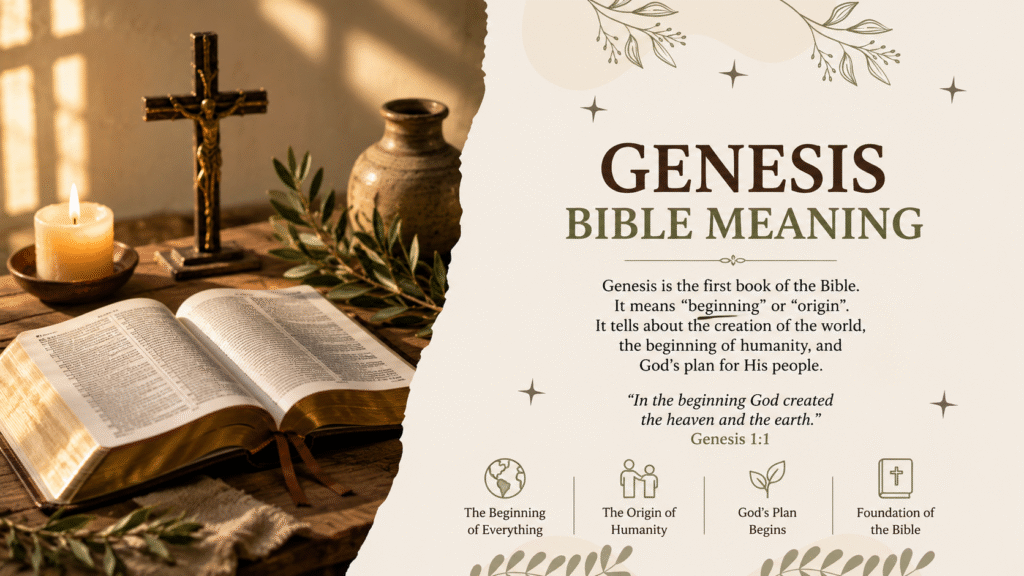
Have you ever stood at the edge of a new chapter in your life a new job, a new relationship, a new faith and wondered if God sees it too? genesis bible meaning That feeling of standing at the threshold of something new is exactly what the word Genesis captures. It is the first word, the first story, and the first promise of an entire Scripture.
Whether you are a lifelong Bible reader or just beginning to explore your faith, understanding the Genesis Bible meaning can offer surprising depth, comfort, and spiritual direction. This guide walks you through its origin, spiritual symbolism, real-life significance, and practical lessons all in plain, honest language.
Biblical Meaning of Genesis
What Does “Genesis” Actually Mean?
The word Genesis comes from the ancient Greek term γένεσις (génesis), which means “origin,” “birth,” or “beginning.” Early Greek translators of the Hebrew Bible working on what is known as the Septuagint chose this title because the book describes the birth of everything: the heavens, the earth, humanity, and God’s covenant relationship with His people.
In Hebrew, the book is called Bereshit (בְּרֵאשִׁית), which literally translates as “In the beginning” the very first words of Scripture.
Marvel Meaning in the Bible: Is God Showing You Something?
“In the beginning God created the heavens and the earth.” Genesis 1:1
This opening verse is not simply a scientific statement. It is a theological declaration: God existed before everything, and everything that exists flows from Him. The Hebrew word used here for “created” is bara, which means to create from nothing — ex nihilo. No raw materials. No pre-existing chaos. Pure divine will.
The Two Main Divisions of Genesis
| Section | Chapters | Focus |
|---|---|---|
| Primeval History | 1–11 | Creation, the Fall, Noah’s Flood, Tower of Babel |
| Patriarchal History | 12–50 | Abraham, Isaac, Jacob, and Joseph |
The first eleven chapters deal with universal themes how the world began, how sin entered creation, how God responded with both judgment and mercy. From chapter 12 onward, the lens narrows to one family: Abraham and his descendants, through whom God’s redemptive plan for all humanity unfolds.
Key Hebrew Terms to Know
- Elohim — The name for God used in Genesis 1, a plural form used as a singular, hinting at the richness of God’s nature
- Bara — Created from nothing (Genesis 1:1)
- Bereshit — “In the beginning,” the Hebrew title of the book
- Sheva (seven) — The number of completion; God rests on the seventh day, signaling wholeness in creation
Genesis Bible Meaning: Spiritual Significance and Symbolism
More Than History A Spiritual Mirror
Genesis is not just the opening chapter of an ancient text. It is a mirror that reflects the deepest questions of human life: Where did I come from? Why am I here? What went wrong, and can it be fixed?
Spiritually, Genesis teaches that:
- You are made in the image of God (Imago Dei) Genesis 1:27. This is the foundation of human dignity. It means you carry intrinsic worth, not because of what you do, but because of who made you.
- Creation is declared “good” Seven times in Genesis 1, God looks at what He made and calls it tov (good). This affirms that the material world is not something to escape but something God values.
- Every beginning carries divine purpose Just as God brought order from formlessness and light from darkness, He can do the same in any season of your life.
Symbolic Themes in Genesis
| Symbol | Spiritual Meaning |
|---|---|
| Light (Genesis 1:3) | God’s presence, clarity, and divine guidance |
| Water (Genesis 1:6–10) | Life, purification, and spiritual renewal |
| Garden of Eden (Genesis 2:8) | Peace, divine order, and intimate fellowship with God |
| The Covenant with Noah (Genesis 9) | God’s mercy, faithfulness, and promise of restoration |
| Abraham’s call (Genesis 12:1–3) | Trusting God into the unknown; stepping out in faith |
The Covenant Thread
One of the most significant spiritual themes running through Genesis is covenant God’s binding promise to His people. He makes covenants with Noah (a rainbow, a promise of preservation), with Abraham (offspring as numerous as the stars, a land, and a blessing for all nations), and with Isaac and Jacob, renewing the same promise through each generation.
These covenants reveal something profound: God is not a distant creator who wound up the world and walked away. He is actively involved, personally committed, and completely faithful even when His people fail.
Genesis Bible Meaning: Biblical Interpretations in Dreams or Real Life
When Genesis Speaks to Your Everyday Life
Many believers find that genesis bible meaning surfaces in unexpected moments during prayer, in dreams, in the imagery of daily life. A sunrise. A seed breaking through soil. A child being born. These are not mere coincidences to the spiritually attentive; they are reminders of God’s creative, sustaining presence.
Here is how different Genesis symbols commonly appear and what they may mean spiritually:
- Dreaming of light breaking through darkness — Often signals a new season of clarity, hope, or divine direction after confusion or grief.
- Seeing water or rain in dreams — May point to spiritual renewal, a washing away of past failures, or preparation for growth.
- Images of a garden or lush creation — Can reflect a call back to intimacy with God, or the beginning of a spiritually fruitful period.
- A sense of being “called” somewhere new — Mirrors Abraham’s call in Genesis 12:1, where God said “Go… to the land I will show you.” It is an invitation to step forward in faith, even without a full map.
Real-Life Parallels to Genesis Themes
The stories of Genesis are not just ancient narratives they play out in human life again and again:
- Adam and Eve remind us that every human being faces choices between obedience and self-will — and that consequences are real, but so is God’s grace (Genesis 3:21, where God clothes them after the fall).
- Noah shows that faithful obedience in an unfaithful world is both costly and ultimately vindicated.
- Abraham teaches that God’s promises often require a long journey before fulfillment — and that faith is counted as righteousness even before the outcome is visible (Genesis 15:6).
- Joseph demonstrates that what others intend for harm, God can redirect for redemption — one of the most powerful theological truths in all of Scripture (Genesis 50:20).
Practical Lessons & Faith Insights
What Genesis Teaches You for Today
The biblical meaning of Genesis is not confined to ancient history. Its lessons are actively relevant for the believer in 2026.
1. You Are Never Beyond a Fresh Start Just as Genesis opens with God creating something beautiful from formlessness, God can bring new life, new purpose, and new direction to any situation no matter how chaotic it feels.
2. Faith Involves Moving Before You See the Whole Picture Abraham did not receive a full itinerary when God called him. He received a direction and a promise. That is often how faith works. Genesis normalizes the experience of trusting God into the unknown rather than after all the answers arrive.
3. Sin Has Consequences, But Grace Is Always Closer Genesis does not hide the mess of human failure. It shows the fall honestly. But it also shows God seeking Adam and Eve in the garden (Genesis 3:9), covering them, and continuing His plan. Grace is not the absence of consequence it is the presence of God within consequence.
4. You Are Part of a Larger Story The patriarchal narratives of Genesis make clear that individual lives are woven into something much bigger than personal comfort or success. You are part of a covenant lineage of faith, bearing responsibility and privilege in God’s unfolding plan.
5. Stewardship Is a Sacred Call Genesis 1:28 calls humanity to “fill the earth and subdue it” not to exploit it, but to cultivate and care for it. Creation care, ethical responsibility, and wise stewardship of relationships and resources all flow from this original mandate.
Manna Meaning in Bible: God’s Daily Gift Just for You
FAQs
What is the simple meaning of Genesis in the Bible?
Genesis means “beginning” or “origin.” It is the first book of the Bible and describes the creation of the world, the fall of humanity, and God’s covenant with the patriarchs Abraham, Isaac, Jacob, and Joseph.
Why is Genesis so important to Christians?
Genesis establishes the foundation for every major Christian doctrine creation, sin, redemption, covenant, and salvation. Almost all core theological concepts trace back to Genesis.
Who wrote the Book of Genesis?
Traditional belief credits Moses as the author of Genesis, as part of the Pentateuch (the first five books of the Bible). This is consistent with what Jesus affirmed in John 5:46–47.
What is the spiritual significance of Genesis 1:1?
“In the beginning God created the heavens and the earth” declares that God is the uncaused cause of all existence eternal, sovereign, and the source of all life, order, and purpose.
What does Genesis teach about human identity?
genesis bible meaning 1:27 teaches that humanity is made in the image of God (Imago Dei), giving every person inherent dignity, moral responsibility, and a capacity for relationship with their Creator.
Can Genesis appear in dreams with spiritual meaning?
Many believers interpret imagery from Genesis light, water, gardens, new beginnings as spiritually significant when it appears in dreams or moments of reflection, often signaling renewal, calling, or God’s guidance.
What is the difference between the primeval history and the patriarchal history in Genesis?
Chapters 1–11 (primeval history) cover universal beginnings creation, the flood, Babel. Chapters 12–50 (patriarchal history) narrow to God’s chosen family line beginning with Abraham.
Conclusion
The Genesis Bible meaning is both breathtakingly simple and endlessly deep. At its core, it declares that everything begins with God the world, life, humanity, redemption, and your own story.
Whether you are facing a fresh start, wrestling with a difficult season, or simply hungry to understand the foundation of your faith, genesis bible meaning speaks directly to you. It reminds you that God is not surprised by beginnings that feel shaky or chapters that start in darkness. He specializes in bringing light from nothing.
As you read, reflect, and pray through Genesis, let its themes of creation, covenant, and grace sink in. Every page points forward to a God who does not abandon His people and every new day is, in His hands, another Genesis.

Hi! I’m Jenson, the writer behind punslush.com. I craft clever puns and witty wordplay designed to entertain and inspire. Visit punslush.com for a good dose of humor and fun!