
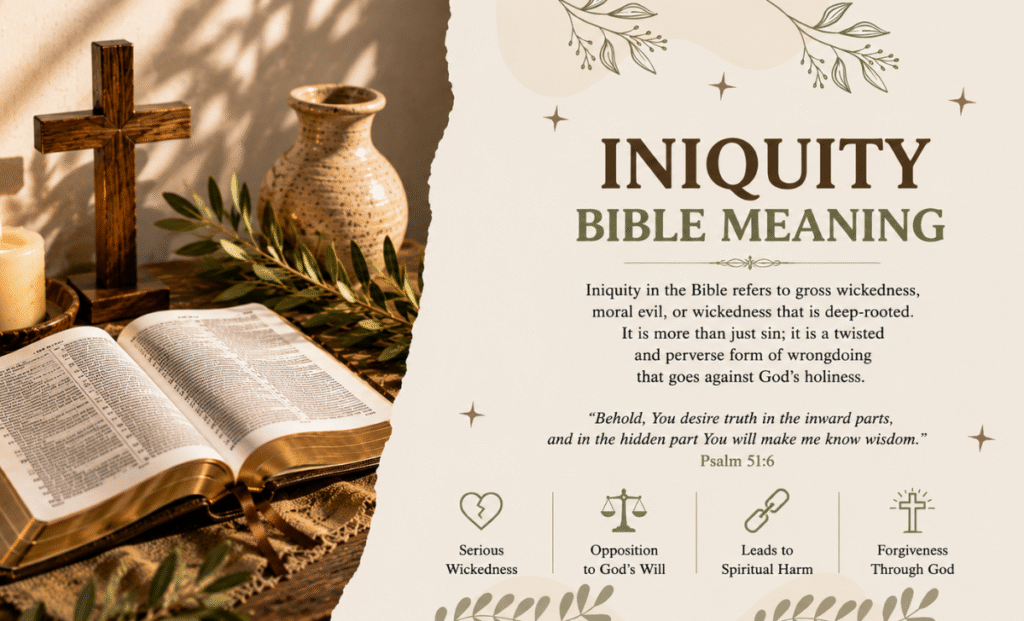
If you’ve come across the word iniquity bible meaning in Scripture and wondered what truly iniquity bible meaning you’re not alone. Many believers treat it as just another synonym for sin. But the Bible uses this term with far greater precision and weight. Understanding the iniquity Bible meaning unlocks a deeper awareness of the human heart, God’s justice, and the boundless mercy offered through repentance and grace.
This article explores the biblical definition of iniquity bible meaning its Hebrew and Greek roots, spiritual symbolism, how it may appear in dreams and real life, and the practical faith lessons it carries for every believer today.
Biblical Meaning of Iniquity
At its core, iniquity in the Bible refers to deep-rooted moral wrongdoing, willful rebellion, and inner corruption of the heart not merely a single mistake or unintentional failure. It describes a condition of the soul, not just an isolated action.
The Old Testament uses the Hebrew word עָוֹן (avon) approximately 215 times, making it by far the most common term translated as “iniquity.” Etymologically, scholars explain avon as meaning “crookedness” or “perverseness” evil regarded as that which is not straight or upright, a moral distortion. It derives from the root iwwah, meaning “to bend,” “to make crooked,” or “to pervert.” Where sin is missing the mark and transgression is crossing a boundary, iniquity describes the bent nature of the heart itself.
In the New Testament, the primary Greek equivalents are:
- ἀνομία (anomia) lawlessness; the condition of one who lives without law
- ἀδικία (adikia) unrighteousness or injustice
Together, these terms paint a picture of iniquity as not just what a person does but what a person has become through sustained rebellion against God’s ways.
What Does 333 Mean in the Bible? (Hidden Truth)
The Three Dimensions of Iniquity in Hebrew
Biblical scholars identify three overlapping meanings of avon that flow into one another:
| Dimension | Meaning | Example Verse |
|---|---|---|
| Iniquity itself | The corrupt character of an action | Psalm 32:5 “the iniquity of my sin” |
| Guilt of iniquity | Moral liability before God | Exodus 34:7 forgiving iniquity and guilt |
| Punishment of iniquity | The consequences that follow | Genesis 4:13 “My punishment is more than I can bear” |
This layered meaning shows why the Bible treats iniquity so seriously it encompasses the act, the guilt it produces, and the suffering it brings.
Iniquity Bible Meaning: Spiritual Significance and Symbolism
Spiritually, iniquity bible meaning represents far more than external behavior. It symbolizes the distance between the human heart and God a state of being spiritually out of alignment with His will.
Iniquity vs. Sin vs. Transgression
One of the most important distinctions in biblical theology is understanding how iniquity differs from related terms:
- Sin (Hebrew: חַטָּאת, chattath) “Missing the mark.” It includes unintentional acts and failures to meet God’s perfect standard.
- Transgression (Hebrew: פֶּשַׁע, pesha) Willful rebellion; deliberately crossing a known boundary set by God.
- Iniquity (Hebrew: עָוֹן, avon) The innate crookedness or moral distortion that leads to repeated, willful sin. It is not just an action but the character behind the action.
As Psalm 32:5 captures it: “I acknowledged my sin to You, and my iniquity I did not hide.” David separates sin (what he did) from iniquity (what lived within him). All iniquity is sin, but not all sin rises to the level of iniquity.
Key Bible Verses About Iniquity
Scripture is rich with references to iniquity and what it reveals about God’s character and human nature:
- Psalm 51:2: “Wash me thoroughly from my iniquity, and cleanse me from my sin.” David’s prayer shows that iniquity requires deep cleansing, not just surface correction.
- Isaiah 53:5–6: “He was bruised for our iniquities… the LORD has laid on Him the iniquity of us all.” This Messianic prophecy points to Christ bearing the full weight of human iniquity.
- Isaiah 59:2: “Your iniquities have separated you from your God.” Iniquity creates a spiritual wall between people and God.
- Ezekiel 18:20: Each person bears their own iniquity; it is not transferred automatically from parent to child.
- Micah 7:18: “Who is a God like you, pardoning iniquity?” God’s willingness to forgive is presented as one of His most remarkable attributes.
- Matthew 7:23: Jesus warns that those who practice lawlessness (anomia) will be told, “I never knew you.”
The Spiritual Symbolism of Iniquity
Beyond its doctrinal definition, iniquity carries powerful symbolism throughout Scripture:
- A twisted or bent path — representing deviation from God’s straight way
- A heavy burden — Psalm 38:4 says, “My iniquities have gone over my head; like a heavy burden, they are too heavy for me.”
- A stain or deep wound — requiring washing and cleansing (Psalm 51:2)
- A barrier or veil — that hides God’s face from those who persist in it (Isaiah 59:2)
- A generational pattern — Exodus 34:7 describes iniquity visiting the children of those who do not repent, pointing to how unchecked sin shapes families and communities
Spiritually, recognizing iniquity in one’s life is not meant to produce shame it is meant to produce repentance and restoration.
Rebuked Meaning in the Bible: What the Bible Really Says
Iniquity Bible Meaning: Biblical Interpretations in Dreams or Real Life
Many believers encounter the concept of iniquity not just in Scripture, but through the lens of dreams, moments of deep conviction, and real-life moral struggles.
Iniquity in Dreams: What It May Symbolize
Dream interpretation in a biblical context is always secondary to Scripture, but spiritual themes can offer meaningful reflection. Dreams involving a sense of moral darkness or inner wrongdoing may carry symbolic significance:
| Dream Theme | Possible Spiritual Meaning |
|---|---|
| Stormy or chaotic scenes | Unresolved guilt or an area of life needing repentance |
| Heavy burden or weight | The spiritual heaviness of persistent sin |
| Washing or cleansing | God’s invitation to forgiveness and renewal |
| Light breaking through darkness | Spiritual awakening and hope after confession |
| Peaceful resolution | Awareness of God’s forgiveness and restored fellowship |
These dream symbols are not definitive; they are reflective. They may invite the believer to examine their heart, bring struggles to prayer, and trust God’s mercy.
Iniquity in Real Life
In everyday experience, iniquity often shows up as recurring patterns of wrongdoing rather than isolated incidents. Some real-life examples the Bible highlights include:
- King David and Bathsheba (2 Samuel 11) — What began as lust escalated through deceit and murder into a web of iniquity. David’s eventual cry in Psalm 51 shows the depth of what iniquity requires: not just apology, but transformation.
- Israel’s repeated idolatry — The prophets repeatedly confronted Israel not just for individual sins but for a national pattern of turning away from God. This collective iniquity brought exile and suffering.
- Generational patterns — Exodus 34:7 acknowledges that the consequences of iniquity can ripple through generations. However, the New Testament affirms that Christ breaks this cycle for those who come to Him in faith.
In modern life, iniquity may appear as persistent selfishness, habitual dishonesty, bitterness that goes unaddressed, or pride that resists correction. Recognizing these patterns is not condemnation — it is a divine invitation to seek God’s grace.
Practical Lessons & Faith Insights
Understanding the iniquity Bible meaning has direct, life-changing implications for the believer’s walk with God. Here are four key faith lessons:
1. Recognize Iniquity Before It Hardens the Heart
Persistent iniquity leads to what Romans 1:28 calls a “reprobate mind” — a conscience so dulled that it loses the desire to repent. The earlier a believer identifies patterns of moral distortion, the more open the door to healing. Psalm 139:23–24 offers a model prayer: “Search me, O God, and know my heart… see if there is any wicked way in me.”
2. Confession Is the Path to Freedom
Psalm 32:5 records that when David stopped concealing his iniquity and brought it before God, forgiveness came immediately. Iniquity loses its power when exposed to God’s light. Confession is not about shame — it is about freedom.
3. Christ Has Borne Our Iniquities
The central hope of the gospel addresses iniquity directly. Isaiah 53:6 says the LORD laid the iniquity of us all on the Servant — Jesus Christ. His death was not just for individual acts of wrongdoing but for the deep corruption that drives them. Believers are not just forgiven; they are healed.
4. Pursue Ongoing Sanctification
Understanding iniquity is not a one-time exercise. It calls believers to a lifestyle of daily self-examination, prayer, and reliance on the Holy Spirit. Practical steps include:
- Daily prayer for a clean heart (Psalm 51:10)
- Scripture meditation to realign the mind with God’s truth
- Spiritual accountability through trusted believers or a pastor
- Repentance as a habit, not just a crisis response
Conclusion
The iniquity Bible meaning goes far deeper than a synonym for sin. It describes moral distortion at the level of the heart — a willful, often habitual turning away from God’s ways. Yet the Bible never presents iniquity as the final word. From David’s Psalm 51 to Isaiah’s prophecy of the Suffering Servant to Jesus’s atoning work on the cross, Scripture consistently moves from the weight of iniquity to the wonder of divine forgiveness.
Recognizing iniquity in your life is not a cause for despair. It is the beginning of transformation. God’s mercy is greater than any crookedness of the human heart, and His grace is sufficient to straighten what sin has bent.
Covet Meaning in the Bible: What God Really Says
FAQs
What is the simple definition of iniquity in the Bible?
Iniquity refers to deep moral wrongdoing or inner corruption — willful, habitual sin that reflects a heart turned away from God, not just a single mistake.
How is iniquity different from sin?
Sin includes any act that misses God’s standard, even unintentionally. Iniquity goes deeper — it describes the character or condition of the heart from which repeated, deliberate wrongdoing flows.
What is the Hebrew word for iniquity?
The primary Hebrew word is avon (עָוֹן), used about 215 times in the Old Testament, meaning “crookedness,” “perverseness,” or “moral distortion.”
What does Isaiah 53:5 mean by “bruised for our iniquities”?
It is a Messianic prophecy fulfilled in Jesus Christ — He bore the full weight of humanity’s deep-rooted moral corruption so believers could be forgiven, healed, and restored.
Can iniquity be passed down through generations?
Exodus 34:7 indicates that the consequences of unrepented iniquity can affect descendants. However, through faith in Christ, believers receive a new spiritual identity not bound by inherited patterns of sin.
Does God forgive iniquity?
Yes. Micah 7:18 asks, “Who is a God like you, pardoning iniquity?” God’s forgiveness is available to all who sincerely repent and turn to Him through Jesus Christ.
What does iniquity mean in the New Testament?
The Greek word anomia (lawlessness) is the primary equivalent, meaning living outside of God’s law. Jesus uses it in Matthew 7:23 as a serious warning about those who claim faith but live in ongoing moral rebellion.
How do I overcome iniquity in my own life?
Through honest confession (Psalm 32:5), daily Scripture reading, prayer for a clean heart (Psalm 51:10), and spiritual accountability with other believers or a pastor.

Hi! I’m Jenson, the writer behind punslush.com. I craft clever puns and witty wordplay designed to entertain and inspire. Visit punslush.com for a good dose of humor and fun!