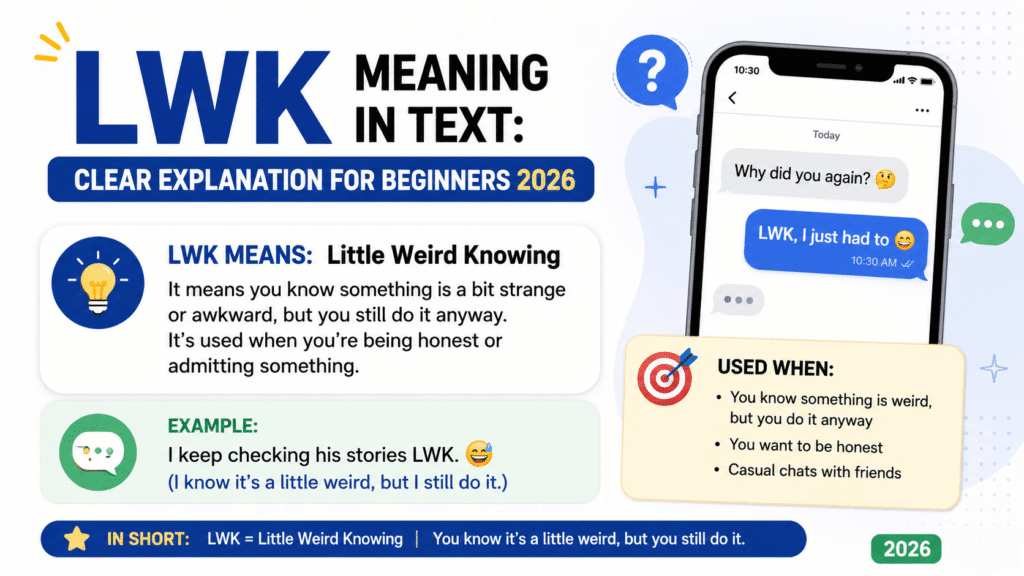
You’re scrolling through your messages and suddenly spot “LWK” staring back at you. LWK meaning in text is simple — it stands for “low-key,” a slang term describing something understated, subtle, or quietly honest.
Here’s the thing though. Three tiny letters carry surprisingly deep emotional weight in modern digital conversations.
LWK isn’t just shorthand — it’s a whole communication style. People use it to soften opinions, admit hidden feelings, and express quiet excitement without sounding “extra.” Understanding LWK texting slang unlocks how millions of people actually talk online today, especially Gen Z.
What Does LWK Mean in Text?
The One-Line Definition
LWK is an abbreviation for “low-key.” That’s it at its most basic. But “low-key” itself is doing a lot of work in modern texting culture, so let’s unpack that too.
When someone says something is low-key, they mean it’s:
- Understated
- Subtle
- Mild in intensity
- Quietly honest — not shouting it from the rooftops
So when your friend texts “I LWK like that song,” they’re not denying they like it. They’re admitting it — just softly. With a little emotional distance. That’s the whole personality of LWK communication style.
ALSO READ: WTV Meaning in Text: What It Really Means for You!
What “Low-Key” Actually Means Before Texting
Before LWK texting slang existed, “low-key” was already a powerful phrase. In jazz, “low-key” described music that was muted, cool, and controlled. Think of Miles Davis — not loud, not showy, just deeply expressive in a quiet way.
That spirit carried into everyday casual communication. By the 1990s, people used “low-key” to describe parties that weren’t wild, opinions they held quietly, or feelings they didn’t fully broadcast. lwk meaning in text was always about holding something back — just a little.
How LWK Differs From Typing “Low-Key”
Same meaning. Different energy. LWK in text messages feels more native to digital conversations — faster to type, more casual, and honestly a bit more Gen Z. Typing out “low-key” in full sounds slightly more deliberate. Using LWK feels like you’re speaking the language of the internet fluently.
Where Did LWK Come From?
Internet slang doesn’t appear overnight. It builds in layers — borrowed words, shortened phrases, cultural moments that accelerate adoption. LWK followed that exact path.
The timeline looks something like this:
| Era | Development |
|---|---|
| 1940s–1960s | “Low-key” used in jazz culture to mean muted, restrained |
| 1990s | “Low-key” enters everyday spoken slang |
| 2000s–2010s | SMS slang culture explodes; abbreviations dominate texting |
| 2015–2019 | “Low-key” becomes mainstream internet vocabulary |
| 2020–2023 | LWK abbreviation solidifies across TikTok, Twitter/X, and Instagram |
| 2024–2026 | LWK is standard Gen Z slang in everyday online communication |
The abbreviation itself grew naturally from messaging culture. When you’re typing fast on a phone, squeezing meaning into character limits, three letters beat eight every time. lwk meaning in text was a practical evolution as much as a cultural one.
TikTok played a major role. Comment sections on viral videos normalized LWK social media meaning at scale. Millions of people saw it used, absorbed it contextually, and started using it themselves — no dictionary required.
The Emotional Tone Behind LWK
This is where it gets genuinely interesting. LWK emotional tone is not neutral. It’s performing something specific — and once you see it, you can’t unsee it.
Emotional Restraint as a Social Tool
Using LWK is a form of emotional restraint. You’re admitting something real, but you’re wrapping it in a layer of cool detachment. It says: I feel this, but I’m not making a big deal about it.
In a culture that mocks people for being “extra” or “too much,” LWK becomes a form of protection. You get to be honest — soft honesty — without risking embarrassment. You said the thing, but lightly.
“LWK functions like a social cushion. It lets people share hidden feelings without fully exposing themselves.” — This matches what linguists call hedging: language designed to soften commitment to a statement.
The Psychology of Hedging in Digital Conversations
Hedging isn’t weakness. It’s actually sophisticated conversational tone management. Academic linguist Robin Lakoff identified hedging as a core feature of human communication as far back as 1973. People naturally soften statements to:
- Avoid conflict
- Signal humility
- Leave room to back out if the other person doesn’t respond well
- Sound more relatable
LWK does all four of those things in three letters. That’s efficient.
LWK vs HWK — Two Ends of the Spectrum
You can’t fully understand LWK without its opposite. HWK means “high-key” — and where LWK plays it cool, HWK is fully committed, no filter.
| Term | Meaning | Energy |
|---|---|---|
| LWK | Low-key — subtle, mild, understated | Cool, relaxed, guarded |
| HWK | High-key — openly, strongly, without reservation | Intense, unfiltered, emphatic |
| No modifier | Neutral statement | Flat, no emotional coloring |
“I LWK miss her” is quiet longing. “I HWK miss her” is unguarded emotion on full display. The abbreviation you choose tells the other person exactly how exposed you’re willing to be.
LWK Examples in Real Text Conversations
LWK examples are the fastest way to lock in the meaning. Here are real-world scenarios, explained so you understand not just what was said — but why it was said that way.
Casual Admissions
- “I LWK love that show” — Admitting genuine enjoyment, but keeping it laid-back. Not a full endorsement. Just a quiet thumbs-up.
- “She lwk meaning in text reminds me of my ex” — Acknowledging a feeling without making it a whole thing.
The difference from saying “I love that show” is subtle but real. The LWK version sounds more offhand — less invested, more chill. That’s intentional.
Understated Complaints
- “That was LWK rude”
- “He LWK ignored me the whole night”
Here, LWK in text messages functions as a social buffer. You’re naming something that bothered you — but you’re not escalating. It’s subtle honesty that invites the other person to acknowledge it without feeling attacked.
Quiet Excitement
- “I’m LWK excited for the trip ngl”
- “This is LWK the best pizza I’ve ever had”
Emotional vulnerability is real even in exciting moments. People downplay enthusiasm in digital conversations to avoid looking over-eager or cringe. LWK lets you be excited while maintaining your composure. Irony culture on the internet heavily reinforces this behavior.
Side-by-Side Comparison
| With LWK | Without LWK | What Changes |
|---|---|---|
| “I LWK like him” | “I like him” | More cautious, softer admission |
| “That was LWK weird” | “That was weird” | Less confrontational |
| “I’m LWK tired” | “I’m exhausted” | Downplayed, more relatable |
| “She LWK got me there” | “She was right” | Grudging, understated agreement |
| “That movie LWK slapped” | “That movie was great” | Casual praise, very Gen Z |
LWK vs Similar Slang — How It Stacks Up
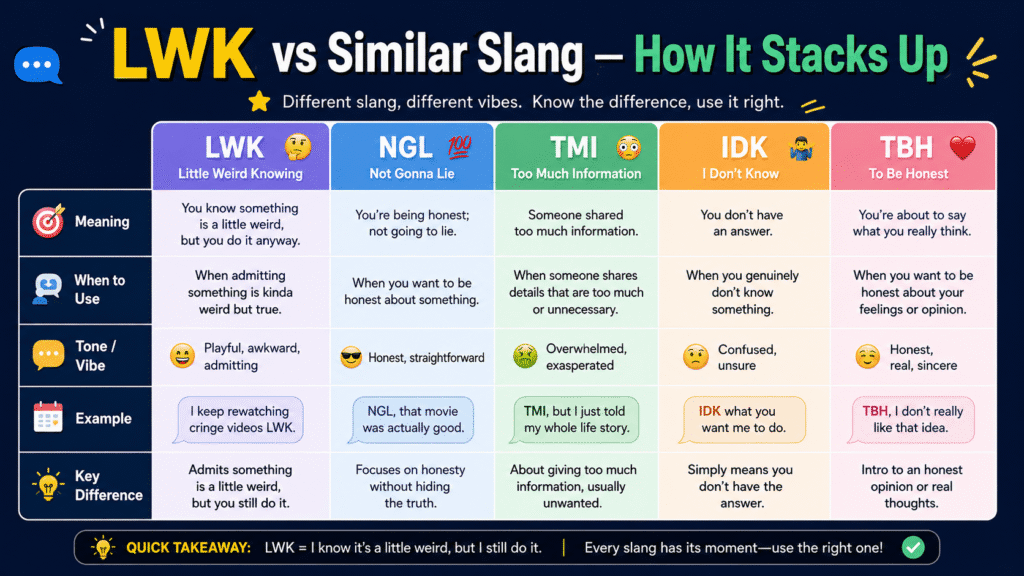
LWK doesn’t exist in isolation. It lives inside a whole ecosystem of internet jargon that younger texters move between fluidly. Here’s how it compares:
| Slang | Stands For | Core Feeling | Difference From LWK |
|---|---|---|---|
| LWK | Low-key | Subtle, understated | The base term |
| HWK | High-key | Open, emphatic | Opposite intensity |
| NGL | Not gonna lie | Direct confession | More blunt, less soft |
| TBH | To be honest | Honest opinion | Slightly more formal confession |
| ISTG | I swear to God | Emphasis, frustration | Higher emotional intensity |
| FR | For real | Sincerity | Confirms honesty, not subtlety |
| IMO | In my opinion | Casual opinion | More neutral, less emotional |
Notice the pattern. LWK sits in a unique spot — softer than NGL, less intense than ISTG, more emotional than IMO. It carves out a specific emotional lane that none of the others quite fill.
How LWK Is Used on Social Media
LWK social media meaning plays out differently depending on the platform. Same abbreviation, different context and purpose.
LWK on TikTok
TikTok’s comment sections are where LWK thrives. Users drop it to react to videos without going overboard:
- “This LWK made me cry” under an emotional video
- “She LWK ate that” — quiet praise for a performance
- “I LWK do this too” — quiet solidarity
Gen Z slang evolves fastest on TikTok. Trending expressions get hundreds of millions of impressions and normalize new usage patterns almost instantly. LWK reached critical mass here.
LWK on Instagram
On Instagram, you’ll find LWK in two places:
Instagram captions — especially when someone wants to share something personal without seeming too earnest: “LWK proud of how far I’ve come this year 🖤”
Comments and replies — as soft reaction to someone else’s post: “You LWK look amazing here”
That second example is interesting. It’s a compliment — but the LWK makes it feel more genuine, less performative. Without it, “you look amazing” can sound like a throwaway comment. With LWK, it reads as a real, slightly reluctant admission.
LWK on Snapchat and iMessage
In private DMs, LWK functions differently than in public spaces. The audience is one person — so the softening effect is more intimate. Relationship texting and romantic texting are where LWK gets genuinely revealing:
- “I LWK miss you” in a private conversation carries real weight
- “That LWK hurt” in a text argument is emotionally honest but not aggressive
Casual messaging in these spaces uses LWK as a way of saying: I’m being real with you, but I’m not ready to be completely raw about it.
LWK on Twitter/X
Twitter/X users deploy LWK for a specific purpose: stating opinions without full accountability. Online engagement culture on that platform is aggressive. Using LWK pre-softens a take:
- “LWK think this movie was overrated” — an opinion, but hedged enough to avoid a pile-on
- “I LWK agree with him” — partial endorsement without full commitment
It’s implied meaning doing heavy lifting in social media posts designed for maximum engagement with minimum blowback.
Is LWK Positive, Negative, or Neutral?
The honest answer: all three. What makes LWK communication style flexible is that it bends to context. The word itself doesn’t carry a fixed moral charge.
Positive Uses
- Quiet excitement: “I’m LWK obsessed with this album”
- Soft admiration: “She’s LWK incredible at her job”
- Understated hype: “This restaurant LWK hits every time”
Negative Uses
- Mild criticism: “That was LWK disrespectful”
- Understated disappointment: “I LWK expected more from him”
- Passive disapproval: “She LWK embarrassed herself there”
Neutral Uses — The Category Most People Miss
Sometimes lwk meaning in text carries zero emotional judgment. It’s just description:
- “It was LWK a long day” — not complaining, not celebrating. Just noting.
- “The movie was LWK two hours” — factual observation, softened.
Understanding this third category separates people who use LWK fluently from those still figuring out what does LWK mean at a surface level.
Common Misreadings of LWK
Even fluent texters misread LWK in text messages sometimes. Here are the most frequent mistakes:
Reading it too literally. When someone says “I LWK hate that,” they probably don’t actually hate it. The LWK signals mild, not extreme. Over-interpreting the base emotion is the most common error.
Confusing it with sarcasm. LWK isn’t inherently sarcastic. But because it often downplays something, readers sometimes assume irony that isn’t there.
Missing it entirely when reading fast. Three letters in the middle of a sentence are easy to skip. Misreading LWK as “like” or simply ignoring it changes the meaning of a message significantly.
Age-related misreadings. Someone outside younger texters’ culture might read “I LWK agree” and not register that the LWK is doing any work. They take the statement at face value without catching the hedged, restrained quality of it.
How to Respond When Someone Uses LWK
You don’t need to mirror the slang to respond well. Here are a few practical principles:
Match the energy, not necessarily the vocabulary. If someone says “I LWK want to hang out this weekend,” you don’t have to reply with LWK. A relaxed “Yeah, same — let’s make it happen” fits the tone perfectly.
Don’t over-read the hedge. LWK is not a red flag. It’s not them pushing you away. It’s just how casual communication works in digital language right now.
Ask if you genuinely need clarity. If “I LWK like you” arrives in a romantic texting context and you can’t tell how seriously to take it — just ask. Directly. “What does that mean for you?” is a legitimate question.
Example exchange:
Alex: “I LWK think we should just go. It’ll be fine.” Jordan: “Yeah honestly. Let’s just do it.”
ALSO READ: HM meaning in text: Clear Explanation for Everyday Chats 2026
When to Use LWK — And When to Leave It Out
lwk meaning in text is a powerful tool in the right hands, in the right room. Use it wrong and you’ll sound out of place — or worse, confuse the person you’re texting.
Use LWK When:
- Texting friends your own age in informal conversations
- Sharing casual opinions you’re not fully committed to
- Softening criticism you want to land gently
- Posting public captions aimed at a younger, social-media-native audience
- Admitting feelings in romantic texting without going full vulnerability
- Participating in comment sections and discussion threads where casual tone is expected
Skip LWK When:
- Writing professional messages or formal emails — it will undermine you instantly
- Texting authority figures like a manager, professor, or a parent who won’t recognize it
- You actually feel something strongly — LWK undercuts genuine emotion
- Communicating something that needs to be taken seriously
- Business messaging or workplace communication of any kind
- Texting someone significantly older who might be confused by SMS slang
Rule of thumb: If you wouldn’t say “low-key” out loud in that conversation, don’t type LWK either.
LWK Across Different Conversation Types
The same three letters do different jobs depending on who’s in the conversation.
Friend group chats — LWK thrives here. It’s shorthand for shared emotional reactions, understated humor, and the quiet acknowledgment of something everyone’s feeling but nobody wants to say too loudly.
Romantic texting and dating messages — LWK carries real emotional weight in private DMs. It’s how people admit feelings while keeping a foot out the door. “I LWK really like spending time with you” is genuinely vulnerable, just wrapped in a calm exterior.
Sibling and family texts — Depends entirely on the age gap. Younger siblings use it naturally. Older family members may have no idea what it means. Code-switching happens constantly in these conversations.
Fandom spaces online — Hugely popular. Fans use LWK to react to content without looking obsessive. “This scene LWK destroyed me” in a fan forum reads as authentic — not like someone completely spiraling.
How to Use LWK Naturally — Without Sounding Forced
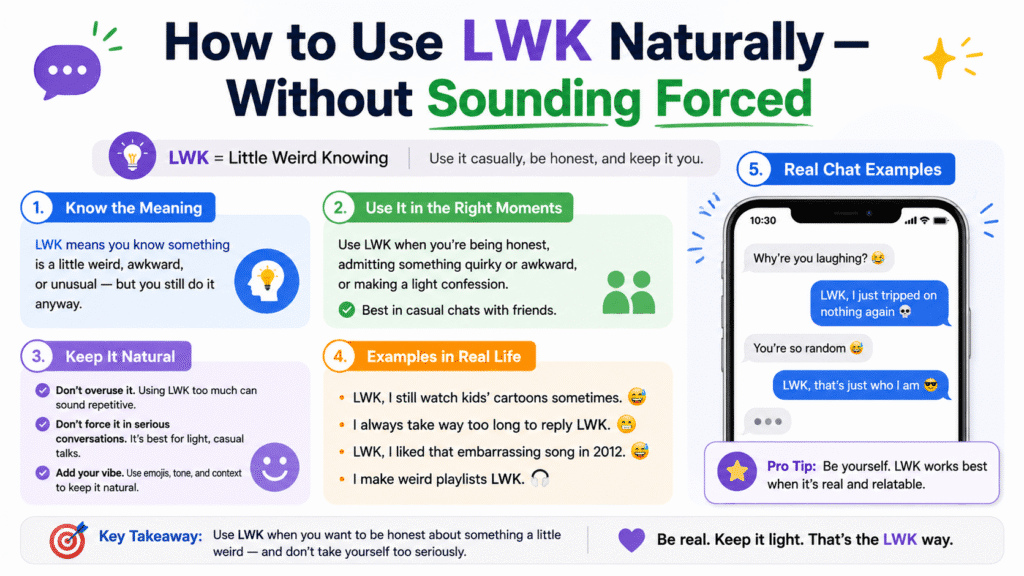
The biggest mistake beginners make is overusing it. Drop LWK into every sentence and it loses all its impact. The whole power of the word is restraint — so the usage should be restrained too.
Think of it as replacing “kind of,” “sort of,” or “a little bit.” Those are its natural equivalents. Wherever you’d say one of those, LWK can step in — but only when the conversational tone is casual.
Practice by swapping:
| Original Sentence | With LWK |
|---|---|
| “I kind of agree with that” | “I LWK agree with that” |
| “That was sort of impressive” | “That was LWK impressive” |
| “I’m a little nervous” | “I’m LWK nervous” |
| “I sort of want to go” | “I LWK want to go” |
Feel the difference? lwk meaning in text is snappier. It signals fluency in online communication without trying too hard.
Read your message before you send it. Does LWK fit naturally, or does it feel shoehorned in? If it feels off, remove it. Good digital communication never sounds like someone following a tutorial.
Frequently Asked Questions
What does LWK mean in text?
LWK stands for “low-key” — meaning something subtle, understated, or quietly admitted. Example: “I LWK love this song” means you genuinely like it but aren’t making a big deal about it.
Where did LWK come from?
LWK evolved from internet slang culture in the early 2020s, accelerated massively by TikTok comment sections, and became standard Gen Z texting slang by 2024–2025.
Is LWK positive or negative?
Neither exclusively — LWK works both ways. It softens positive admissions (“I LWK like him”) and mild criticism (“That was LWK rude”) equally well.
Can I use LWK in professional messages?
Absolutely not. Keep LWK strictly in casual conversations with friends and peers. It has no place in work emails, business messaging, or any formal communication.
Is LWK still popular in 2026?
Yes — LWK remains widely used across TikTok, Instagram, Snapchat, and iMessage in 2026, especially among Gen Z and younger Millennials in everyday digital conversations.
conclusion
Understanding LWK meaning in text is genuinely useful in today’s digital world. It means “low-key” — subtle, understated, quietly honest. Three letters that carry real emotional weight in everyday conversations.
Now you’ve got the full picture. You know when to use LWK meaning in text, when to avoid it, and exactly what someone means when they send it your way. It’s simple slang — but it says a lot about how people communicate online today. Use it naturally and you’ll fit right in.

Hi! I’m Jenson, the writer behind punslush.com. I craft clever puns and witty wordplay designed to entertain and inspire. Visit punslush.com for a good dose of humor and fun!