
Gyatt meaning, in plain terms, is internet slang that works two ways: as an exclamation of shock or admiration, and as a noun for an attractive figure. Either way, it started as a stylized spin on “goddamn.”
Here’s the wild part: this word wasn’t crafted by a marketing team or coined for clout. It was born from a Twitch streamer getting mocked by his own chat for mispronouncing a phrase, and that inside joke somehow snowballed into a dictionary entry.
From YourRAGE’s stream in 2021 to TikTok captions everywhere, gyatt’s journey says a lot about how fast Gen Z slang travels, and why understanding it beats just scrolling past confused.
What Does Gyatt Actually Mean?
Here’s the short version: gyatt works two ways. It’s an exclamation, and it’s a noun. Which one you’re looking at depends entirely on the sentence around it.
As an exclamation, gyatt is basically a louder, weirder cousin of “goddamn.” Someone sees something impressive, shocking, or attractive, and they shout it out — the same reflex behind “whoa” or “no way,” just with more personality.
As a noun, gyatt refers to an attractive figure, specifically someone’s backside. This is the meaning most people encounter first, because it’s the one that went viral hardest on TikTok.
Merriam-Webster’s slang dictionary captures both senses cleanly. It notes that gyatt started as an expressive way of spelling the “god” in “goddamn,” alongside similar stylized spellings like “dayum,” used for greater emphasis or humorous effect. From there, the dictionary explains, gyatt picked up its association with attraction and eventually became slang for the butt itself, while also functioning as a general way to call something “excellent” or “impressive.
So when your nephew yells “GYATT” at a video game clip, he’s not necessarily talking about anyone’s body. Context decides.
The Core Definition in Plain Terms
Strip away the internet noise and here’s the plain-English gyatt definition:
| Usage type | What it means | Example |
|---|---|---|
| Exclamation | An expression of shock, excitement, or admiration | “Gyatt! Did you see that dunk?” |
| Noun | A term for an attractive body shape, usually referring to the butt | “She’s got a gyatt.” |
| General hype word | Used for anything impressive, not just looks | “That plot twist? Gyatt.” |
This is the same pattern slang always follows. A word starts narrow, gets used a lot, and then stretches to cover more ground than it originally did. Gyatt did that stretching fast — within about two years, it went from a very specific reaction to a general-purpose exclamation.
ALSO READ: SS Meaning in Text: Ultimate Guide You Need to Know 2026
How It’s Spelled — Gyatt vs. Gyat vs. GYAT
You’ll see this word spelled at least three different ways, and none of them are wrong. Gyatt, gyat, and even stretched-out versions like “gyaaatt” all refer to the same word. The extra letters aren’t a typo; they’re doing a job.
Think about how people type “yesss” instead of “yes,” or “noooo” instead of “no.” Extending a word in text mimics how it sounds when someone actually shouts it out loud. The longer the spelling, the more emphasis it’s carrying. A quick “gyat” in a group chat reads pretty casually. A drawn-out “GYAAATTTT” in all caps signals genuine shock or excitement.
Know Your Meme’s documentation of the term shows this variation going back years, describing it plainly: gyatt meaning, also written GYATT or GYAAATT, functions on Twitch and TikTok as a slang shorthand for “goddamn,” typically said fast and with aggressive energy. That aggressive, fast delivery is exactly why the spelling stretches the way it does — people are trying to type the sound of a shout.
How to Pronounce It (and Why That Matters)
Here’s a detail most guides skip entirely: gyatt rhymes with “cat,” not “date.” The correct pronunciation is closer to “jat” or “gyat,” with a short A sound — Wikipedia’s linguistic entry lists it phonetically as /ɡjɑːt/.
Why does this matter? Because plenty of people only ever encounter this word in writing, and they guess the pronunciation wrong when they try to say it out loud. Saying it with a long A (“gyate,” like “gate”) immediately signals to younger listeners that you learned the word from a screenshot, not from actually hearing it used. If you’re going to use it at all, get the sound right first.
Is Gyatt a Bad Word? Tone, Connotation & Context
This is the part most articles either skip or oversimplify, and it deserves an honest answer instead of a quick “it’s totally fine!” or “never say this.”
Gyatt isn’t a slur. It’s not banned on any social media platforms, and dictionaries have added it as a legitimate slang entry rather than flagging it as hate speech. But it’s also not neutral. The word’s rise is tightly connected to commentary on physical attractiveness, specifically about women’s bodies, which means it can slide into objectifying territory depending on how — and about whom — it’s used.
There’s a real difference between:
- Shouting “gyatt” as a general reaction to something impressive in a video
- Typing “gyatt” as a joke in a private conversation between friends
- Commenting “gyatt” on a stranger’s photo, uninvited
The first two are harmless. The third one crosses into the kind of unsolicited commentary that makes people uncomfortable, regardless of what word you’re using to say it. Linguist Kelly Elizabeth Wright, a research fellow in language sciences at Virginia Tech, has traced the word’s roots to Black Southern and Jamaican communities, among other communities of the African diaspora< worth remembering before treating it as a throwaway meme word with no history behind it.
The Origin of Gyatt — Who Started It and When
Most viral slang doesn’t actually have a clean origin story. Gyatt is a rare exception — it has both a documented long history and a specific, well-recorded viral moment. Both parts matter.
The AAVE Roots — Long Before Twitch Existed
Before any streamer made this word famous, it already existed.
This detail matters because a lot of coverage treats gyatt meaning like it was invented out of thin air in 2021. It wasn’t. What happened in 2021 wasn’t the birth of the word — it was the moment a very old expression got picked up, repackaged, and launched into a completely different level of visibility.
YourRAGE and the Streaming Roots of the Word
The current, dominant version of gyatt traces back to a specific Twitch streamer: a content creator who goes by YourRAGE. In June 2021, he began an on-stream gag where he’d shout “GYATT” whenever an attractive woman appeared during his livestream, then pause and let his chat spam the word back at him.
But here’s the twist almost nobody reports accurately: according to YourRAGE himself, the word didn’t start as an intentional bit. It started as chat mocking the way he naturally talked. In his own words, from a 2023 video explaining the term:
“Everybody used to say ‘god damn’ or ‘golly’ but I said it weird. I’d always say ‘gyatt,’ I would never say ‘god damn.’ Chat realized that, and as a way of making fun of me in 2020, they started typing ‘gyatt’ to mock me.”
So the origin isn’t a marketing gimmick or a scripted catchphrase. It’s a gaming creator getting teased by his own audience for a speech quirk, and that teasing accidentally became one of the biggest viral terms of the decade. That’s a genuinely funny detail worth including in any real explanation of where this word came from.
How It Jumped From Twitch to TikTok
A word can be huge within gaming communities and still stay invisible to the rest of the internet. gyatt meaning didn’t stay contained. Its jump from Twitch culture to mainstream short-form content happened through a familiar pipeline: clips.
Reaction videos and stream highlights from YourRAGE started getting clipped and reposted to YouTube and TikTok. Once those clips existed as standalone viral clips, they didn’t need the full livestream culture context anymore — anyone scrolling could see a five-second moment of someone shouting “GYATT” and immediately understand the joke, or at least want to find out what it meant.
Kai Cenat, another massively popular live streamer, is widely credited with accelerating that jump. Once a streaming personality with Cenat’s reach started using the word regularly, it stopped being niche online gamers vocabulary and became something that showed up in TikTok comments, comment sections on Instagram, and eventually regular text chats between teenagers who’d never watched a single stream.
A Case Study in How Modern Slang Spreads
The gyatt story is honestly one of the cleanest examples of how online language travels in the streaming era, so it’s worth walking through step by step.
- The trigger: A content creator’s natural speech pattern gets mocked by his own audience.
- The bit: The creator leans into the joke instead of correcting it, turning an accident into a recurring on-stream gag.
- The clip economy: Other creators and fan accounts start clipping those moments and reposting them on YouTube, stripped of the original stream’s full context.
- The amplifier: A bigger-name streaming personality (Kai Cenat) picks up the same word, exposing it to a much larger, more mainstream audience overnight.
- The platform jump: Short clips migrate to TikTok, where the sound and the word get remixed into unrelated meme videos, completely detaching it from streaming culture.
- The legitimization: Usage volume gets high enough that lexicographers at Merriam-Webster and Dictionary.com formally document it.
Almost every major slang term to come out of gaming communities in the last five years — “sheesh,” “no cap,” “rizz” — has followed roughly this same six-step path. Understanding this pattern makes it a lot easier to predict which new slang terms are likely to stick around and which ones will disappear within a month.
The Timeline — From Niche Gamer Slang to Mainstream Viral Term
Here’s the documented progression, pulled from tracked usage across platforms:
| Period | What happened |
|---|---|
| 2009 | Earliest documented online use, as a stylized spelling of “god damn” |
| June 2021 | YourRAGE begins his on-stream “GYATT” reaction bit after chat starts mocking his pronunciation |
| Late 2021 | Clips of the gag circulate on YouTube; usage spreads within streaming community circles |
| 2022 | Kai Cenat and other creators adopt the term, pushing it into TikTok captions and comments; hashtag usage climbs sharply |
| October 2023 | A viral TikTok video helps push the word into a broader, meme-driven second wave |
| 2023–2024 | Major dictionaries (Merriam-Webster, Dictionary.com) formally add gyatt as a slang entry |
That’s roughly a fourteen-year gap between the word’s earliest recorded appearance and its dictionary recognition — a good reminder that “new” internet slang often has much deeper roots than the viral moment suggests.
How People Use Gyatt Today — Real-World Contexts
Knowing the definition is one thing. Understanding how it actually shows up in daily conversation is what makes the word make sense.
In Casual Texting and Group Chats
Inside group chats and messaging apps, gyatt usually shows up as a quick, low-effort reaction — the text equivalent of a raised eyebrow. Someone sends a photo, a screenshot, or a wild story, and “gyatt” lands as shorthand for “wow” or “no way.” It rarely needs a follow-up sentence. The word does the whole job by itself.
As a Reaction in Comments and Live Streams
On YouTube and Twitch, gyatt still functions closest to its original form: a live, real-time reaction dropped into the comment section or stream chat the instant something surprising happens. This is its most natural habitat. Esports audience members and casual viewers alike use it as a one-word way to flood chat with reaction energy during a big play, a funny fail, or an unexpected moment on camera.
In Memes, Videos, and Internet Humor
As a piece of meme language, gyatt now shows up detached from its original meaning entirely. Creators drop it into unrelated meme videos purely for comedic timing — reacting to food, weather, a pet doing something silly, or literally anything mildly interesting. This ironic, exaggerated usage is a big part of why the word has stuck around instead of fading immediately after its first viral wave.
In Flirting, Compliments, and Thirst Traps
This is where the word’s original sense still lives most directly. In flirtatious contexts, gyatt operates as a bold, over-the-top compliment about someone’s appearance or visual appeal. It’s blunt by design — nobody using it this way is going for subtlety. That bluntness is part of the joke, but it’s also exactly why the word can land badly outside of a context where both people are in on it.
Among Gamers and Streaming Communities
Within gamer culture, gyatt meaning still gets used constantly as online jargon tied to reaction and hype — not always about appearance at all. This general-hype usage is actually the most common one inside gaming circles today.
Voice chat during multiplayer matches has become a particularly common place to hear it shouted rather than typed. A teammate pulls off an unlikely clutch, and “GYATT” comes out as a pure reflex — no different from someone yelling “no way” or “let’s go.” Online gamers who spend hours a day in voice chat together tend to develop shared reaction vocabulary fast, and gyatt slotted neatly into that space because it’s short, easy to shout, and instantly recognizable to anyone plugged into gaming streams or esports audience culture.
A Quick Note on Overuse
Like most viral vocabulary, gyatt loses its punch fast when it’s overused. A single well-timed gyatt meaning lands as a genuine reaction. Ten of them in a row, dropped into every other sentence, reads as trying too hard rather than actually reacting to anything. The word works best as a spike, not a constant background noise — which is part of why it still feels fresh in short reaction videos but can feel exhausting in a chat log where someone’s typed it fifteen times in a row.
Gyatt Meaning Explained: Origin, Definition & Real 2026 Usage
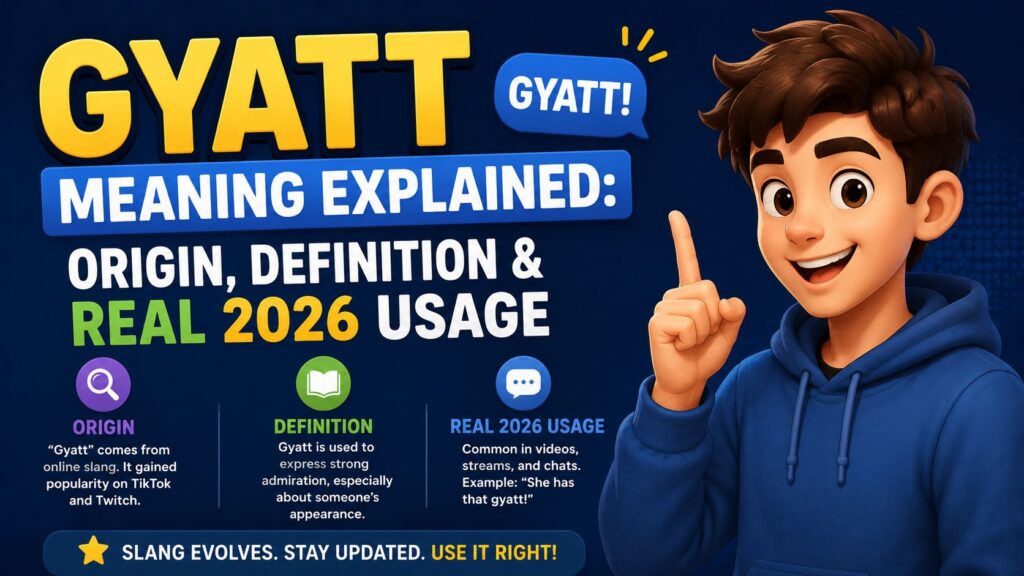
Short answer: not really, and any article that tells you gyatt meaning means something different” on five different apps is stretching the truth to pad out a word count. The core definition holds steady everywhere. What does change is tone and frequency.
TikTok is where the word achieved true mainstream social engagement, largely through captioned short videos and comment threads. Instagram usage mirrors TikTok closely, mostly showing up in comments under photos or reels. On Snapchat and other private messaging apps, it tends to appear more casually between friends who already share the same slang, without needing to explain it. WhatsApp sees far less of it simply because that platform skews toward an older, more international user base less immersed in Gen Z slang.
YouTube and Twitch remain the word’s real native environment — the place it was born and still gets used most naturally, particularly in reaction videos and live gaming streams. If you want to see the word used exactly the way it was intended, that’s where to look.
Here’s a side-by-side look at how the same word shows up slightly differently depending on where you encounter it:
| Platform | How it typically appears | Who’s mostly using it |
|---|---|---|
| TikTok | Video captions, comment threads, remixed audio clips | Broad Gen Z and Gen Alpha audience |
| Comments under reels and photos | Similar to TikTok, slightly older skew | |
| Twitch | Live chat spam during streams | Esports audience, online gamers, regular viewers |
| YouTube | Comment sections under clips and reaction videos | Streaming fans, gaming circles |
| Snapchat | Casual private messaging between friends | Close friend groups already familiar with the slang |
| Rare, occasional use in younger family or friend groups | Smaller, less consistent usage |
The takeaway: the word doesn’t change shape from platform to platform. What changes is the format it shows up in — a shouted chat message on Twitch looks different from a typed comment on Instagram, but the underlying gyatt meaning stays identical.
ALSO READ: Sigma Meaning Slang: What It Really Means in Modern Conversations (2026)
Who Uses Gyatt — Demographics, Age Groups & Social Dynamics
Gyatt is overwhelmingly a youth slang term, driven primarily by teenagers and young adults immersed in streaming culture and short-form content. It’s closely tied to what researchers and linguists generally describe as Generation Alpha and younger Generation Z usage — the age groups who grew up watching livestream clips rather than discovering slang through older word-of-mouth channels.
There’s a genuine generational split in how the word gets used, too. Among the age groups who grew up with it, gyatt often carries irony and self-aware humor — it’s used as much for comedic effect as literal meaning. Among much younger users, particularly Gen Alpha, the term tends to get used more sincerely, as an everyday reaction word without the layer of self-awareness older users bring to it.
This split explains a common awkward moment: when an older millennial or a parent tries to use gyatt, it frequently lands wrong — not because the definition is misunderstood, but because the timing and tone miss the mark that younger native speakers of the slang pick up on instantly.
There’s also a clear gender dynamic worth naming honestly. The word originated as commentary directed at women’s bodies, and that usage still exists. But its expansion into a general hype word means plenty of usage today has nothing to do with gender at all — teenagers of any gender now use it to react to gameplay, food, weather, or just about anything mildly surprising. Both realities are true at once, and pretending otherwise (either by claiming it’s always about appearance, or that it never is anymore) misrepresents how the word actually functions in everyday conversations.
Gyatt vs. Similar Slang — What’s the Difference?
Gyatt doesn’t exist in isolation. It’s part of a broader wave of viral vocabulary that’s reshaped how younger users communicate online. Here’s how it stacks up against its closest cousins.
| Term | Core meaning | Typical use case |
|---|---|---|
| Gyatt | Exclamation of shock/admiration; also a noun for an attractive figure | Reacting to something impressive or physically striking |
| Sheesh | General exclamation of amazement or approval | Reacting to skill, talent, or an impressive moment |
| Rizz | Charisma, especially in a romantic or flirtatious sense | Describing someone’s ability to attract or charm others |
| Skibidi | Largely meaningless, meme-derived filler word | Used for absurdist humor, tied to a specific viral video series |
The key difference between gyatt and something like “sheesh” is specificity. Sheesh is pure, contextless hype — it can react to literally anything. gyatt meaning carries a heavier connection to body appearance and physical reaction, even when it’s used more generally now. That inherited weight is exactly why it needs more context-awareness than a word like “sheesh” does.
How to Respond When Someone Says Gyatt
If someone directs the word at you, your response should match the tone it was clearly meant in — but you’re never obligated to play along if it doesn’t sit right.
If It’s Directed at You — Confident Responses That Work
A few easy, low-stakes replies that keep things light without over-explaining:
- “Ha, thanks I guess?”
- “Okay okay, noted.”
- A simple laughing emoji reaction works fine too — you don’t owe anyone a full sentence back.
When to Laugh It Off vs. When to Set a Boundary
Context is everything here. A friend using it as a joke in a private chat is completely different from a stranger commenting it, uninvited, on a public photo. If it feels like a harmless joke among people you know, laughing it off is the easiest path. If it feels invasive, dismissive, or comes from someone you don’t know, you’re entirely within your rights to ignore it, delete it, or say directly that it’s not something you want directed at you. Nobody is required to accept a comment about their appearance just because it’s phrased as slang instead of a plain compliment.
Quick Chat-Style Response Examples
| Situation | Sample response |
|---|---|
| Friend jokes with it in a group chat | “Lmaooo stop 😭” |
| Used as hype after you did something impressive | “Yooo appreciate it” |
| Stranger comments it on a public post | Ignore, or reply with a simple boundary if needed |
| Someone uses it sincerely as a compliment | “Aw thank you!” |
When to Use Gyatt — and When to Absolutely Avoid It
Slang like this thrives in casual spaces and dies fast in formal ones. Knowing the difference keeps you from an awkward moment.
Appropriate Contexts
Gyatt fits naturally in:
- Group chats with friends who already use similar slang
- Comment sections on TikTok, Instagram, or YouTube among peers
- Reacting to gaming streams, clips, or reaction videos
- Casual conversations where humor and exaggeration are already the tone
Situations Where It Goes Wrong Fast
Avoid it around:
- Anyone significantly older who doesn’t already use internet slang themselves
- Strangers, especially in comment sections directed at their appearance
- Any conversation where the tone is already serious or sensitive
The Workplace, Classrooms, and Professional Settings — Hard No
This one deserves zero ambiguity. Professional settings, office environments, formal communication, and academic settings are not places for this word, full stop. It doesn’t matter how casual your workplace culture feels — gyatt carries enough connection to commentary on physical attractiveness that using it about a coworker, classmate, or client isn’t a slang misstep; it’s a genuine professionalism and respect issue. Save it for group chats. Leave it out of emails, meetings, and anything with your name attached in an official capacity.
A useful gut check: if you wouldn’t say “damn, look at that” out loud to the person’s face in that setting, don’t type the slang version either. The playful wrapper doesn’t change what the comment actually is. HR complaints have been built on far less than an unsolicited gyatt meaning typed into a company Slack channel, and it’s not worth testing that boundary to get a laugh.
ALSO READ: What Does RS Mean in Text Must-Know 🔥 2026
Gyatt’s Popularity Over Time — Is It Still Relevant?
Viral slang almost always follows a predictable arc: a sharp spike, a plateau, and then a slow fade as new terms take its place. Gyatt has already been through its steepest climb — the 2022–2023 window was its peak moment, driven by the Kai Cenat push and the wave of TikTok content that followed.
Is Gyatt Fading or Holding Its Ground?
By 2025 and into 2026, gyatt has settled into a familiar pattern for viral internet expression: it’s no longer the fresh, dominant term it was at its 2022–2023 peak, but it hasn’t disappeared either. It’s become embedded enough in online language — and formally recognized enough by major dictionaries — that it now functions more like an established slang fixture than a fleeting trend. That’s actually rare. Most viral posts and hashtag-driven slang terms burn out completely within a year or two. Gyatt’s dictionary recognition suggests staying power beyond the usual viral lifespan.
What Usually Happens to Viral Slang Terms
Compare gyatt’s trajectory to past internet slang, and a pattern emerges. Terms like “on fleek” spiked hard and vanished almost entirely within a couple of years. Others, like “no cap” or “sus,” stuck around far longer because they got adopted into general digital language well beyond their original niche. gyatt meaning looks closer to the second category — it’s been absorbed into broader meme language and general reaction vocabulary rather than staying tied exclusively to its streaming origins, which is usually the strongest sign a slang term will outlast its initial viral wave.
FAQs
Is gyatt still used in 2026?
Yes. It’s holding steady rather than fading, with continued volume in TikTok comments, Instagram, gyatt meaning and gaming chats as a standard reaction term in everyday Gen Z speech, not just as irony.
Is gyatt in the dictionary now?
Yes, Merriam-Webster carries an official slang entry, most recently updated April 1, 2026, confirming it’s moved from meme to documented internet slang.
Is gyatt offensive?
Not inherently, but since it’s widely used to describe women’s bodies, Merriam-Webster notes it can be seen as mildly offensive depending on context.
Does gyatt only refer to appearance now?
No. It’s split into two active lanes: a general hype reaction to anything impressive, and a more specific comment on physical attractiveness — usage depends entirely on context.
Where is gyatt used most in 2026?
Mainly TikTok, Instagram comments, and Discord/gaming chats, though it’s largely confined to casual online language rather than spoken or formal settings.
conclusion
So there you have it: gyatt meaning boils down to a simple reaction word with a wild backstory. It started as a streamer’s accent joke and turned into dictionary-approved slang. Not bad for one word.
Next time you see it in a comment or hear it in a stream, you’ll know exactly what’s going on. That’s really the whole point of learning gyatt meaning — staying in the loop, not out of it. Use it with friends, skip it at work, and read the room. That’s all the rule you need.

Hi! I’m Jenson, the writer behind punslush.com. I craft clever puns and witty wordplay designed to entertain and inspire. Visit punslush.com for a good dose of humor and fun!