
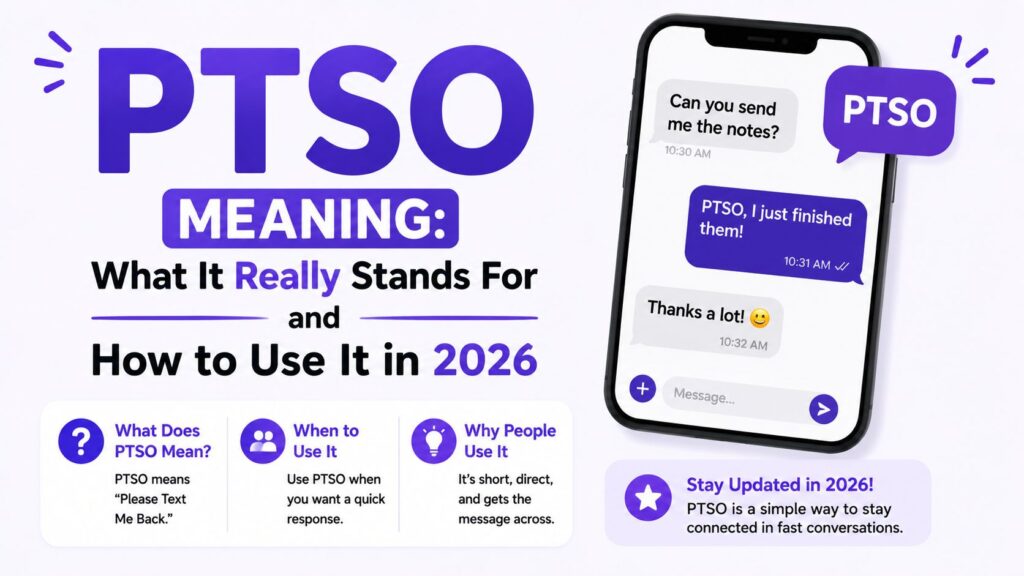
PTSO meaning comes down to one clear definition: Parent Teacher Student Organization, a school organization where parents, teachers, and students team up to support the school community through fundraising, events, and shared decision-making.
But here’s the twist nobody warns you about: type “PTSO” into a text or social caption, and you’ll land in a completely different world, one full of hype, outfits, and internet slang that has nothing to do with school at all.
Two meanings, one acronym, zero overlap. This guide breaks down both sides clearly, from PTSA and PTA comparisons to the real story behind the slang version, so you’ll never second-guess “PTSO” again.
The Short Answer: What PTSO Actually Means
Here’s the PTSO definition in one line: PTSO stands for Parent Teacher Student Organization. It’s a school organization made up of parents, teachers, and students who work together to support a school and its school community.
That’s the dominant meaning, and it’s the one you’ll find in school email threads, on a parent bulletin, or printed on a school flyer announcing the next meeting.
But here’s the twist. PTSO also lives a second life as internet slang. On TikTok, Instagram, and X, it shows up as a hype phrase people use to compliment someone’s outfit or confidence. Same acronym, two unrelated meanings, and almost zero overlap in how or where each one gets used.
A quick way to remember it:
| If you see PTSO… | It probably means… |
|---|---|
| In a school email or parent group chat | Parent Teacher Student Organization |
| In a comment on a fashion post or TikTok | Internet slang (see below) |
| In a text from your kid’s school | Parent Teacher Student Organization |
| In a caption with an outfit photo | Internet slang |
Context solves the mystery almost every time. Let’s dig into both meanings properly, starting with the one that matters most for parent involvement and school support.
PTSO in Schools: Parent Teacher Student Organization

When schools use the term, the PTSO full form is always the same: Parent Teacher Student Organization. It’s a volunteer-run group that brings parents, teachers, and — critically — students into the same room to make decisions about school life.
Think of it as a parent group with one key upgrade. Traditional parent groups talk about students. A PTSO invites students to talk with everyone else, as equal voices in the conversation.
What a PTSO Actually Does
A typical PTSO handles a mix of practical and community-building work. The exact list varies by school, but most fall into a few recurring categories:
- Fundraising — book fairs, walk-a-thons, bake sales, and galas that fund supplies, programs, or scholarships the school budget can’t stretch to cover
- Event planning — dances, spirit weeks, teacher appreciation days, and family nights
- Communication — bridging gaps between families, teachers, and administration through school updates, meeting recaps, and newsletters
- Teacher support — classroom supply drives, appreciation gifts, and small grants for classroom projects
- Student advocacy — giving students a formal channel to raise concerns and propose changes, from cafeteria menus to start times
That last point is what separates a PTSO from a plain parent organization. Students aren’t just discussed in meetings — in many PTSOs, they hold seats, vote on proposals, and chair committees alongside adults.
Why Schools Choose PTSO Over PTA or PTO
Schools generally land on the PTSO model for one specific reason: they want students formally included in school governance, not just informed after decisions get made.
This structure shows up most often in middle schools and high schools, where students are old enough to meaningfully participate in planning, fundraising strategy, and policy conversations. Elementary schools lean toward a plain Parent Teacher Organization (PTO) instead, since younger kids aren’t typically ready for officer roles or voting responsibilities.
There’s also a flexibility factor. Because a PTSO is usually independent — not affiliated with a national body — it can build its own bylaws and adapt them however the school community needs, without waiting on approval from a state or national office.
PTSO vs. PTA vs. PTO vs. PTSA: What’s the Real Difference
This is where most people get tangled up, and honestly, it’s not their fault — the acronyms are close enough to blur together. Here’s the breakdown that actually clears things up.
Parent Teacher Association (PTA) is the oldest and most recognizable of the bunch. It’s affiliated with the national PTA, founded back in 1897. Local chapters pay dues, follow standardized bylaws, and gain access to national advocacy resources, leadership training, and liability insurance. If you grew up hearing “PTA meeting tonight,” this is the group your parents were talking about.
Parent Teacher Organization (PTO) is the independent parent group version. No national affiliation, no mandatory dues, no standardized rulebook beyond local, state, and federal law. Each PTO writes its own bylaws and keeps 100% of its fundraising local. This local governance model gives PTOs a lot of freedom, but it also means they don’t get the built-in resources a parent association tied to a national network would have.
Parent Teacher Student Organization (PTSO) takes the PTO’s independence and adds one major feature: formal student membership. Students don’t just attend — they can hold officer positions, chair committees, and vote, depending on the group’s bylaws.
Parent Teacher Student Association (PTSA) is the one almost every other article on this topic skips, and it’s the piece that actually explains most of the confusion. A PTSA is the national PTA-affiliated version of a PTSO. It follows national guidelines, collects dues, and includes students as formal members — combining PTA structure with PTSO-style student inclusion.
Here’s the full picture in one table:
| Group | Full Form | National Affiliation | Dues Required | Students Included as Members |
|---|---|---|---|---|
| PTA | Parent Teacher Association | Yes (National PTA) | Yes | No |
| PTO | Parent Teacher Organization | No | No | No |
| PTSO | Parent Teacher Student Organization | No | Sometimes (small, optional) | Yes |
| PTSA | Parent Teacher Student Association | Yes (National PTA) | Yes | Yes |
As one school partnership coordinator put it in a district newsletter, the goal across all four models is basically the same: “Building a bridge between school and home.” The differences are really about structure, not mission.
How to Join or Start a PTSO at Your Child’s School
Joining a PTSO is usually simple:
- Check the school website, front office, or school newsletter for the next meeting date
- Attend an introductory meeting — most are open to any parent, teacher, or student
- Volunteer for a committee or event that fits your schedule
- Register as a member if the group requires it (often a small optional fee)
- Show up consistently — student participation and parent turnout are what keep these groups functional
Starting one from scratch takes a bit more groundwork, but it’s not complicated:
- Gauge interest first. Talk to a handful of other parents, a few teachers, and students who’d actually want to participate. You need a committed core before you need paperwork.
- Loop in the principal early. A PTSO without administrative buy-in runs into walls fast — room access, communication channels, and fundraising approval all go through the school.
- Draft simple bylaws. Define officer roles, voting rules, and membership terms in language new members can actually understand.
- Hold an election. Fill your core officer positions — president, vice president, secretary, treasurer — and open at least a few seats specifically for students.
- Set a meeting rhythm. Monthly works well for most schools and keeps momentum without becoming a burden on volunteers.
Common PTSO Roles
Most PTSOs mirror standard nonprofit-style leadership, with one addition that makes them unique:
| Role | Typical Responsibilities |
|---|---|
| President | Runs meetings, sets agenda, represents the group to administration |
| Vice President | Supports the president, often leads a major event or committee |
| Secretary | Takes minutes, handles official communication |
| Treasurer | Manages funds, tracks fundraising, reports on the budget |
| Committee Chairs | Lead specific initiatives — fundraising, events, teacher appreciation |
| Student Officers/Representatives | Vote on proposals, chair student-focused committees, bring peer feedback directly to the group |
That last row is the whole point of the “S” in PTSO. Without it, you’re just describing a PTO.
Why “PTSO” Is Also Showing Up as Internet Slang
Outside of school context, PTSO has picked up an entirely different identity in texting slang and social slang. If you’ve seen it under a photo on Instagram or in a TikTok comment section, the school meaning almost certainly isn’t what’s being used.
The Real Origin (With the Correction Most Articles Get Wrong)
The slang version of PTSO stands for “Put That S* On”** — a hype phrase used as a compliment, usually about someone’s outfit, style, or overall confidence. It traces back to rapper Key Glock’s 2022 track titled “PTSO,” which helped push the phrase into mainstream online slang through TikTok and Instagram.
Here’s the part worth flagging directly: a lot of the content floating around online misattributes this origin to a different artist entirely, or invents unrelated meanings like “Please Turn Something Over.” If you’re researching this term, treat single-source claims with skepticism — the version tied to Key Glock’s track is the one that shows up consistently across multiple independent references, not the one-off guesses.
A typical use in the wild looks like this:
“Your jacket is fire! You really PTSO with that fit 😎”
That’s the tone. It’s a compliment, not an instruction, even though the literal phrase sounds like a command.
How to Tell Real Slang From Made-Up SEO Slang
This matters more than it sounds like it should. A lot of low-quality content online exists purely to catch search traffic, and acronym pages are some of the worst offenders. Here’s a simple test:
- Real slang shows up consistently across independent sources — song lyrics, genuine social media threads, and multiple unconnected write-ups that agree on the same core meaning.
- Invented slang tends to appear only on acronym-farm websites, often listed alongside four or five other unrelated “meanings” for the same term, with zero real examples of anyone actually using it that way.
If a site tells you PTSO simultaneously means “Put That Stuff On,” “Process, Track, Solve, Optimize,” and “Post-Traumatic Stress Outcome” — all in the same article, with no citations for any of them — that’s a strong signal you’re reading SEO filler, not a real usage pattern. Genuine chat abbreviation meanings don’t usually multiply that fast without any real-world evidence backing them up.
What to Do If Someone Texts You “PTSO” and You’re Not Sure What They Mean
Context almost always gives it away. Ask yourself:
- Is this thread about a school event, volunteering, or your kid’s class? → Parent Teacher Student Organization
- Is this about an outfit, a photo, or general hype? → Slang compliment
- Is this in a group chat with other parents? → Almost certainly the school meaning
- Is this a direct message reacting to a selfie or fit pic? → Almost certainly the slang meaning
When genuinely unclear, it’s fine to just ask. A simple “wait, PTSO like the school thing or…?” clears it up faster than guessing.
Other Legitimate Meanings of PTSO
Beyond the two dominant meanings, PTSO occasionally shows up in a few workplace communication contexts — though these are far less common and worth only a brief mention:
- Program Technical Support Office or Project Technical Support Office — used in some government or corporate settings for internal technical support teams
- Occasional shorthand in aviation or logistics documentation, though usage here is inconsistent and not standardized
Worth being direct about what to skip: claims that PTSO stands for something like “Post-Traumatic Stress Outcome” in medical settings, or “Process, Track, Solve, Optimize” in business writing, don’t hold up under scrutiny. These show up on a handful of low-quality acronym sites with no real citation trail, no examples of actual clinical or corporate usage, and no consistency between sources. Treat them as noise, not genuine PTSO acronym meanings.
Common Mistakes People Make With PTSO
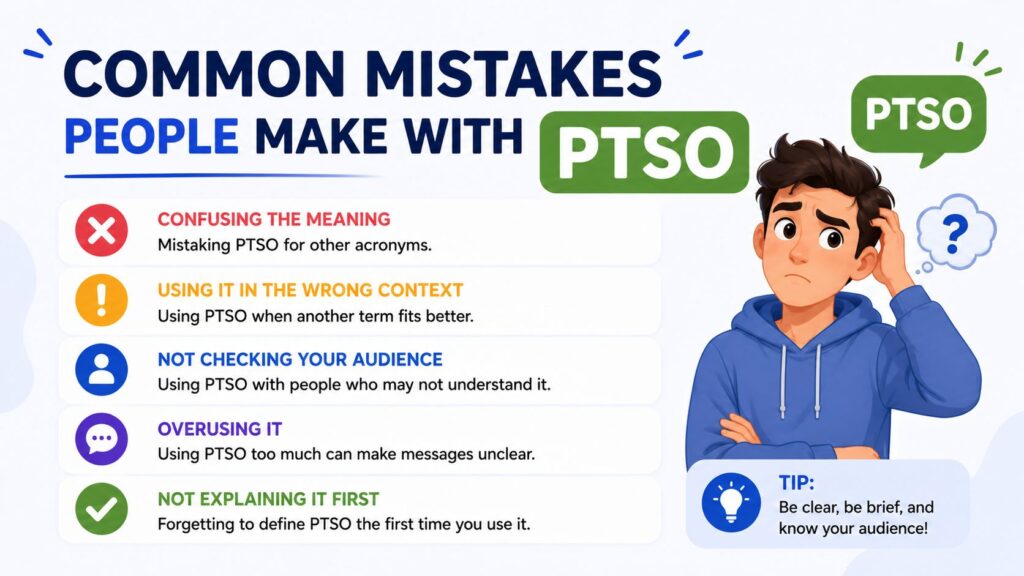
A few frequent errors and misconceptions come up again and again:
- Confusing PTSO with PTSD. These are visually similar acronyms, and it’s an easy typo to make — especially on mobile keyboards. If the conversation has nothing to do with school, double-check before assuming the school meaning.
- Assuming every “parent group” with an S in the name formally includes students. Some schools use “PTSO” loosely as a rebrand of what’s structurally still a PTO, without actually giving students voting rights. If student involvement matters to you, ask directly rather than assuming from the name alone.
- Using the slang meaning in professional settings. Dropping “PTSO” in a formal email or office communication thread — intending the slang meaning — will land badly and confuse colleagues who only know the school version, or vice versa.
- Mixing up PTSO and PTSA. Since PTSA includes national affiliation and PTSO usually doesn’t, this mix-up can lead to wrong assumptions about dues, resources, or governance structure.
Best Practices for Using and Interpreting PTSO Correctly
A few habits eliminate almost all the confusion and misunderstandings:
- Spell it out on first use in any formal document, school newsletter, or school email — “Parent Teacher Student Organization (PTSO)” — before switching to the acronym
- Confirm context before assuming meaning, especially in mixed-audience messaging apps or chat conversations where both meanings could theoretically apply
- Never use the slang version in professional settings — it contains mild profanity in its uncensored form and simply doesn’t belong in business writing
- Check your state and school district’s naming conventions before starting a new group, especially if you might want national affiliation (a PTA or PTSA structure) down the line
- Ask instead of guessing when a text message or direct message leaves the meaning genuinely unclear
Quick Comparison Table: PTSO Meanings at a Glance
| Meaning | Context | National Affiliation? | Students Formally Included? | How Common |
|---|---|---|---|---|
| Parent Teacher Student Organization | Schools, school events, education community | No | Yes | Common, especially in middle/high schools |
| Parent Teacher Student Association (PTSA) | Schools with national ties | Yes | Yes | Less common than PTSO, more structured |
| Parent Teacher Association (PTA) | Schools, teacher association | Yes | No | Very common, especially older/legacy groups |
| Parent Teacher Organization (PTO) | Schools, mostly elementary | No | No | Very common |
| “Put That S*** On” | Social media, online platforms, social networks | N/A | N/A | Moderate on Gen Z-heavy platforms, low elsewhere |
FAQs
What does PTSO mean?
PTSO stands for Parent Teacher Student Organization, a school-based group where parents, teachers, and students work together to support the school community. It also has a separate slang meaning online, tied to a 2022 Key Glock track, where it means “Put That S*** On.”
Is PTSO the same as PTA?
No. A PTA is affiliated with the National PTA, follows national bylaws, and charges dues, while a PTSO is typically independent and formally includes students as members.
What’s the difference between PTSO and PTO?
A PTO includes only parents and teachers, while a PTSO adds formal student membership, often with voting rights and officer positions.
Can students actually vote in a PTSO?
Yes, depending on the group’s bylaws — many PTSOs give students full or advisory voting rights, especially in middle and high schools.
Is it okay to use PTSO in professional or formal writing?
Only when referring to the actual school organization, and spell it out on first use. The slang meaning contains mild profanity and doesn’t belong in professional communication.
conclusion
The PTSO meaning really comes down to two simple ideas. In schools, it means parents, teachers, and students working together. Students get a real voice, not just a mention. That’s what makes it different from a PTA or PTO.
Online, the PTSO meaning shifts completely. It becomes a fun compliment, not a school term. Context always tells you which one is being used. Now you know both sides. No more guessing when you see “PTSO” pop up in a text, email, or comment.

Hi! I’m Jenson, the writer behind punslush.com. I craft clever puns and witty wordplay designed to entertain and inspire. Visit punslush.com for a good dose of humor and fun!