
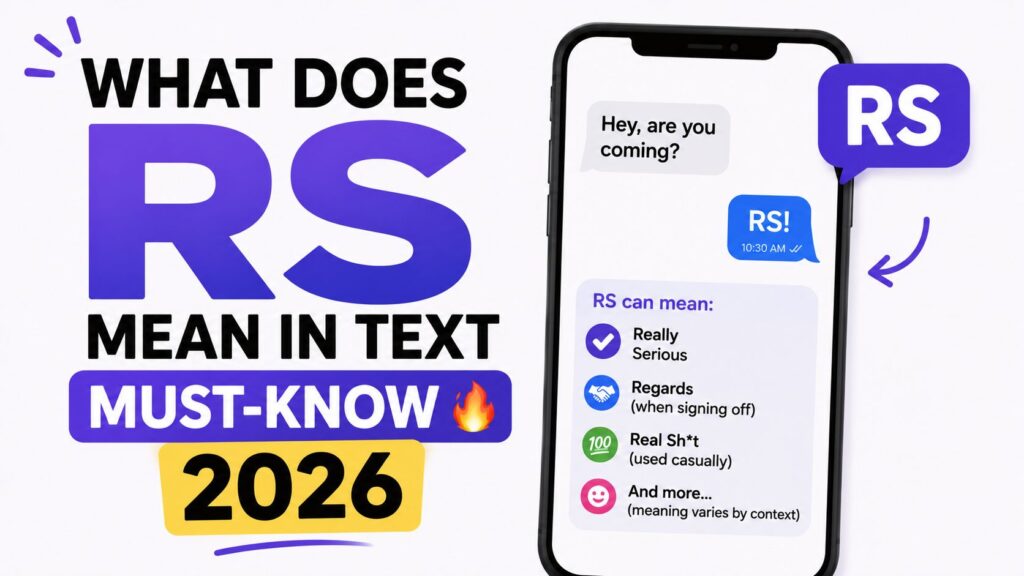
RS in text is internet slang that most often stands for “Real Sh*t” or its cleaner cousin, “Real Stuff.” People drop it into casual conversations to back up something honest, add emphasis to a statement, or show strong agreement without typing a full sentence.
Two letters, endless confusion. One text and RS means raw honesty; the next, it’s rupees, RuneScape, or a polite way of saying “respectfully.” Same abbreviation, completely different worlds colliding in your inbox.
This guide breaks down every real meaning behind RS, shows exactly how context reveals which one applies, and walks through platform-by-platform examples so you’ll never misread a message again. By the end, decoding RS becomes second nature.
Quick Answer: What Does RS Mean in Text?
In the vast majority of casual conversations, RS stands for “Real Sh*t.” It’s a piece of internet slang used to back up something someone just said — a way of saying “that’s true,” “I agree completely,” or “no joke, that’s exactly how it is.”
Some people soften the phrase into a clean version for more polite company, writing it out as “Real Stuff” instead. Same intent, slightly gentler wording. Either way, the function is identical: RS adds weight to a statement. It tells the other person you mean what you’re saying, and you mean it with your whole chest.
Here’s the catch, though. RS isn’t a one-meaning abbreviation. Depending on the platform, the country, or the community you’re chatting in, RS can also point to:
- Rupees (a currency reference, especially common in South Asia)
- RuneScape (a reference to the long-running online game)
- Respectfully (used to soften pushback, mostly on X)
- Relationship (a rare, lazy-typing shorthand)
We’ll walk through each one. But first, let’s talk about why this little texting acronym caught on in the first place.
ALSO READ: PTSO Meaning: What It Really Stands For and How to Use It in 2026
Why Do People Use RS in Text Messages?
Typing takes time. Even with autocorrect and swipe keyboards, spelling out full sentences during a fast-moving conversation slows things down. That’s the entire reason chat abbreviations exist — from LOL to BRB to RS. People want to communicate quickly without losing the emotional punch of what they’re actually trying to say.
RS specifically fills a gap that other slang doesn’t quite cover. Think about the difference between these two replies to a friend venting about a rough day:
“Yeah, that sounds annoying.”
versus
“RS, that’s exactly how I feel too.”
The second one hits differently. It’s shorter, but it carries more emphasis. It signals that you’re not just passively acknowledging what someone said — you’re validating it as genuine, truthful, and worth taking seriously. That’s the core appeal of RS: two letters that do the emotional work of a full sentence.
There’s also a cultural layer here. RS has roots in African American Vernacular English (AAVE) and hip-hop speech, where the full phrase “real sht” has been used for decades as a way to flag authenticity. As digital communication evolved and messaging apps made short-form replies the norm, that phrase got trimmed down to fit the pace of modern texting. Urban Dictionary has documented the “real sht” definition of RS since at least 2017, describing it as agreeing “at a strong level” — which lines up with how people still use it today.
So when you see RS pop up in a group chat, it’s not random keyboard mashing. It’s a shorthand with real linguistic roots, adapted for a world where everyone is typing on a five-inch screen.
Main Meaning of RS: “Real Sh*t” Explained
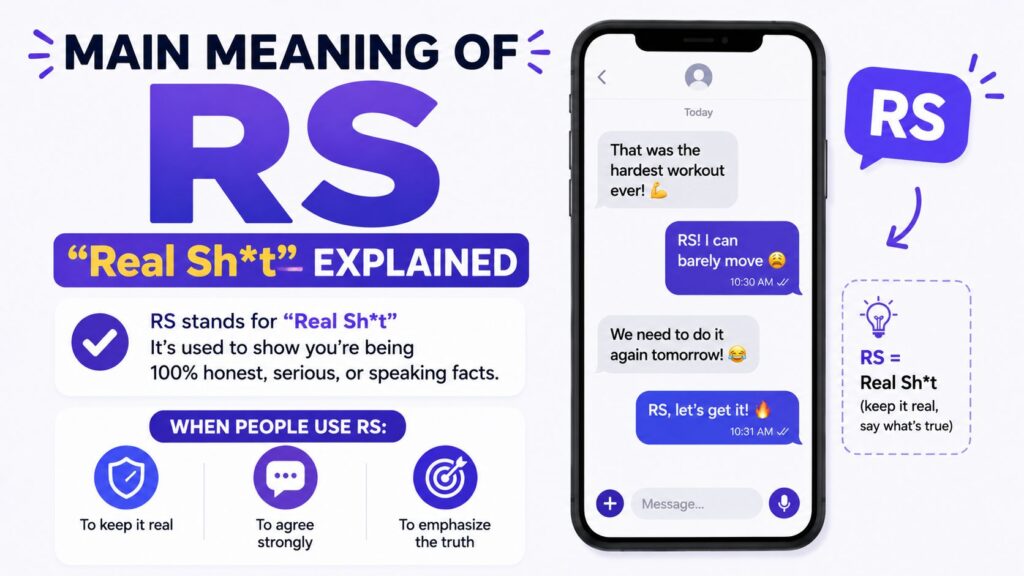
Let’s slow down on this one, because it’s the meaning you’ll run into most often across social media platforms and casual conversations.
“Real Sh*t” works as an intensifier. It doesn’t really translate word-for-word into a dictionary definition — it’s more of a vibe than a phrase. When someone types RS after a statement, they’re doing one of a few things:
| Function | What It Signals | Example |
|---|---|---|
| Confirming honesty | “I’m not exaggerating” | “This class is actually impossible. RS.” |
| Strong agreement | “I feel that completely” | Friend: “Mondays should be illegal.” You: “RS.” |
| Adding weight to venting | “This is a serious message, not a joke” | “I haven’t slept properly in a week, RS.” |
| Reacting to something shocking | “No cap, that’s wild” | “She really said that to your face? RS?” |
Notice that last row — RS can also function as a question. When someone types “RS?” with a question mark, they’re usually asking “are you serious?” or “is that actually true?” It’s a quick way to check whether the other person is being straight with them.
Here’s a short exchange that shows both uses in action:
Maya: I think I’m actually going to quit my job next month. Jordan: RS? Maya: Yeah. RS, I can’t keep doing this to myself.
In that one conversation, RS shows up twice — first as a question checking for authenticity, then as a statement reinforcing it. That flexibility is part of why the term spread so fast.
One more thing worth knowing: because the full phrase contains a swear word, plenty of people avoid spelling it out even in casual texting. Using the abbreviation lets them keep the meaning and the emotional punch without typing something they’d rather not send to, say, a grandparent or a coworker who happens to be in the group chat. That’s the whole reason the clean version — “Real Stuff” — exists. Same energy, more polite wording.
Other Possible Meanings of RS in Text
Now here’s where it gets interesting. RS isn’t locked into one definition the way some slang is. Depending on where the conversation is happening, the letters can point somewhere completely different. Below are the meanings that actually show up with real, documented usage — not made-up guesses.
Rupees
In Pakistan, India, Sri Lanka, and other parts of South Asia, Rs (sometimes written RS. or ₨) is the everyday shorthand for the local currency — rupees. This has nothing to do with slang or online messaging culture. It’s just standard financial notation, the same way “$” stands in for dollars.
If someone messages you “Rs 500 for this?” they’re almost certainly talking about a price, not agreeing enthusiastically with something you said. Context does all the heavy lifting here. A number sitting right next to RS is one of the clearest signals you’ll get that the currency meaning applies.
RuneScape
For gamers, particularly anyone active in Discord servers, gaming forums, or multiplayer communities, RS is shorthand for RuneScape — the massively popular MMORPG that’s been running since the early 2000s. In a gaming context, you’ll see RS used constantly:
- “Anyone want to grind RS tonight?”
- “I haven’t logged into RS in months.”
- “RS servers are down again.”
This meaning has staying power because RuneScape itself has stayed relevant for over two decades, with an active player base that still uses the abbreviation as second nature. If the conversation is happening in a gaming community, RuneScape is very likely what’s being referenced, especially if there’s no emotional statement right before it.
Respectfully
This one’s less well known outside of X (Twitter) culture, but it’s genuinely common in reply threads and quote posts. When people want to disagree with something without sounding aggressive, they’ll open with RS as shorthand for “Respectfully.”
Example: “RS, this policy makes absolutely no sense.”
It’s a softening device — a way of saying “I’m about to push back, but I’m not trying to start a fight.” This use case has grown alongside the platform’s debate-heavy culture, where quick, pointed replies are the norm and tone can be hard to read without some kind of signal attached.
Relationship (Rare Usage)
This last one is uncommon, but it does show up occasionally, mostly among people who type fast and skip vowels or shorten anything over five letters. In this context, RS is just lazy shorthand for “Relationship.” You might see it in a bio, a status update, or a quick text like “not looking for an RS rn.” It’s far less common than the other meanings on this list, but it’s real enough to be worth knowing.
A Quick Case Study: How One Word Sparked a Thousand Confused Replies
To understand just how much confusion context — or the lack of it — can cause, it helps to look at a real pattern that keeps repeating across online forums and comment sections.
A user on a South Asian marketplace app once posted a product listing that read: “Rs 3000, negotiable.” Within minutes, a handful of comments from international buyers unfamiliar with the currency shorthand piled up, asking things like “wait, is this a joke?” and “RS as in real sh*t 3000?” The seller had to clarify, twice, that Rs simply meant rupees — a completely mundane price tag that had nothing to do with slang at all.
Flip that scenario around, and you get the opposite problem. A Gen Z user replying “RS” to a friend’s emotional Instagram story once got a reply back from an older relative asking, quite genuinely, “how much money do you need?” The relative had only ever encountered RS in a financial context and assumed the currency meaning applied, even though the conversation had nothing to do with money.
Neither person was wrong. Both were simply applying the meaning of RS that was most familiar to them. That’s the real lesson buried in these mix-ups: RS meaning isn’t fixed. It’s shaped entirely by who’s reading it and what world they spend their time in online. A teenager scrolling TikTok comments and a shopkeeper messaging a customer are both using the exact same two letters, but they’re speaking two completely different languages that just happen to share an abbreviation.
This is also why interpretation matters so much more with RS than with most other slang. Terms like LOL or BRB have basically one meaning across the entire English-speaking internet. RS doesn’t have that luxury — it’s a genuine homograph of the texting world, and reading it correctly takes a little bit of situational awareness every single time.
The Psychology Behind Why RS Feels So Powerful
There’s a reason two letters can carry so much emotional weight. Linguists who study digital communication point out that short, emphatic slang terms like RS work because they mimic the rhythm of real speech — specifically, the way people naturally add emphasis in spoken conversation without needing extra words.
Think about how someone might say “no, for real” out loud, dropping their voice slightly and slowing down to signal sincerity. Texting can’t capture tone of voice, pacing, or facial expression, so texting language had to invent workarounds. RS is one of those workarounds. It compresses an entire vocal cue — sincerity, weight, emphasis — into two characters that take less than a second to type.
That’s also why RS tends to show up right after something emotionally loaded rather than in neutral small talk. Nobody texts “RS” after “the weather’s nice today.” It shows up after confessions, complaints, surprising news, or blunt opinions — moments where the sender wants to make sure their honest statement actually lands the way they intended it to. In a format where sarcasm, jokes, and genuine feeling can all look identical on a screen, RS acts as a small flag planted next to the truth.
This is part of a much bigger pattern in online slang. Nearly every generation of internet users has invented some version of an “I’m not joking” signal — from “no cap” to “fr fr” to “on god.” RS belongs to that same family. It just happens to be one of the more flexible ones, since its letters double as shorthand for completely unrelated concepts depending on the platform.
RS in Everyday, Non-Slang Situations
It’s easy to get so focused on the slang meaning that the more mundane, functional uses of RS get overlooked. But plenty of everyday chat and daily communication relies on RS in ways that have nothing to do with emphasis or honesty at all.
Retail and e-commerce messages across South Asia use Rs constantly as standard currency notation — it’s built into how prices get quoted in SMS, WhatsApp, and casual marketplace listings. Customer service chats, delivery confirmations, and even automated payment receipts often display “Rs” the same way a receipt in the U.S. might display a dollar sign.
In some corporate and technical contexts, RS can also stand in for terms like “Reservation System” or, occasionally, “Response,” though these usages are far less common in day-to-day online messaging and mostly show up in internal business documentation rather than casual conversations. If you ever see RS used this way, it’s almost always inside a formal document or system-generated message, not a text from a friend.
The takeaway here is simple: not every RS is trying to be clever or emotional. Sometimes it’s just doing an administrative job, quietly, in the background of a receipt or a price tag.
RS Meaning by Context: Quick Reference Table
Because context changes everything with this abbreviation, here’s a table you can scan quickly the next time you’re staring at an unexplained RS in your messages.
| Context Clue | Likely Meaning | Where You’ll See It |
|---|---|---|
| Follows an emotional or honest statement | Real Sh*t / Real Stuff | Snapchat, Instagram, TikTok, group chats |
| Has a number right before or after it | Rupees | WhatsApp messages, South Asian conversations, online marketplaces |
| Appears in a gaming server or Discord | RuneScape | Discord, gaming forums, Reddit gaming threads |
| Opens a disagreement or pushback reply | Respectfully | X (Twitter) replies and quote posts |
| Used in a bio or dating-related text | Relationship | Dating app bios, casual texting about dating status |
Keep this table in mind as a mental checklist. Ask yourself: what platform am I on, and what was said right before RS showed up? Nine times out of ten, those two questions will get you to the right answer.
How RS Is Used on Social Media
Different social media platforms lean toward different meanings, mostly because each platform has its own culture, pace, and typical audience. Here’s a breakdown of how RS tends to function on each one.
Instagram. RS shows up constantly in comment sections, usually reacting to something relatable. Someone posts a caption about a rough week, and the top comment reads “RS 😭.” It’s short, expressive, and fits the platform’s fast-scrolling, comment-heavy culture perfectly.
Snapchat. This is arguably where the slang meaning feels most natural. Snapchat conversations move fast, streaks keep things casual, and RS fits right into that low-effort, high-meaning communication style. A quick “RS” reply to a Snap keeps the back-and-forth moving without slowing anyone down.
TikTok. In comment sections under relatable videos, RS usually functions as “I’m serious” or “no joke, that’s real.” It often shows up stacked with other slang like “fr fr” or “no cap,” reinforcing the same idea from multiple angles.
X (Twitter). As covered above, this is the platform where the “Respectfully” meaning gets the most use, especially in reply threads where people are pushing back on a take without wanting to sound combative.
WhatsApp. Here, meaning depends heavily on the audience. Among South Asian users, Rs as a currency reference is extremely common in everyday messaging apps conversations. Among younger, English-speaking users chatting with friends, the “Real Sh*t” slang meaning is more likely.
Discord and gaming platforms. In online communities built around gaming, RuneScape dominates as the default meaning, especially in servers dedicated to MMORPGs or retro gaming nostalgia.
Real-Life Examples of RS in Text
Seeing RS used in actual conversations makes the meaning click faster than any definition can. Here are several examples across different tones and situations.
Validating a tired complaint:
“That gym session almost killed me.” “RS, leg day is brutal.”
Backing up an honest confession:
“I don’t think I’m cut out for this job.” “RS? Talk to me.” “Yeah. I can’t deal with that manager anymore.”
Reacting to something surprising:
“She actually said that to your face?” “RS. I couldn’t believe it either.”
Currency context (South Asia):
“How much for the delivery?” “Rs 150, bhai.”
Gaming context:
“You still play RS or nah?” “Every weekend, honestly.”
Respectfully, on X:
“RS, I don’t think this take holds up under any real scrutiny.”
Each of these examples uses the exact same two letters, but the interpretation shifts entirely based on what surrounds it. That’s the whole game with this abbreviation — read the sentence around it, not just the letters themselves.
When NOT to Use RS
Slang has its place, and that place isn’t everywhere. Here’s where RS should generally stay out of your writing:
- Business emails. RS reads as informal at best and confusing at worst in workplace writing. A colleague unfamiliar with the slang might interpret it as a typo or, worse, think you’re referencing currency or a completely unrelated acronym.
- Official correspondence. Anything involving contracts, HR communication, or formal communication with institutions should stick to full, clear language.
- Cross-generational or cross-cultural chats. Not everyone has been exposed to this particular piece of texting language. Using it with someone unfamiliar with web culture risks confusion rather than connection.
- Sensitive conversations. Discussions involving grief, health issues, or serious disputes deserve full sentences. Slang can come across as dismissive even when that’s not the intent, simply because it strips away the weight that a fuller sentence would carry.
- First-time professional contacts. LinkedIn messages, cold outreach, or any first conversation with someone in a professional capacity calls for standard etiquette — save the slang for people who already know your texting style.
A good rule of thumb: if you wouldn’t say the full phrase “real sh*t” out loud in that setting, don’t type the abbreviation either. The letters might be shorter, but the tone carries the exact same weight as the full phrase.
Origin of RS: Where Did It Come From?
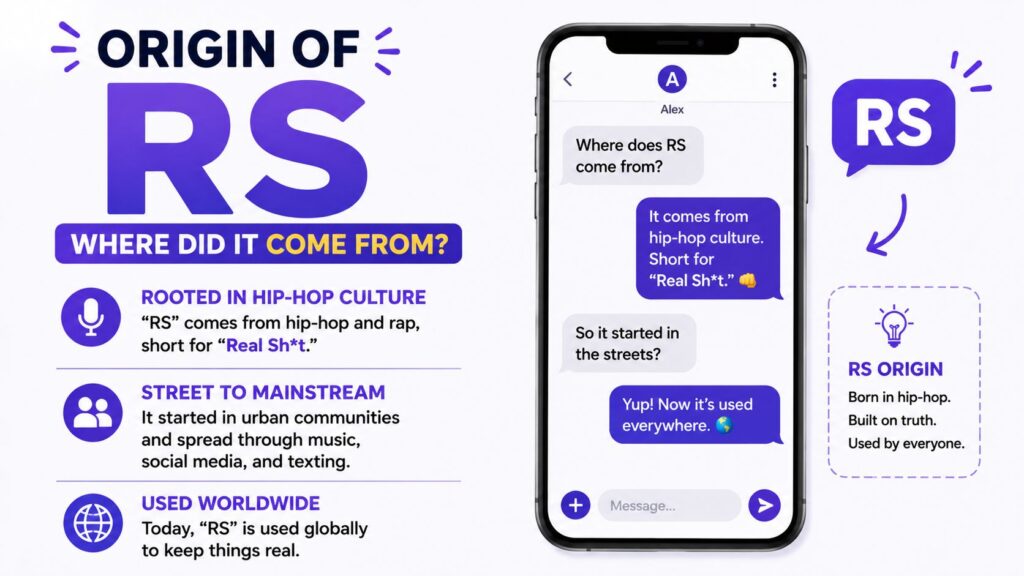
The roots of RS trace back further than most people expect. The full phrase “real sh*t” has circulated in spoken English for decades, especially within Black American vernacular and hip-hop culture, where it’s long been used to flag something as genuinely true or deeply felt. Musicians and speakers used the phrase to add gravity to a statement — a verbal underline, essentially.
As texting and online messaging became the dominant form of daily communication, that spoken phrase made the natural jump into shorthand. Urban Dictionary’s earliest documented entry for RS as “real sh*t” dates back to at least 2017, describing it as a way of “agreeing at a strong level.” From there, the abbreviation spread the same way most digital slang does — through shared online communities, group chats, and eventually mainstream social media platforms where younger users picked it up and ran with it.
It’s worth noting that RuneScape’s own abbreviation predates a lot of this. Gamers have used “RS” as shorthand for the game since its early-2000s launch, meaning the letters were already carrying meaning in online spaces well before the slang usage caught on more broadly. Both meanings developed somewhat independently, in different corners of the internet, which is exactly why context still matters so much today.
Who Uses RS the Most?
RS skews younger. It’s most common among Gen Z and younger millennial users who grew up texting in shorthand from an early age. That said, usage clusters differently depending on the specific meaning:
- The “Real Sh*t” slang meaning is most common among younger users active on Snapchat, TikTok, and Instagram, particularly in the U.S. and among English-speaking online communities globally.
- The currency meaning is used broadly across all age groups in Pakistan, India, Sri Lanka, Nepal, and Bangladesh — it’s not slang there at all, just everyday shorthand for money.
- The RuneScape meaning skews toward a slightly older crowd of gamers, many of whom have played the game since its original release and carried the shorthand with them into Discord and other modern platforms.
- The “Respectfully” meaning shows up most among X users engaged in political, cultural, or opinion-based discourse, regardless of age.
So while the stereotype is that RS is purely a “Gen Z thing,” the reality is more layered. Different generations and different regions have adopted different meanings of the same two letters, often without any overlap or awareness of the other usage.
ALSO READ: ASF Meaning in Text: How to Interpret This Common Acronym
RS vs Other Similar Slang Terms
RS doesn’t exist in isolation. It sits alongside a handful of other short, emphatic terms that people use to add weight to a statement. Here’s how it compares:
| Term | Full Meaning | Tone | Best Used For |
|---|---|---|---|
| RS | Real Sh*t / Real Stuff | Genuine, emphatic | Backing up honest or emotional statements |
| FR | For Real | Casual agreement | Confirming something is true, lighter tone than RS |
| NGL | Not Gonna Lie | Honest admission | Prefacing a confession or blunt opinion |
| NC | No Cap | Denial of exaggeration | Insisting you’re not lying or overstating |
| LOL | Laugh Out Loud | Amusement | Reacting to something funny, not necessarily true or serious |
The key difference between RS and something like LOL is intent. LOL reacts to humor. RS reacts to truth. If someone tells you something serious and you respond with LOL, it can come across as dismissive. RS, on the other hand, tells them you’re taking what they said seriously — that’s the emotional lane this particular piece of chat slang occupies, and it’s part of why it caught on the way it did.
FR and RS often get used interchangeably, and honestly, most people won’t notice or care about the subtle difference. If there is one, it’s that RS tends to carry slightly more emotional urgency — closer to “I need you to understand this is real” rather than the lighter “yeah, for real” energy of FR.
FAQs
Is RS still commonly used in 2026?
Yes — it remains widely used across Snapchat, TikTok, and Instagram comment sections, especially among Gen Z and younger millennial users.
What’s the most common meaning of RS in text right now?
“Real Sh*t” (or “Real Stuff”) is still the most common meaning overall, used to show strong agreement or emphasize that something is genuine.
Does RS mean something different on Twitter/X compared to Snapchat?
Yes — on X, RS often means “Respectfully” in reply threads, while on Snapchat it almost always carries the “Real Sh*t” slang meaning.
Is RS appropriate for professional messages in 2026?
No — it’s still considered informal slang and should be avoided in emails, LinkedIn messages, or any formal workplace communication.
Can RS mean currency in modern texting?
Yes — “Rs” remains the standard shorthand for rupees across Pakistan, India, and Sri Lanka, and this usage hasn’t changed or faded over time.
conclusion
So, what does RS mean in text? Most of the time, it means “Real Sh*t” or “Real Stuff.” It’s a quick way to show honesty or strong agreement. But the meaning can shift. Rupees, RuneScape, and “Respectfully” all fit too. Context always decides.
Next time you see RS, don’t panic. Check the platform. Check the sentence before it. That’s really all what does RS mean in text comes down to. Once you know the clues, you’ll read it right every time. It’s simple, once you know what to look for.

Hi! I’m Jenson, the writer behind punslush.com. I craft clever puns and witty wordplay designed to entertain and inspire. Visit punslush.com for a good dose of humor and fun!