
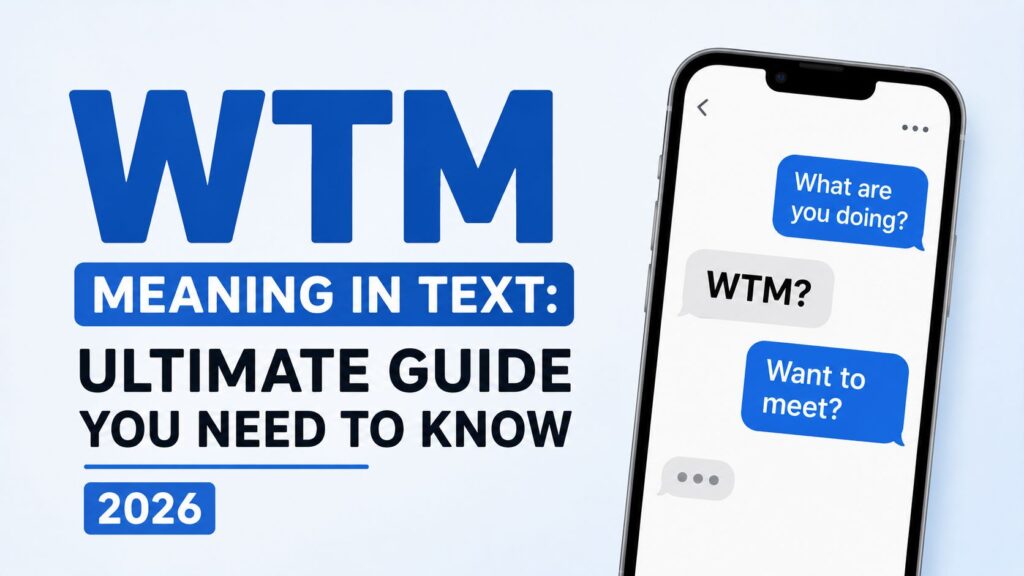
wtm meaning in text is one of the most widely used texting acronyms in modern digital communication. It primarily stands for “What’s the Move?” — a casual way to ask about plans — or “Whatever That Means” — a sarcastic, dismissive reaction. This chat abbreviation exploded across platforms like Snapchat, Instagram, and Twitter/X, becoming a staple of everyday online chats among Gen Z and Millennials alike.
Imagine misreading one tiny acronym and completely derailing a conversation. That’s exactly what happens when people confuse WTM’s two very different meanings. One wrong interpretation and suddenly you’re planning a hangout nobody invited you to.
Understanding WTM meaning in text goes deeper than memorizing a definition. Context, tone, and platform all shape what those three letters actually communicate. Whether someone’s rallying friends for a Friday night or rolling their eyes at confusing news, WTM carries real social weight in today’s digital communication landscape.
What Does WTM Mean in Text?
WTM stands for two main things in casual texting and online chats:
- “What’s the Move?” — asking about plans, hangouts, or what’s happening next
- “Whatever That Means” — expressing confusion, sarcasm, or mild dismissiveness
That’s it. Simple on the surface. But the real skill is knowing which one someone means — and that’s where context becomes everything.
“Language is the dress of thought.” — Samuel Johnson
In digital communication, a single acronym like WTM carries completely different emotional weight depending on the conversation. Think of it like the word “fine.” It can mean genuinely okay, or it can mean absolutely not okay — tone decides.
ALSO READ: FS Meaning in Text What It Really Means 2026
Breaking Down Both Meanings of WTM
WTM Meaning — What’s the Move?
This is the dominant meaning of WTM in text, especially among Gen Z. It’s a casual, energetic way of asking: What are we doing? Where are we going? What’s the plan?
You’ll see it flying around on Snapchat, Instagram DMs, and iMessage threads every Friday and Saturday night. It’s the digital equivalent of leaning over to your friend and whispering, “so what are we actually doing tonight?”
When people use it this way:
- Checking if friends have made plans yet
- Asking what’s happening after an event
- Nudging a group chat for a decision
- Figuring out the next move in a casual situation
Example texts:
- “Done with work, WTM tonight?”
- “WTM after the game?”
- “It’s been a boring Saturday, WTM?”
The tone here is upbeat and social. It fits naturally into casual communication between friends who are already in a planning mindset.
WTM Meaning
This one’s different in vibe. It’s often sarcastic, sometimes genuinely confused, and occasionally a little passive-aggressive — depending on the relationship and context.
Someone drops a complicated explanation, a confusing piece of news, or a vague statement. The response? “WTM.” It’s a shorthand eyeroll. A verbal shrug.
Example texts:
- “He said he’s in his ‘healing era,’ WTM.”
- “She texted ‘it’s fine’ after that whole argument, WTM.”
- “They rescheduled again for ‘logistical reasons,’ WTM.”
Notice how the meaning flips completely. Same three letters — totally different energy. This usage dominates Twitter/X and TikTok comment sections, where sarcasm and wit are practically a second language.
Lesser-Known WTM Meanings
Here’s what most guides skip. WTM has a few niche interpretations that actually show up in specific communities:
| WTM Meaning | Context |
|---|---|
| What’s the Move? | General texting, Snapchat, iMessage |
| Whatever That Means | Sarcasm, confusion, Twitter/X, TikTok |
| Watch the Movie | Niche usage in entertainment discussions |
| Work the Mic | Hip-hop and music communities |
| World Travel Market | Business, travel industry, professional emails |
If someone in a music forum drops “WTM” after hyping up a performance, they probably mean “Work the Mic.” If you get it in a travel industry email, it’s almost certainly “World Travel Market.” Context is always king.
Where Did WTM Come From?
To understand WTM, you need to understand why texting slang and SMS language exist at all.
It started with early mobile phones. SMS messages in the late 1990s and early 2000s were capped at 160 characters. Every letter counted. People compressed language out of necessity — and habits formed. LOL, BRB, SMH — all products of that era.
But WTM didn’t fully bloom until smartphones arrived and social platforms scaled up. Somewhere around 2012–2015, “What’s the Move?” started circulating heavily in chat conversations among teenagers and young adults in urban American communities. It caught on fast because it’s just satisfying to say — and type.
Key milestones in WTM’s spread:
- Early 2010s — Emerges in urban youth texting culture in the U.S.
- 2015–2018 — Snapchat’s explosive growth gives it a massive platform
- 2019–2021 — TikTok’s rise seeds it into global internet slang
- 2022–2024 — Fully embedded in Gen Z vernacular across all major apps
- 2025–2026 — Now recognized by Millennials too, crossing generational lines
Linguists who study digital communication note that acronyms with dual meanings — like WTM — tend to stick longer than single-use ones. The ambiguity keeps them flexible, and flexibility keeps them alive.
ALSO READ: Ion Meaning in Text – Shocking Truth You Must Know Before Using It (2026)
How Context Changes Everything
This is where most people get tripped up. You can’t just memorize “WTM = What’s the Move” and call it a day.
Here’s a quick framework for decoding WTM in text every time:
Ask yourself three questions:
- What was the conversation about right before this?
- Who sent it — and what’s your relationship with them?
- What platform or messaging app are you on?
Then use this table:
| Situation | WTM Most Likely Means |
|---|---|
| Friend texts on a Friday night | “What’s the Move?” — they want plans |
| Responding to confusing news | “Whatever That Means” — sarcasm or confusion |
| Group chat going quiet at 9 PM | “What’s the Move?” — nudging for action |
| Reacting to a vague excuse | “Whatever That Means” — mild eyeroll |
| Music/hip-hop community post | “Work the Mic” — performance energy |
| Travel industry message | “World Travel Market” — professional context |
Notice the pattern? “What’s the Move?” almost always appears when someone is looking forward — making plans, figuring out the next action. “Whatever That Means” almost always appears when someone is reacting backward — to something already said or done.
One more thing: pay attention to punctuation and emojis. “WTM 🔥” reads very differently from “WTM 🙄.”
Real Conversation Examples of WTM in Action
Let’s make this concrete. Here are real-world style examples showing both meanings in actual text conversations.
WTM as “What’s the Move?” — Real Scenarios
Weekend Planning:
Jake: “Done with the gym. WTM tonight?” Maya: “Thinking rooftop bar or just pre-game at mine” Jake: “Say less, I’m coming through at 9”
Group Chat:
Alex: “WTM for the holiday weekend?” Sam: “Road trip?” Taylor: “I’m in if we leave Friday”
Post-Event:
“That concert was insane. WTM after? Tacos?”
WTM as “Whatever That Means” — Real Scenarios
Sarcastic Reaction:
Friend 1: “He said he’s ‘taking space to realign his energy.'” Friend 2: “WTM 🙄”
Confused Response:
“She told me the situation is ‘organically evolving.’ WTM.”
Dismissive Tone:
“Management says we’re ‘pivoting to a synergistic model.’ WTM lol”
The tone is unmistakable once you see them side by side. Planning energy vs. reaction energy. That’s the clearest shortcut to decoding WTM meaning every time.
WTM Across Social Media Platforms
WTM doesn’t behave identically across every app. Each platform has its own chat culture and communication norms — and WTM adapts to all of them.
WTM on Snapchat
Snapchat is WTM’s natural habitat — specifically the “What’s the Move?” version. The entire platform is built around fleeting, casual, right now interactions. People share their Stories, see what everyone’s up to, and then text “WTM?” to figure out where to go.
It pairs naturally with the platform’s ephemeral design. No one’s writing essays on Snap. It’s quick, instinctive, conversational.
Typical Snapchat WTM usage:
- Replying to someone’s Story with “WTM?”
- Sending a late-night snap that just says “WTM tonight”
- Using it in group chats to coordinate meetups
WTM on Instagram
Instagram DMs are slightly more considered than Snapchat — but not by much. Here, WTM shows up both in direct messages and occasionally in comment sections, usually under posts about going out, events, or Friday-night energy content.
The “Whatever That Means” version also appears in comments under confusing captions or cryptic posts.
Example Instagram comment:
Caption: “Sometimes you just have to surrender to the flow.” Comment: “WTM but okay 😭”
WTM on TikTok
TikTok’s comment section is basically a sarcasm arena. The “Whatever That Means” usage thrives here. When a creator says something convoluted or pretentious, the top comment is often some version of “WTM” paired with a crying-laughing emoji.
The “What’s the Move?” meaning also appears, but it’s less dominant. TikTok skews more reactive than planning-focused.
WTM on Twitter/X
Twitter/X is where WTM gets its sharpest sarcastic edge. The platform’s culture rewards wit and brevity — and “Whatever That Means” fits perfectly. Political statements, corporate jargon, celebrity quotes — all prime targets for a well-placed WTM.
Real-style tweet example:
“Brand just announced they’re ‘committed to authentic transparency.’ WTM.”
WTM vs. Similar Acronyms
WTM doesn’t exist in isolation. It lives alongside a whole ecosystem of common acronyms in modern communication. Knowing when to use which one is the mark of a genuinely fluent texter.
| Acronym | Full Meaning | Vibe | Best Used When |
|---|---|---|---|
| WTM | What’s the Move? / Whatever That Means | Casual / Sarcastic | Planning or reacting |
| WYD | What You Doing? | Casual check-in | Checking on someone’s current activity |
| WYA | Where You At? | Location-focused | Trying to find someone |
| HMU / HBU | Hit Me Up / How About You? | Inviting / curious | Opening conversation |
| BRB | Be Right Back | Temporary exit | Stepping away briefly |
| SMH | Shaking My Head | Disbelief / disappointment | Reacting to something frustrating |
| WBU | What About You? | Conversational | Redirecting the conversation |
| IDK | I Don’t Know | Uncertainty | Expressing indecision |
The key distinction between WTM and WYD:
- WYD asks what someone is currently doing — it’s about the present moment.
- WTM asks what someone wants to do or reacts to something — it’s forward-looking or reactive.
They’re close enough that people sometimes swap them casually. But there’s a subtle difference in intent that fluent texters pick up on.
How to Use WTM Without Sounding Awkward
Knowing what WTM means is step one. Using it naturally is step two — and that’s where a lot of people stumble.
The golden rule: match it to the relationship.
WTM works between friends, classmates, teammates, and close family members. It does not work in professional settings, formal communication, work emails, or business messages. Sending your manager “WTM for the Q3 review?” will not end well.
Do’s:
- Use it in casual group chats with friends
- Pair it with clear context so the meaning isn’t ambiguous
- Let it flow naturally — don’t force it into conversations where it doesn’t fit
- Use it when you’re genuinely asking about plans or reacting to something confusing
Don’ts:
- Don’t use it with people who aren’t familiar with internet slang — you’ll just confuse them
- Don’t use it in professional writing or any formal context
- Don’t overuse it — even the best slang loses its punch when it’s everywhere
- Don’t use it ironically in a way that reads as genuine and confuses the other person
The age factor matters too. While many Millennials (born 1981–1996) recognize WTM now, it still skews younger. Gen Z (born 1997–2012) uses it most naturally and frequently.
Emojis That Actually Pair Well With WTM
Emojis aren’t decorative — in text messaging, they’re functional. They signal tone. And with an acronym like WTM that carries two very different meanings, the right emoji can instantly clarify which one you mean.
| Emoji | Pairs With | What It Signals |
|---|---|---|
| 🔥 | “What’s the Move?” | Hype, excitement, let’s go energy |
| 👀 | “What’s the Move?” | Curious, watching, waiting for the plan |
| 🏃 / 👟 | “What’s the Move?” | We’re about to go somewhere |
| 🙄 | “Whatever That Means” | Light sarcasm or skepticism |
| 😅 | “Whatever That Means” | Softening the sarcasm slightly |
| 🤷 | Either | Genuine confusion or a shrug response |
| 😭 | “Whatever That Means” | Comedic exasperation (very TikTok) |
Quick tip: if you’re using WTM and worried the meaning might be ambiguous, just add an emoji. “WTM 🔥” and “WTM 🙄” communicate two totally different messages without adding a single extra word.
Common Mistakes People Make With WTM
Even people who know what WTM means make these errors. Avoid them.
Using it in the wrong setting. This is the biggest one. WTM is casual communication slang. Drop it in a work Slack, a professional email, or a message to someone you barely know — and it reads as unprofessional at best, confusing at worst. Workplace etiquette matters even in digital spaces.
Not providing context. Texting someone just “WTM?” out of nowhere can genuinely confuse people. Are you asking about plans? Reacting to something? Add a little context: “Just got off work, WTM tonight?”
Misreading the tone. Getting “WTM” as a response to something you shared and assuming it’s an invitation to hang out — when it’s actually a sarcastic “whatever that means” — is an easy mistake that can lead to a very awkward follow-up text.
Overusing it. Slang depreciates fast. The more any term gets used, the less impact it has. Reserve WTM for moments where it actually fits rather than sprinkling it into every conversation.
Using it with the wrong audience. Texting your parents, your professor, or your boss “WTM?” is a quick way to derail a conversation. Know your audience before you hit send.
ALSO READ: ML Meaning in Text: What It Really Means in Chat, Social Media & Slang 💬
How Gen Z Slang Evolves — And What Comes After WTM
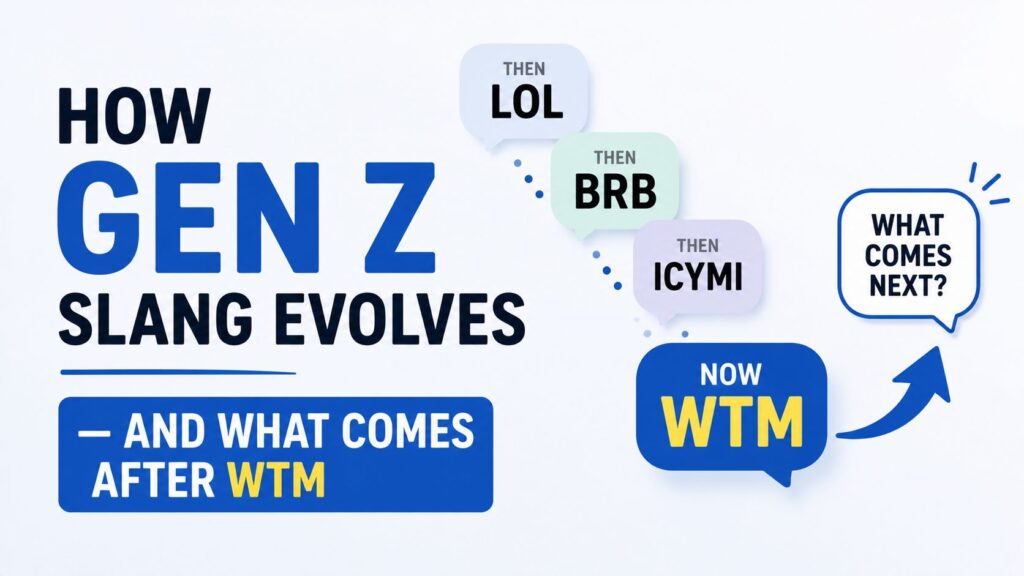
Here’s something worth understanding: internet language doesn’t stay still. It moves in cycles — rises fast, peaks, fades, gets replaced. That’s been true since the early days of SMS language and it’s accelerating as platforms multiply.
The typical slang lifecycle looks like this:
- Emerges in a specific community or subculture
- Spreads via social media platforms
- Peaks when mainstream adoption hits
- Declines as older generations adopt it (signal it’s “uncool”)
- Either dies or becomes permanent vocabulary
WTM is currently in a mature, stable phase. It’s past the early-adopter stage but hasn’t become so mainstream that Gen Z is abandoning it. For 2026, it remains firmly embedded in everyday digital communication for people under 35.
What comes next? Terms like “WTS” (What’s the Situation), “IYKYK” (If You Know You Know), and various platform-specific slang are already in circulation. The cycle continues.
Will WTM still be relevant in 2027? Almost certainly — especially “What’s the Move?” It’s too useful and versatile to fade quickly. “Whatever That Means” may slowly migrate toward new expressions, but the planning-focused meaning has real staying power.
conclusion
Understanding WTM meaning in text is simpler than it looks. Context decides everything. “What’s the Move?” drives plans forward. “Whatever That Means” signals sarcasm or confusion. Master that difference and you’ll never misread a conversation again.
WTM meaning in text keeps evolving alongside digital culture. New platforms bring new contexts. But the core meanings stay consistent. Use it wisely, match it to your audience, and always read the tone first. Now you’re fully equipped to use WTM like a natural.

Hi! I’m Jenson, the writer behind punslush.com. I craft clever puns and witty wordplay designed to entertain and inspire. Visit punslush.com for a good dose of humor and fun!