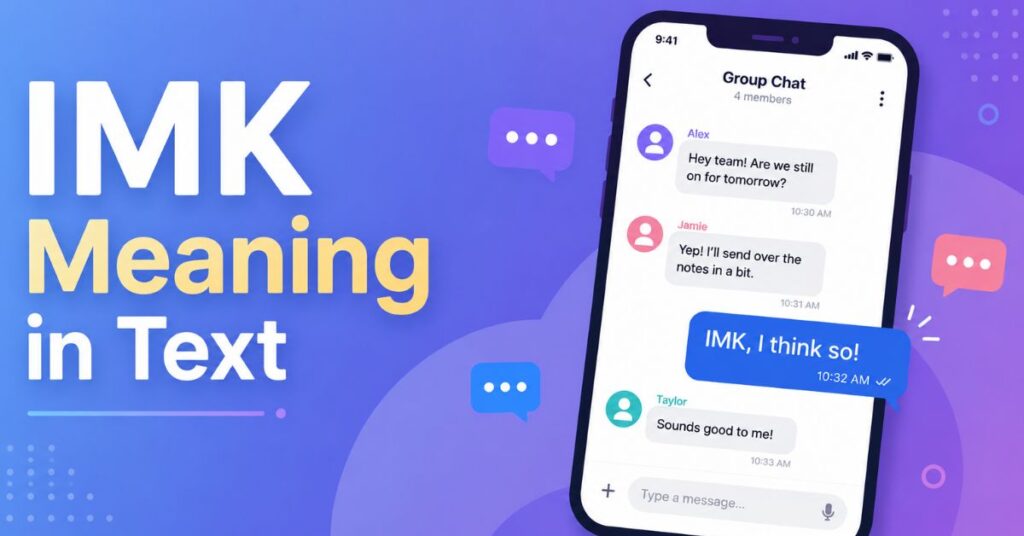
IMK meaning in Text comes down to one simple phrase: “In My Knowledge.” People use it in texts and chats to share information they believe is true, without claiming it as a guaranteed fact. It’s the digital shorthand version of saying “as far as I know.”
Three little letters, and suddenly a whole message changes tone. That’s the quiet power of internet slang a tiny abbreviation carrying honesty, humility, and context all at once, right in the middle of a fast-moving group chat.
Beyond the basic definition, IMK actually shifts meaning depending on context, sometimes hinting at “I’ll let you know” or even a joking “I’m just kidding.” Understanding those layers turns confusing texts into conversations you can read with total confidence.
What Does IMK Mean in Text?
In most digital communication, IMK stands for “In My Knowledge.” It’s the texting equivalent of saying “as far as I know” or “to the best of my knowledge.” When someone types IMK before a statement, they’re telling you they believe what they’re saying is true, but they’re not staking their reputation on it.
Think of it as a built-in disclaimer. Instead of writing out a full sentence like “I’m not 100% sure, but based on what I know,” people just tack IMK onto the front and move on. It’s efficient. It’s honest. And it fits the pace of modern texting apps and messaging platforms, where nobody wants to type more than they have to.
Simple Breakdown
Here’s the IMK definition stripped down to basics:
| Element | Explanation |
|---|---|
| Full form | In My Knowledge |
| Function | Hedges a statement — signals partial certainty |
| Tone | Neutral, honest, non-confrontational |
| Closest equivalent | “As far as I know” (AFAIK) |
| Typical placement | Start of a sentence |
| Common platforms | WhatsApp, Snapchat, Instagram, TikTok, Discord, group chats |
The phrase itself isn’t complicated. What trips people up is context because, as you’ll see in a minute, IMK doesn’t always mean the same thing.
Example
Teacher: “Did your classmate turn in that assignment like I asked?” Student: “IMK, yeah he said he submitted it this morning.”
The student isn’t guaranteeing it happened. They’re passing along what they personally know, while leaving room to be wrong. That’s the entire function of IMK in one exchange.
ISO Meaning: Definition, Uses, and Popular Contexts Explained
IMK Has More Than One Meaning (Don’t Skip This)
Most guides treat IMK like it has exactly one meaning and call it a day. That’s not the full picture. If you search for IMK explained across enough real conversations and slang dictionaries, you’ll notice the acronym actually shifts depending on who’s typing it and what came before it.
In My Knowledge – The Dominant Meaning
This is the one you’ll run into probably 90% of the time. IMK indicates that a person is pretty sure about what they’re saying, based on their personal experience. It’s informal, it’s polite, and it works across nearly every context where slang is acceptable at all.
I’ll Let You Know – A Real Alternate
Less common, but genuinely used: in some contexts, IMK means “I’ll Let You Know,” a casual way of saying “I will inform you later” or “I’ll update you,” used when someone doesn’t have an answer yet but plans to give one. You’ll usually catch this version in a text like “imk when you’re outside” someone’s promising a future update, not hedging a current claim.
I Might Know – Occasional Casual Variant
Some users shorten “I might know” to IMK, especially when they’re not sure but think they recall something. It’s less standard, but it pops up enough in fast-typed group chats that it’s worth recognizing.
I’m Just Kidding – Rare, But Real
This one surprises people. According to Capitalize My Title, an alternate IMK meaning can be “I’m just kidding” or “ignore my kidding,” typically used without other text and in response to someone taking a comment too seriously. It’s uncommon, but if IMK shows up standalone after a joke, this might be what’s going on.
How to Tell Which One Someone Means
Context does almost all the work here. Ask yourself:
- Does it come before a factual claim? → Probably “In My Knowledge”
- Does it come after a promise or a “when you get there” type message? → Probably “I’ll Let You Know”
- Does it stand alone after something over-the-top or dramatic? → Possibly “I’m just kidding”
- Is it answering a “do you know…?” question with hesitation? → Could be “I might know”
Most of the time, you’ll know instantly. The confusion only creeps in when the message is short, dry, and lacks any other context clues.
IMK vs. Similar Slang
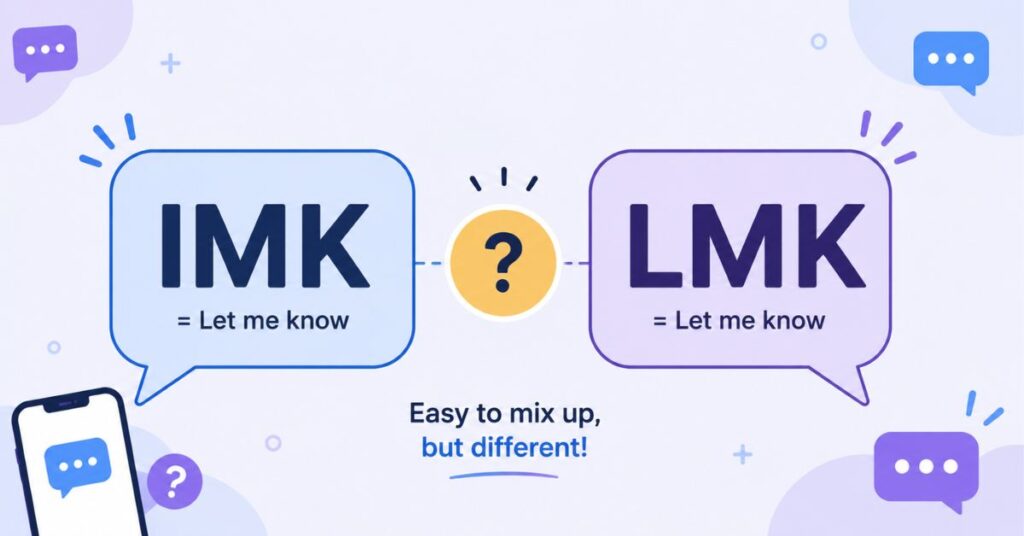
Text slang tends to cluster around the same handful of ideas opinion, certainty, information. IMK sits right in the middle of that cluster, which is exactly why it gets confused with its neighbors.
| Abbreviation | Full Meaning | What It Signals |
|---|---|---|
| IMK | In My Knowledge | Sharing info, unsure if fully accurate |
| IMO | In My Opinion | Sharing a personal view, not a fact claim |
| AFAIK | As Far As I Know | Nearly identical to IMK, slightly more formal |
| LMK | Let Me Know | Requesting information from someone else |
| IDK | I Don’t Know | Zero knowledge, no answer to give |
| FWIW | For What It’s Worth | Offering info while downplaying its importance |
Key Insight
The IMK vs LMK mix-up isn’t a myth it’s a real, common typo. Since IMK and LMK look almost identical when typed quickly (a capital “I” and a lowercase “l” render nearly the same in a lot of fonts), people genuinely send one when they meant the other. It’s worth double-checking before you hit send, especially on a phone keyboard where autocorrect sometimes makes the swap for you.
The other mix-up worth flagging is IMK vs IDK. These aren’t interchangeable, even though they sound related. IDK means you’ve got nothing no info to offer. IMK means you’ve got something, just not a guarantee. Confusing the two changes the entire meaning of your message.
How People Actually Use IMK in Conversations
Slang doesn’t live in a dictionary it lives in real conversations, and IMK shows up differently depending on where you see it.
Casual Texting
In one-on-one texts, IMK usually softens an answer to a direct question. Someone asks what time a place closes, you’re not totally sure, so you hedge with IMK before giving your best guess.
Group Chats
This is probably where IMK shows up most. In a group messaging thread, someone asks a question “does anyone know if the game got rescheduled?” and whoever answers first often leads with IMK, because in a shared thread, being wrong in front of five people feels riskier than being wrong one-on-one.
Social Media Replies
On social media, IMK shows up in comment sections and reply threads constantly. Someone comments a claim, another user replies “IMK that’s not accurate,” softening what could otherwise read as an aggressive correction.
Online Discussions
In forums, Discord servers, and other online communities, IMK functions almost like a built-in disclaimer for information that hasn’t been verified yet. It keeps discussions moving without turning every unconfirmed detail into a debate.
Why People Prefer IMK
Three reasons, mostly:
- Speed three letters beats an entire sentence
- Honesty it flags uncertainty instead of hiding it
- Social safety it protects the sender if the information turns out wrong
Real Examples That Sound Natural
Generic textbook examples don’t help much. Here’s how IMK actually shows up in real conversations.
Answering a Question in a Group Chat
Jordan: does anyone know what time the store closes tonight? Sam: IMK it’s 9, but I’d call to be safe
Making Plans With Friends
Priya: are we still meeting at the usual spot? Alex: IMK yeah, nothing’s changed on my end
A Semi-Casual Work Message
“IMK the client meeting got pushed to Thursday — worth confirming with Dana though.”
This one works, but only in a relaxed team culture. In a more formal workplace, it can read as sloppy more on that in the next section.
A Social Media Comment
“IMK that update hasn’t rolled out to everyone yet, might just be your device.”
What Makes These Examples Effective
Notice the pattern: IMK almost always sits at the start of the sentence, right before the claim it’s hedging. That placement tells the reader immediately, “what follows is my understanding, not a confirmed fact.” Put it at the end, and the sentence loses that upfront honesty it reads more like an afterthought than a disclaimer.
The Subtle Tone Behind IMK
Every piece of text slang carries a tone, even when the words themselves seem neutral. IMK’s tone is worth understanding, because it changes how your message actually lands.
When You Use IMK, You’re Saying
- “I believe this, but don’t quote me”
- “I want to help, even if I’m not fully certain”
- “I’d rather be upfront about my uncertainty than pretend I know for sure”
Tone Breakdown
IMK reads as modest, not weak. It doesn’t undercut your credibility the way “I don’t know, maybe?” does. Instead, it positions you as someone offering useful information while staying honest about its limits. That’s a subtle but important distinction in how people perceive your communication tone over text, where there’s no facial expression or vocal inflection to soften a claim.
Why This Tone Works
In casual conversations, overconfidence can feel abrasive, and total uncertainty can feel unhelpful. IMK threads the needle. It’s the texting version of a shrug paired with a genuinely useful answer relaxed, but not dismissive.
When You Should Use IMK (And When You Shouldn’t)
Not every context calls for it. Knowing where IMK fits and where it doesn’t matters more than knowing the definition itself.
Use IMK When
- You’re answering a casual question and you’re fairly, but not fully, confident
- You’re in a group chat and want to contribute without overstating certainty
- You’re commenting on social media and want to soften a correction
- You’re texting friends or close coworkers in a relaxed setting
Avoid IMK When
- You’re writing a professional email or formal document
- The information involves health, legal, or financial decisions situations where clarity matters more than brevity
- You’re communicating with someone unfamiliar with internet messaging slang, across generations or cultures
- Accuracy is critical and a vague hedge could cause real problems
Quick Checklist
Ask yourself before you type it:
- [ ] Is this a casual or semi-casual conversation?
- [ ] Would the reader understand the abbreviation?
- [ ] Does the situation tolerate some uncertainty?
- [ ] Is precision not mission-critical here?
If you checked all four, IMK fits. If you hesitated on any of them, spell it out instead: “to my knowledge” works everywhere IMK does, minus the risk of confusion.
Zesty Meaning: What Does “Zesty” Really Mean Today?
Common Mistakes and Misinterpretations
Even simple slang gets misused. Here’s where people trip up most.
Confusing IMK With IMO
These aren’t the same thing, even though they look similar and share a letter pattern. IMO shares an opinion a subjective take with no claim to accuracy. IMK shares knowledge a claim about what’s true, just with a built-in uncertainty flag. Mixing them up changes what you’re actually communicating.
Using IMK for Facts
If you’re certain about something, don’t hedge it with IMK. It undersells information you actually know to be true, and it can make you sound less reliable than you are. Save IMK for genuine uncertainty.
Overusing It
Sprinkling IMK into every other sentence turns a useful hedge into a verbal tic. It stops meaning anything specific and starts reading like filler the texting equivalent of saying “like” every third word.
Misreading Tone
Because IMK is short and flat on the page, some readers misread it as sarcastic or dismissive, especially without any emoji or punctuation softening it. If you’re worried about that, a quick follow-up sentence usually clears it up fast.
Pro Tip
If a message feels like it might come across the wrong way, add one small clarifying word after IMK “IMK, could be wrong though” and the ambiguity disappears.
The Origin and Rise of IMK
Slang doesn’t appear out of nowhere. IMK has a traceable path, even if it’s not a headline-making one.
Timeline Snapshot
| Era | What Happened |
|---|---|
| Early-to-mid 2000s | IMK originates in early- and mid-2000s texting and forum culture, initially shortened from “In My Knowledge” for brevity |
| Mid-to-late 2000s | SMS character limits push abbreviation culture harder across texting generally |
| 2010s | Smartphones and app-based chat apps carry IMK from forums into everyday texting |
| 2015–2020 | Social platforms (Instagram, Twitter, Snapchat) spread the abbreviation to a wider, younger audience |
| 2020s–now | IMK settles into everyday use across mobile messaging, gaming chat, and social apps |
Why IMK Gained Popularity
It followed the same trajectory as other now-common abbreviations: IMO, IKR, FYI. All of them emerged from a period where typing speed and character limits mattered a lot, and shorthand became the default rather than the exception. IMK survived that era because it filled a genuine gap a quick way to share information honestly without overstating certainty.
Cultural Insight
What’s interesting about IMK specifically is that it reflects a broader shift in how people communicate online: a growing habit of flagging uncertainty rather than stating everything as fact. In an environment where misinformation spreads fast, a small phrase like IMK acts as a built-in honesty marker practically a linguistic safety net for online sharing.
Why Understanding IMK Actually Matters Today
It’s easy to dismiss slang as trivial, but small phrases like this genuinely shape how well a conversation goes.
It Improves Clarity
Using IMK correctly tells the reader exactly how much weight to put on what you’re saying. That’s a small but real improvement in message context the reader knows not to treat your statement as gospel.
It Prevents Conflict
Hedged statements are less likely to spark arguments than confident-sounding claims that turn out to be wrong. IMK gives you an out without sounding evasive, which keeps group chats and comment sections calmer.
It Keeps You Relevant
Understanding current chat language even small pieces of it helps you read tone accurately across messaging apps, avoid awkward misunderstandings, and communicate naturally with people who use this kind of shorthand daily.
Real-World Impact
Consider the IMK/LMK typo problem again. One flipped letter, and a message meant to share information (“in my knowledge, yes”) gets read as a request for information (“let me know”). In a work context, that kind of mix-up can genuinely derail a conversation or create confusion about who’s supposed to follow up on what. Small acronym, real consequences.
Pro Tips to Sound Natural Using IMK
A few practical habits make the difference between sounding natural and sounding like you just learned the term five minutes ago.
Practical Tips
- Lead with it. Put IMK at the start of your sentence, not buried in the middle or tacked on at the end.
- Pair it with a real answer. IMK works best when followed by actual information, not vague hedging with nothing behind it.
- Match the setting. Casual chats, yes. Formal emails, no.
- Don’t overuse it. One well-placed IMK carries more weight than three scattered through the same message.
- Double-check before sending. Make sure you didn’t mean LMK.
Example of Good Usage
“IMK the flight’s still on time, but I’d check the app before heading out.”
Clear, honest, naturally placed, and followed by a genuinely useful suggestion.
Example of Bad Usage
“IMK I think maybe IMK it could be true IMK not sure though.”
Overused to the point of meaninglessness — and it reads more confusing than helpful.
Case Study: How IMK Changes Conversation Tone
Here’s a side-by-side look at how the same information lands differently with and without the hedge.
Scenario A — Without IMK:
“The restaurant closes at 9.”
This reads as a confirmed fact. If it turns out wrong, the sender looks careless or unreliable.
Scenario B — With IMK:
“IMK the restaurant closes at 9, but might be worth a quick call.”
Same core information, completely different tone. The sender comes across as helpful and honest about the limits of what they know.
Outcome difference: In Scenario A, being wrong damages trust. In Scenario B, being wrong is a non-issue, because the sender never claimed certainty in the first place. That’s the entire value of the acronym in one comparison it’s not about the words themselves, it’s about managing expectations before information turns out to be off.
Frequently Asked Questions
Does IMK mean the same as IDK?
No. IDK means you have no information to offer. IMK means you have some information, just not a guarantee it’s fully accurate.
Is IMK rude or sarcastic?
Not typically. It’s a neutral, polite way of hedging a statement. Tone can shift based on surrounding context, but the acronym itself carries no negative charge.
Is IMK the same as LMK?
No and this is the most common mix-up. LMK means “let me know” (a request). IMK means “in my knowledge” (a statement). They’re easy to confuse when typed quickly.
Can IMK mean “I’m just kidding”?
Occasionally, yes, though it’s a much rarer usage. It typically shows up standalone, right after an exaggerated or joking statement.
Is it okay to use IMK at work?
In relaxed team chats, sure. In formal emails or important documentation, spell out “to my knowledge” instead same meaning, clearer for anyone unfamiliar with the shorthand.
Conclusion
So there you have it — IMK meaning in Text really just comes down to sharing what you know, while staying honest about what you don’t. It’s simple. It’s polite. And it fits perfectly into fast, casual texting.
Next time you spot IMK in a chat, you won’t pause or guess. You’ll know exactly what it means and how to reply. That’s the real value of understanding IMK meaning in text fewer mix-ups, clearer texts, and conversations that just flow naturally.

Hi! I’m Jenson, the writer behind punslush.com. I craft clever puns and witty wordplay designed to entertain and inspire. Visit punslush.com for a good dose of humor and fun!