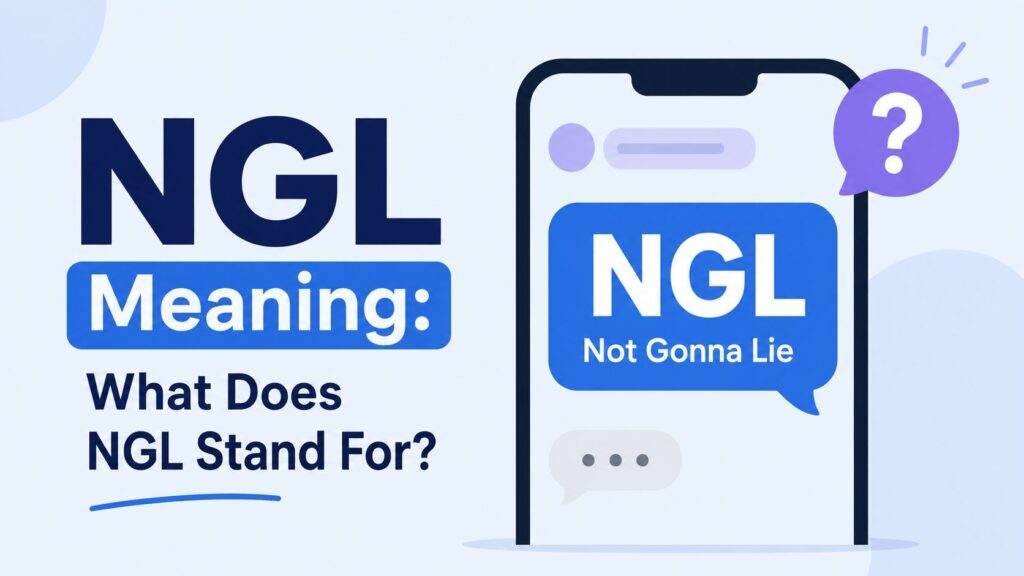
ngl meaning stands for Not Gonna Lie, a piece of internet slang people use to flag an honest, unfiltered opinion before saying it out loud. It’s also the name of a viral anonymous messaging app and, in a completely unrelated world, shorthand for Natural Gas Liquids in the energy industry.
Three meanings, one tiny acronym, and a lot of confused parents, texters, and Googlers caught in the crossfire.
This guide breaks down every version of NGL you’ll actually run into: the slang’s real origin, exact usage examples, its Google Trends spike, and the surprisingly serious legal trouble the NGL app landed in with the FTC.
NGL Meaning at a Glance
Let’s get the quick answer out of the way first, since that’s probably why you’re here.
| Meaning | Full Form | Where You’ll See It |
|---|---|---|
| Slang | Not Gonna Lie | Texting, social media, casual conversation |
| App | NGL (stands for the slang term) | Instagram, Snapchat, App Store |
| Industry term | Natural Gas Liquids | Oil and gas, energy markets, finance |
If someone texted you “ngl that’s a good point,” they mean Not Gonna Lie — they’re being honest, maybe reluctantly. If your teenager downloaded an app called NGL, it’s the anonymous messaging app that exploded in popularity a few years back. And if you’re reading a financial report or an energy sector analysis, NGL almost certainly refers to Natural Gas Liquids, a group of hydrocarbons pulled out of raw natural gas during processing.
Three meanings, one acronym. Let’s dig into each one, because the details matter more than you’d think.
ALSO READ: FYI Meaning in Text: What It Means, How to Use It, and Examples
The Three Meanings of NGL (Don’t Get Them Confused)
Context clues will save you here, but it helps to actually understand what separates these three uses instead of just guessing from the sentence around them.
NGL as Slang (“Not Gonna Lie”)
This is the version most people mean when they type ngl. It’s a verbal hedge — a little phrase you drop right before you say something honest, blunt, or slightly uncomfortable. Think of it as a cousin to “honestly,” “to be honest,” or “real talk.” It signals that what follows is a candid opinion, not a polite dodge.
Example: “Ngl, I forgot your birthday.”
That single word does a lot of work. It softens the confession while also making it clear you’re not sugarcoating anything. It’s become one of the most common pieces of internet shorthand, right up there with “tbh” and “fr.”
NGL the App (Anonymous Q&A on Instagram)
The second meaning is a literal product — the NGL app, a social app built around anonymous messages. Users generate a personal link, drop it into their Instagram Story or bio, and anyone who clicks it can send them a message without their name attached.
It’s an anonymous messaging app in the same category as older platforms like Ask.fm and Yik Yak, but NGL leaned hard into Instagram integration, which is a big reason it spread so fast. By June 2022, it had become the most downloaded app on the U.S. Apple App Store. We’ll get into the mechanics, the business model, and — importantly — the legal trouble the company ran into a little further down.
NGL in Finance & Energy
The third meaning shows up far less in casual conversation but constantly in a specific professional world: oil and gas. In that industry, NGL stands for Natural Gas Liquids — a group of hydrocarbons that includes ethane, propane, butane, and pentane, extracted from raw natural gas during gas processing.
You’ll also see “NGL” as a stock ticker for NGL Energy Partners, a midstream energy company. If you’re researching energy markets, commodities, or that specific company, that’s almost certainly the meaning in play — not the slang, and definitely not the app.
Quick gut check: if the sentence involves texting, Instagram, or casual tone, you’re looking at the slang or the app. If it involves barrels, processing plants, or commodity prices, you’re looking at the energy term.
How to Use NGL in a Sentence
Once you know ngl means “Not Gonna Lie,” using it correctly is simple. It works almost anywhere a spoken hedge like “honestly” would work, and it’s flexible about where it sits in a sentence.
At the Start of a Sentence
Putting ngl first sets the tone before you even get to the point. It’s a heads-up that something honest — sometimes a little awkward — is coming.
- “Ngl, I didn’t expect you to actually finish that.”
- “Ngl, this recipe is way better than I thought it’d be.”
- “Ngl, I’ve been avoiding your texts all week.”
At the End of a Sentence
Tacking ngl onto the end works more like a closing confession — you’ve made your statement, and now you’re underlining that it’s genuine.
- “That movie was way too long, ngl.”
- “I kind of miss my old job, ngl.”
- “This is the best burger I’ve had all year, ngl.”
Real Example Sentences
Here’s a broader set showing how flexible the phrase really is across different tones:
- Casual compliment: “Ngl, you clean up nice.”
- Sarcastic: “Ngl, waking up at 5 a.m. is my favorite thing ever.” (clearly not true)
- Serious admission: “Ngl, I’ve been struggling with this project more than I let on.”
- Social media caption: “Ngl this view is unreal 😍”
- Group chat: “Ngl I forgot we had plans tonight, I’m so sorry.”
Notice that in every case, ngl does the same job: it flags the sentence as unfiltered. That’s the entire function of the phrase, and it’s why it’s stuck around in digital communication far longer than a lot of other slang terms.
Where NGL Came From
Understanding the NGL definition is one thing. Understanding where it came from adds context that most quick explainer articles skip entirely.
The Phrase “Not Gonna Lie” Before It Was an Acronym
“Not gonna lie” existed as a full spoken phrase long before anyone shortened it into three letters. People have used variations of “I’m not going to lie to you” as a conversational hedge for decades — it’s a natural way to flag trut hful expression before delivering something the listener might not expect. Think of it as sitting in the same linguistic family as “honestly,” “in all fairness,” or “if I’m being real with you.”
The acronym didn’t invent the sentiment. It just compressed it for faster typing.
When NGL First Appeared Online
Like most texting shorthand, ngl entered internet vocabulary during the SMS and instant-messaging era, well before it became a hashtag or an app name. It sat alongside other early internet acronyms like “lol,” “brb,” and “tbh” — compact, lowercase, meant to save keystrokes on a flip phone or in an AIM chat window.
This is an important distinction that a lot of explainer content glosses over: the slang predates the app by years. The app’s founders picked the acronym because it was already widely understood shorthand — they didn’t invent the phrase, they borrowed it.
How Google Trends Data Shows Its Rise
If you actually look at Google Trends data for the search term “NGL,” you’ll notice something interesting: search interest in the word stayed relatively flat and modest for years, then spiked hard in mid-2022. That spike doesn’t line up with organic slang growth — it lines up almost exactly with the NGL app’s explosive App Store growth in June 2022.
In other words, most of the recent search volume and keyword popularity around “NGL” isn’t people suddenly discovering the slang term. It’s people downloading, using, and searching for help with the app. This matters if you’re doing trend analysis or content research on the topic, because the slang and the app are driving completely different (and sometimes overlapping) search intent. A search phrase like “what does NGL mean” could be someone learning the slang for the first time, or a parent trying to figure out what their kid just installed.
NGL vs Similar Slang: TBH, FR, FRFR, IMO
Ngl doesn’t operate alone. It’s part of a small family of acronyms that all signal some version of honesty or emphasis, but they’re not interchangeable. Here’s how they actually differ:
| Term | Full Meaning | Tone | Example |
|---|---|---|---|
| NGL | Not Gonna Lie | Confession-like, slightly reluctant honesty | “Ngl, I cried at that movie.” |
| TBH | To Be Honest | Softer, more neutral opinion-sharing | “Tbh, I don’t really like sushi.” |
| FR | For Real | Agreement or emphasis | “That test was so hard, fr.” |
| FRFR | For Real, For Real | Stronger emphasis, often doubling down on FR | “I’m not joking, frfr.” |
| IMO | In My Opinion | Explicitly frames a statement as subjective | “Imo, the book was better than the movie.” |
The key difference: ngl almost always implies you’re admitting something, even if it’s small. TBH is more neutral — it can introduce an opinion without any confessional weight. FR and FRFR aren’t really about honesty at all; they’re about emphasis and agreement, closer to “seriously” than “honestly.” IMO is the most explicit of the group, directly labeling a statement as personal opinion rather than fact.
Knowing these distinctions helps you pick the right one, and it’s genuinely useful if you’re a parent, teacher, or anyone trying to keep up with how younger generations communicate on TikTok, Instagram, and group texts.
Is It OK to Use NGL at Work or in Formal Writing?
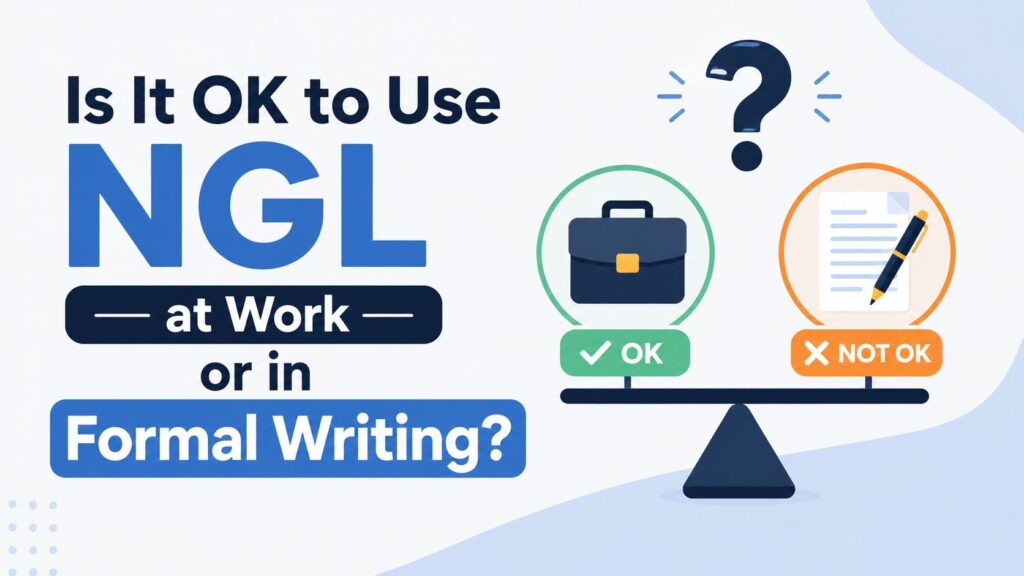
Short answer: usually not, but there’s more nuance to it than a flat “never.”
When It’s Fine
- Casual internal Slack channels where your whole team already communicates informally
- Direct messages to coworkers you’re close with, especially in creative or startup-culture workplaces
- Social media captions for a brand account that leans playful and youth-oriented
If your workplace culture already embraces a loose, conversational tone in internal chats, dropping an occasional “ngl” isn’t going to raise eyebrows. Some brands even use it deliberately in marketing copy aimed at Gen Z audiences, because it reads as authentic rather than corporate.
When to Avoid It
- Client-facing emails — it undercuts a professional tone instantly
- Formal reports, proposals, or documentation
- Cover letters and resumes
- Any communication with someone significantly senior to you, unless you already know they’d find it charming rather than sloppy
The general rule: if you wouldn’t say “not gonna lie” out loud in that exact meeting, don’t type “ngl” in the email version of it. Formal writing benefits from clear sentences and a controlled voice — slang like this tends to read as underprepared, even if that’s not the intent.
How to Respond When Someone Says NGL to You
This one trips people up more than you’d expect, mostly because the right response depends heavily on what came after the “ngl.”
- If it’s a compliment: “Ngl, you’re actually really good at this.” → Just say thanks. Don’t overanalyze the “ngl” — it’s just adding sincerity, not a warning.
- If it’s mild criticism: “Ngl, that outfit isn’t really your color.” → Take it as genuine, low-stakes feedback rather than an attack. The person is signaling they’re being straightforward, not harsh.
- If it’s an awkward confession: “Ngl, I’ve had a crush on you for a while.” → This deserves a real response, not a joke-deflection, since the person likely felt vulnerable saying it.
- If it’s sarcastic: “Ngl, I love Mondays.” → Play along or call it out with humor — context will make the sarcasm obvious.
The safest general response, when in doubt, is simply acknowledging the honesty: “appreciate you being real about it” works in almost every scenario, whether it’s a compliment or mild criticism.
Common Mistakes People Make With NGL
A few recurring errors show up constantly, whether in texts, comments, or even in content written about the term itself:
- Confusing it with other acronyms. People sometimes mix up “ngl” with “nvm” (never mind) or “idk” (I don’t know) — they’re not related at all.
- Overusing it until it loses meaning. If every single sentence starts with “ngl,” the phrase stops signaling anything special. It works because it’s occasional.
- Using it in a context where it reads as insincere. Dropping “ngl” before an obvious compliment you’d say anyway just adds noise rather than sincerity.
- Assuming it’s always about the app. Not every mention of “NGL” online is about the messaging platform — plenty of posts are just using the slang.
- Forgetting the energy/finance meaning exists. If you’re doing research and the word “NGL” shows up next to “barrels” or “processing plant,” that’s Natural Gas Liquids — not slang, not the app.
The NGL App: What It Is and How It Works
Now let’s get into the app itself, since this is where most of the current news, safety concerns, and search traffic around “NGL” actually comes from.
NGL — short for “Not Gonna Lie,” per its own branding — is an anonymous messaging app launched in November 2021 by NGL Labs, founded by Raj Vir and João Figueiredo out of Venice Beach, California. It’s built specifically around social interactions on Instagram, positioning itself as an anonymous Q&A tool for Stories.
The app’s growth was fast and dramatic. By June 2022, it had become the most downloaded app on the U.S. Apple App Store — a genuine viral moment driven almost entirely by teens and young adults posting NGL links to their online platforms.
How the Anonymous Messages Feature Works
The mechanics are simple, which is part of why it spread so quickly:
- A user creates an account and generates a unique personal link.
- They post that link to their Instagram Story, bio, or other social networking profile — often paired with a prompt like “ask me anything” or “send me honest feedback.”
- Anyone who clicks the link can send a message without their identity attached — true anonymous replies with a hidden sender.
- The recipient sees the message in their NGL inbox and can choose to screenshot it and share it back to Instagram as a reply, which is how the cycle kept spreading — every shared reply advertised the app to a fresh audience.
The app runs on a freemium model. The base experience — sending and receiving anonymous questions — is free. The company also sells a subscription called NGL Pro, which claims to provide “hints” about who sent a message, such as their general location or the type of device they used.
ALSO READ: ISO Meaning: Definition, Uses, and Popular Contexts Explained
Safety, Privacy, and Legal Issues Parents Should Know
This is the part that deserves the most attention, because a lot of content online repeats vague “be careful with anonymous apps” warnings without citing anything concrete. Here’s what’s actually documented.
In July 2024, the Federal Trade Commission and the Los Angeles County District Attorney’s Office filed a joint complaint against NGL Labs and its two co-founders. The allegations were serious:
“NGL marketed its app to kids and teens despite knowing that it was exposing them to cyberbullying and harassment,” said then-FTC Chair Lina M. Khan. “In light of NGL’s reckless disregard for kids’ safety, the FTC’s order would ban NGL from marketing or offering its app to those under 18.”
The complaint alleged violations across several laws, including the FTC Act, the Children’s Online Privacy Protection Rule (COPPA), and the Restore Online Shoppers’ Confidence Act. Specific allegations included:
- Fake, computer-generated messages. The FTC alleged NGL created and sent more than 1,000 pre-written messages designed to look like they came from real friends or followers — messages like “I’ve had a crush on you for years” — specifically to drive engagement and push users toward paid subscriptions.
- A misleading “who sent this” feature. Users who received a message, real or fake, were prompted to pay for NGL Pro to reveal the sender’s identity. Many paying users discovered the “reveal” only offered vague hints like general location or device type, not an actual name.
- Unauthorized recurring charges. The complaint alleged many users believed they were paying a one-time fee, but NGL Pro instead charged a recurring weekly fee of up to $9.99 without clear consent.
- Exaggerated AI moderation claims. NGL marketed “world class AI content moderation” to reassure parents and users that bullying language would be filtered out. Independent tests referenced in coverage of the case found that bullying terms frequently passed through the filters anyway.
- COPPA violations. The FTC alleged NGL collected and indefinitely stored personal data — including Instagram and Snapchat usernames, profile pictures, and location information — from users without proper age screening, parental notice, or verifiable parental consent.
As part of the settlement, NGL Labs agreed to pay $5 million in civil penalties and restitution, and the company was permanently banned from marketing or offering its app to anyone under 18 — the first time the FTC issued a complete under-18 ban of this kind. The company was also required to implement an actual age gate, something it reportedly never had at launch.
Here’s a quick summary table of the key facts:
| Detail | Information |
|---|---|
| Founded | November 2021, Venice Beach, California |
| Founders | Raj Vir and João Figueiredo |
| Peak popularity | Most downloaded U.S. Apple App Store app by June 2022 |
| FTC/LA DA action filed | July 2024 |
| Settlement amount | $5 million in civil penalties and restitution |
| Key restriction | Permanently banned from serving or marketing to users under 18 |
| Refund claims window | January 2026 through April 6, 2026 (now closed) |
| Current ownership | Acquired by Mode Mobile in December 2025 |
Two more updates worth knowing if you’re researching this topic in 2026: the FTC opened a refund claims process in January 2026 for users who were charged that unauthorized recurring fee between January 2022 and July 2024, with a filing deadline of April 6, 2026 — a window that has since closed. And in December 2025, NGL Labs was acquired by Mode Mobile, a smartphone rewards company, with the original founders exiting the business as part of the sale. That means the company currently operating the app is not the same leadership that was named in the FTC complaint.
For parents specifically, the practical takeaway is straightforward: the anonymity that made this app popular is the same feature that made it risky. Even with an age gate now legally required, anonymous messaging apps in general remain a common vector for cyberbullying, simply because removing a sender’s identity removes a major layer of social accountability. If a teenager in your life uses an app like this — NGL or any similar anonymous Q&A platform — it’s worth having a direct conversation about what kinds of messages they’ve received, rather than relying solely on the app’s built-in moderation to catch problems.
FAQs
What does NGL mean in texting?
NGL stands for Not Gonna Lie — it’s used to flag an honest or blunt opinion before you say it.
Is the NGL app still available in 2026?
Yes. NGL Labs was acquired by Mode Mobile in December 2025, and the app continues to operate under new ownership with an age gate blocking users under 18.
Did NGL get sued by the FTC?
Yes. In July 2024, the FTC and LA County DA settled with NGL Labs for $5 million over deceptive marketing to minors and fake anonymous messages, permanently banning it from serving anyone under 18.
Can I still claim an NGL refund?
No. The FTC’s refund claims window for unauthorized NGL Pro charges closed on April 6, 2026, and the agency is no longer accepting new claims.
What does NGL mean in the oil and gas industry?
In energy and finance, NGL stands for Natural Gas Liquids — hydrocarbons like ethane, propane, and butane extracted from raw natural gas during processing.
conclusion
NGL meaning really comes down to context. In texting, it’s just “Not Gonna Lie,” a quick way to sound honest. As an app, it built a huge audience fast, then ran into real legal trouble for how it treated young users. In finance, it’s something else entirely: Natural Gas Liquids.
Once you know the full NGL meaning, you’ll never mix these up again. You’ll spot the slang in a text, recognize the app’s history, and understand the industry term when it shows up in a report. Small acronym, big range.