
Zesty meaning, in its simplest form, refers to something bold, tangy, or full of lively flavor — a word rooted in citrus zest and long used to describe sharp, vibrant tastes in cooking.
But scroll through TikTok for five minutes, and that same word suddenly describes a person, an outfit, or a dance move dripping with unapologetic confidence and flair.
That shift didn’t happen by accident. Zesty slang has quietly become one of the defining terms of modern internet culture, blending old-school culinary sense with fresh Gen Z energy — and understanding it means understanding exactly how language evolves online today.
Key Takeaways
- Zesty originally comes from “zest,” the outer peel of citrus fruit, and has meant “tangy” or “flavorful” since at least the 1600s.
- The personality descriptor sense (“zest for life”) predates the internet by decades — it’s not a brand-new invention of TikTok slang.
- Zesty slang meaning exploded online between 2020 and 2023, driven by meme culture, reaction videos, and short-form video captions.
- Today, calling someone or something “zesty” usually means bold, flamboyant, extra, or dramatically expressive — and it’s most often a compliment.
- Tone, relationship, and platform decide whether “zesty” lands as a compliment or a tease. The same word can mean two very different things in two different DMs.
- It’s not a direct synonym for “gay,” though it’s sometimes used as coded language tied to stereotypes about masculinity — a distinction worth understanding before you use the word casually.
ALSO READ: Dih Meaning: The Slang Everyone’s Using But No One Explains
Zesty — Quick Definition
Zesty (adjective): having a lively, piquant, or spicy quality; in modern slang, describing a person, outfit, performance, or piece of content that feels bold, expressive, dramatic, or full of energetic personality.
That’s the compressed version. The rest of this article unpacks where each half of that definition came from, and how to actually use the word without embarrassing yourself.
The Original Meaning of Zesty (Dictionary & Culinary Sense)
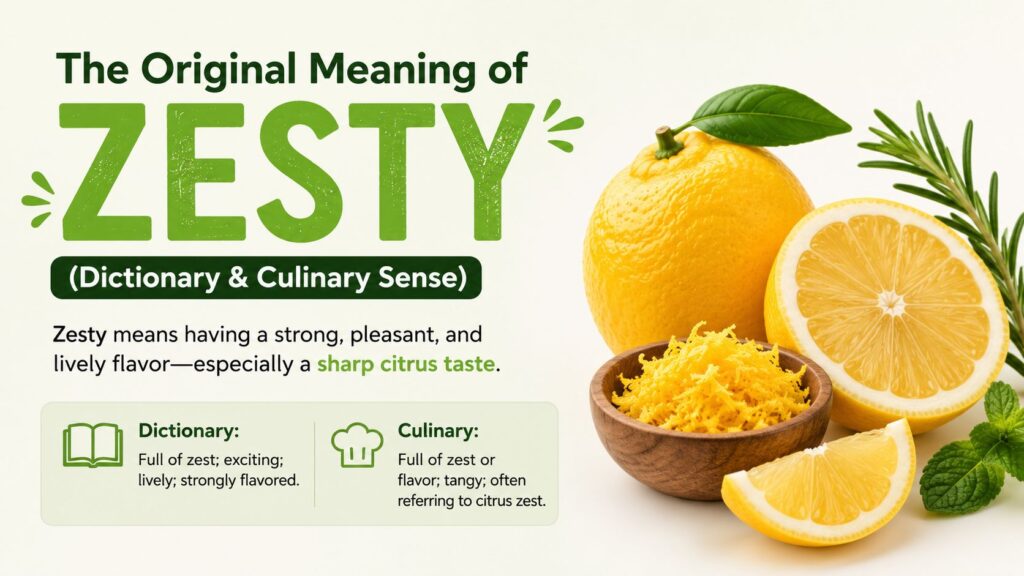
Before it was internet shorthand, “zesty” was — and still is — a completely ordinary food word. Dictionaries define it simply as full of zest, meaning piquant, tangy, or pleasantly sharp in flavor. It’s the word you’d reach for to describe a fresh flavor that wakes up your palate rather than one that sits there quietly.
Where “Zest” Comes From
The noun “zest” entered English from the French word zeste, referring specifically to the outer peel of an orange or lemon — the colorful part, not the bitter white pith underneath. Cooks have used citrus zest for centuries to add brightness to dishes without adding the sourness of the juice itself. Grate an orange peel over a cake batter, and you’re literally zesting.
By the 1670s, “zest” had already stretched beyond the kitchen. English speakers started using it to mean an added quality that makes something more interesting or enjoyable — the way a good story might have “added zest” to a dull evening. The adjective “zesty” followed the same logic: describing anything with citrus zest-like sharpness or, more broadly, anything with a lively kick.
How “Zesty” Is Used in Cooking Today
Open any recipe site and “zesty” is everywhere. It’s a favorite word for:
- Zesty salad dressings (citrus vinaigrettes, anything with lime or lemon juice)
- Zesty marinades for grilled chicken or shrimp
- Zesty sauces — think chimichurri, remoulade, or a spicy aioli
- Zesty seasoning blends that combine citrus, chili, and herbs
In restaurant menus and food blogs, “zesty” signals a dish that’s tangy and a little sharp rather than rich or sweet. It’s the opposite of bland — a tangy taste that makes you sit up and notice. This cooking term usage hasn’t gone anywhere. It’s still the primary meaning you’ll find in a dictionary, and it’s still exactly what a chef means when they use it.
Zesty as a Personality Descriptor Before the Internet
Here’s a detail most slang explainers skip entirely: calling a person zesty isn’t a new, internet-born idea. Long before TikTok existed, English speakers used “zest” and “zesty” to describe people with enthusiasm and energy. The phrase “zest for life” has been common for generations, describing someone who approaches everything with gusto and enjoyment.
A 1950s biography might describe its subject as “a zesty conversationalist,” meaning someone lively and engaging at a dinner party — no internet, no memes, no TikTok involved. So when people frame today’s zesty meaning as some sudden invention of Gen Z, that’s only half true. What’s actually new isn’t the idea of “zesty person” — it’s the specific flavor of personality the word now points to: something bolder, more theatrical, and more visually coded than plain old enthusiasm.
How Zesty Became Internet Slang
So how did a word for salad dressing end up describing someone’s dance moves? The path runs through several distinct phases, and understanding the timeline actually helps explain why the word carries the specific connotations it does today.
The Shift From Flavor to Personality (2000s–2010s)
Online meaning shifts rarely happen overnight — they build slowly across forums, comment sections, and early social platforms. In the 2000s, “zesty” started popping up in online writing as a colorful stand-in for “spicy” personality traits, often applied to comedians, drag performers, and anyone with an over-the-top, theatrical presence. This period matters because it’s where the modern connotation started forming: not just “energetic” in a generic way, but specifically bold, flamboyant, and a little dramatic.
Meme Culture’s Role in the Early Spread
Meme language thrives on repurposing ordinary words for comedic effect, and “zesty” was a perfect candidate. It’s short, it’s fun to say, and it already had a built-in sense of “extra flavor.” Reaction image communities and early Tumblr and Twitter meme accounts picked it up as a way to caption bold, exaggerated behavior — someone striking a dramatic pose, an over-the-top dance move, an unnecessarily theatrical reaction to something small. This is a pattern you see across countless internet memes: a word gets stretched from its literal meaning into a broader vibe, gets used ironically for a while, and eventually settles into everyday online humor as a genuine descriptor rather than a punchline.
Worth noting honestly: several language trackers point out that “zesty” as a coded personality descriptor has roots that trace partly through Black internet culture and queer online spaces before it crossed over into wider social media slang. That lineage is part of why the word carries the specific undertones it does today — particularly the ones tied to masculinity and self-expression discussed later in this guide.
TikTok’s Breakout Moment
If meme culture planted the seed, TikTok is what made it grow into mainstream Gen Z slang. Short-form video is built for words that communicate a whole vibe in one syllable, and “zesty” fits that format perfectly. Around 2021 to 2023, creators began tagging bold outfit videos, confident dance clips, and theatrical reactions with the word — in captions, in hashtags, in comment sections. The platform’s recommendation algorithm rewards exactly this kind of vivid, attention-grabbing content, so the word rode along with every video it got attached to.
By 2023, “zesty” wasn’t a niche reference anymore. It had become instantly recognizable vocabulary — the kind of word a 15-year-old and a 15-year-old’s older sibling would both understand immediately, even if they used it slightly differently.
Timeline: Zesty’s Meaning by Era
| Era | Primary Meaning | Where It Lived |
|---|---|---|
| 1600s–1900s | Tangy, flavorful (food) | Cooking, recipes, everyday speech |
| 1900s–1990s | Lively, enthusiastic (person) | General conversation, writing, biographies |
| 2000s–2010s | Bold, theatrical personality | Online forums, early social media |
| Mid-2010s | Comedic, exaggerated behavior | Meme accounts, Tumblr, Twitter |
| 2020–2023 | Mainstream Gen Z compliment/tease | TikTok, Instagram Reels |
| 2023–2026 | Everyday digital vocabulary | TikTok, Discord, gaming chats, texting |
What Does Zesty Mean in Slang Today?
So here’s the answer to the question that actually brought most readers to this article: what does zesty mean right now, in 2026, on the apps people actually use?
Core Definition — Bold, Dramatic, Flamboyant, Extra
In current zesty slang meaning, the word describes someone or something with big, bold, unmistakable personality. Think of it as sitting at the intersection of a few related ideas:
- Bold — unafraid to stand out or draw attention
- Dramatic — expressive in a theatrical, larger-than-life way
- Flamboyant — flashy in style, movement, or self-presentation
- Extra — doing more than the situation technically requires, on purpose
Put those together and you get the modern zesty definition: a vibrant personality, an expressive person, someone whose energetic behavior makes them impossible to ignore. It applies to people, but it’s just as commonly applied to outfits, dance moves, captions, reactions, and even pets or objects that seem to have “main character energy.”
Compliment vs. Tease — Tone Decides Everything
This is the single most important thing to understand about zesty in text and casual conversation: the word doesn’t have one fixed emotional temperature. It shifts based on delivery.
“Bro why are you so zesty today, I love it.” — This reads as pure affection. It’s celebrating someone’s energy.
“Ok zesty, calm down.” — Same word, but now it’s a light tease, poking fun at someone being a little much.
Neither of these is wrong. That’s the nature of slang — the modern usage of “zesty” depends heavily on who’s saying it, who’s hearing it, and what relationship exists between them. A close friend calling you zesty is almost always affectionate. A stranger doing the same thing carries more risk of landing badly.
Example Sentences People Actually Use
Real usage examples help more than abstract definitions. Here are sample sentences pulled from how people actually talk online and in group chats:
- “Her outfit for the party was so zesty, I’m obsessed.”
- “That’s a zesty way to respond to a simple text lol.”
- “The way he walked into that room was extremely zesty.”
- “Ngl your reaction to losing that game was kind of zesty.”
- “This whole dance routine is zesty from start to finish.”
- “Stop being zesty in the group chat, we’re trying to plan something serious.”
- “That streamer’s commentary style is genuinely zesty, I can’t stop watching.”
Notice how none of these example sentences require any extra explanation to make sense — that’s a sign the word has fully settled into everyday teen slang and beyond.
Is “Zesty” About Sexuality? Clearing Up the Biggest Misconception
This is, by search volume, one of the most common questions attached to this word, so it deserves a direct and honest answer rather than a dodge.
Why People Search “Does Zesty Mean Gay”
Because in practice, some people do use “zesty” as a coded way to comment on a man’s perceived femininity or flamboyance — often tied to assumptions about his sexuality. This usage exists, it’s documented across slang trackers and youth culture writing, and pretending it doesn’t happen would be dishonest.
The Honest Answer
Zesty does not mean gay. It’s not a synonym, and it’s not an official label for sexual orientation. At its core, the word describes a style of expression — boldness, flamboyance, dramatic flair — not a person’s actual identity. Someone can be zesty and straight. Someone can be gay and never described as zesty in their life. The two things are simply not the same category.
That said, because the modern personality sense of “zesty” leans heavily on traits stereotypically associated with femininity in men (expressiveness, flamboyance, theatrical movement), it does get used as if it were shorthand for sexuality in some corners of the internet. Understanding that pattern exists is different from accepting it as an accurate or fair use of the word.
Why the Stereotype Still Persists
Stereotypes like this tend to stick around because slang spreads faster than nuance does. A word gets used a certain way by a loud enough group of people, and the association calcifies even when it’s not technically accurate. This is a broader pattern across internet slang meaning generally — plenty of words pick up baggage that has more to do with cultural assumptions than with the word’s actual definition. “Zesty” is a clear example of that happening in real time, which is exactly why it’s worth pausing before using it to describe someone else’s masculinity or femininity.
Is Zesty Offensive? How to Read the Room
Given everything above, a fair question follows: is it actually safe to use this word?
What Decides Tone
Three factors do almost all the work in determining whether “zesty” lands well:
- Relationship — Close friends have more latitude than acquaintances or strangers.
- Platform — A private group chat is a different environment than a public comment on a stranger’s video.
- Delivery — Paired with warm emojis and clear affection, it reads as praise. Paired with mockery or repeated pointed use, it reads as an insult.
When It Lands as a Compliment
“Zesty” works as a genuine compliment when it’s celebrating someone’s confidence, creativity, or willingness to stand out. Content creators frequently embrace the label themselves — captioning their own bold outfit or dance video with “feeling zesty today” is now a completely normal, self-assured way to use the word. In that context, it’s self-expression, not a label imposed from outside.
When It Can Come Across as Mocking
The word crosses into mocking territory when it’s used to single someone out — especially a man — for behavior that doesn’t fit narrow expectations of how he “should” act. If the comment feels like it’s pointing out someone’s difference rather than celebrating their energy, that’s the signal it’s tipped into teasing, or worse, ridicule.
A Simple Gut-Check
Before using “zesty” to describe another person, ask:
- Would I be comfortable if they saw this comment?
- Am I celebrating their energy, or making fun of it?
- Do I actually know this person well enough for the tone to land the way I intend?
If the answer to any of those feels shaky, a safer alternative to zesty — covered in the next section — is the better call.
How to Use “Zesty” Correctly (With Examples)
Once you understand the tone rules, using the word well is fairly simple. Here’s how it plays out across different contexts.
Zesty About a Person’s Energy or Style
This is the classic use case: praising someone’s confidence, flair, or presence. “She walked into that interview so zesty, I could tell she was going to get the job” — the word here is doing the work of “confident and magnetic” in one syllable.
Zesty About Content, Outfits, Dances, or Performances
This is where the word shows up most often online. A bold fashion choice, a theatrical dance routine, an unexpectedly dramatic reaction video — all fair game. TikTok trends built entirely around “zesty energy” challenges have circulated repeatedly, inviting creators to show off their most confident, expressive selves on camera.
Zesty in Texting and DMs
In one-on-one messaging, zesty often reacts to a message’s tone rather than the person’s whole personality. Someone sends an unnecessarily dramatic response to a simple question, and the reply is a single word: “zesty.” It’s efficient. It communicates “that was a lot, and I noticed” without needing a full sentence.
Real Example Captions, Explained
| Caption | What It’s Communicating |
|---|---|
| “zesty era 🔥✨” | The poster is embracing a bold, confident phase of self-expression |
| “why is he being so zesty rn 💀” | Light teasing about someone’s dramatic behavior in the moment |
| “outfit felt very zesty today ngl” | A compliment about a bold or flashy fashion choice |
| “that clutch play was zesty as hell” | Praise for a flashy, high-energy moment in a game |
Zesty vs. Similar Slang Terms
Slang words often cluster together, and it’s easy to blur them if you don’t use them daily. Here’s how “zesty” actually differs from its closest neighbors.
| Term | Core Meaning | How It Differs From Zesty |
|---|---|---|
| Slay | Praising an accomplishment or great execution | Action-focused — celebrates doing something well, not just having personality |
| Sus | Suspicious or questionable behavior | Completely different tone; carries doubt rather than admiration |
| Extra | Doing more than necessary, often negatively | Can be a criticism on its own; zesty usually skews more affectionate |
| Flamboyant | Bold, showy self-presentation | Older, more formal register; less playful, less likely to be used ironically |
Zesty vs. Slay
“Slay” celebrates a specific achievement — nailing a performance, wearing a look perfectly, handling a situation with skill. “Zesty” is broader; it’s about ongoing personality and vibe rather than a single moment of success.
Zesty vs. Sus
These two aren’t really interchangeable at all, but they get grouped together simply because both are common Gen Z slang terms. “Sus” signals distrust. “Zesty” signals boldness. Confusing the two in conversation would genuinely change the meaning of what you’re saying.
Zesty vs. Extra
“Extra” on its own can be a mild complaint — someone doing too much for the situation. “Zesty” carries a similar sense of “a lot,” but tends to frame that “a lot” as charming rather than exhausting.
Zesty vs. Flamboyant
“Flamboyant” is the more formal, dictionary-standard word for showy self-expression, and it’s been around far longer without slang baggage attached. “Zesty” is its playful, internet-native cousin — same rough territory, much more casual register.
Formal & Casual Alternatives to “Zesty”
Sometimes the word just isn’t right for the room. Here are solid substitutes depending on context.
Workplace-Safe Synonyms
- Vibrant
- Spirited
- Dynamic
- Expressive
- Charismatic
- Energetic
These work in performance reviews, professional bios, or any formal writing where slang would feel out of place but you still want to capture genuine enthusiasm and presence.
Casual, Friend-Group Synonyms
- Iconic
- Unhinged (used affectionately)
- Extra
- A whole vibe
- Main character energy
When a Synonym Is the Smarter Choice
If you’re writing for an audience that spans multiple generations, or communicating in any semi-professional space, reaching for one of the alternatives above avoids the guesswork of whether your reader even knows the modern definition of “zesty” — let alone whether they’ll read the tone correctly.
Who Uses “Zesty” and Where
Gen Z vs. Gen Alpha
Gen Z popularized the word’s modern meaning and still uses it earnestly most of the time — as a genuine compliment about someone’s energy or style. Gen Alpha, the generation coming up behind them, has already started using the word with an extra layer of irony, sometimes deploying it almost as a joke about how frequently older Gen Z uses it. This is a completely normal pattern in internet generation language cycles: each new wave of young internet users takes existing slang and adds its own ironic distance to it.
TikTok, Discord, and Gaming Chat
Each platform shapes the word slightly differently:
- TikTok — captions, hashtags, and comment threads celebrating bold outfits, dances, or reactions
- Discord — a quick reaction word, often paired with emoji like 🔥, ✨, or 💀
- Gaming chat — describing a flashy, skillful, or entertaining play; a streamer pulling off something clip-worthy
In gaming spaces specifically, the word tends to stay firmly about performance and entertainment value rather than personality or identity — a teammate’s flashy movement, an improbable clutch play, a moment worth clipping and sharing.
Can Adults or Brands Use It Without Sounding Forced?
Carefully, and sparingly. Brands attempting to sound current sometimes overuse trending slang in a way that reads as try-hard rather than authentic — a well-documented pitfall of chasing viral language for marketing purposes. If a brand’s actual audience is Gen Z and the usage feels natural rather than forced, it can work. If it’s shoehorned into a caption that otherwise reads like corporate copy, it usually backfires. The safest rule: only use the word if you’d say it out loud without hesitating.
Zesty’s Popularity Over Time
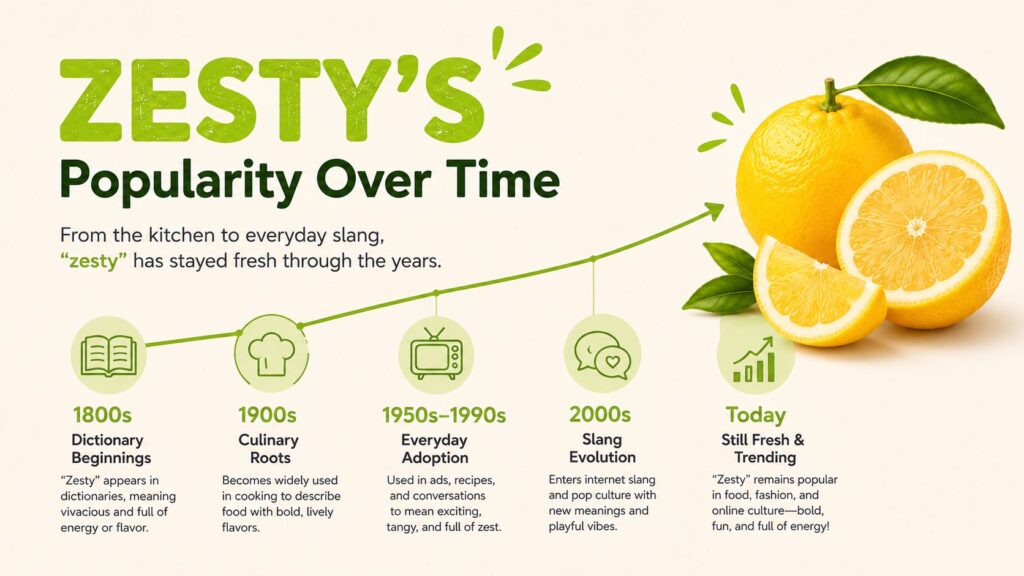
Is It Still Growing, Peaking, or Fading in 2026?
As of 2026, “zesty” has moved past its explosive breakout phase and settled into a stable, well-established place in digital slang. It’s no longer a fresh discovery generating novelty engagement on its own — it’s simply part of the everyday vocabulary of content creators, gamers, and casual texters across the English-speaking internet. That’s actually a sign of staying power rather than decline: slang that survives past its initial hype cycle and becomes background vocabulary, rather than fading out entirely, tends to stick around for years rather than months.
Expect continued use in online platforms like TikTok, Discord, and Instagram, with occasional shifts in emphasis (more gaming-focused one year, more fashion-focused the next) but no sign of the core meaning disappearing anytime soon.
A quick illustration of how settled the word has become: picture a college student, Maya, who first heard “zesty” in a TikTok comment section back in 2022 and assumed it was a passing joke. By 2026, she’s using it herself without thinking twice — captioning a bold outfit photo, calling a friend’s dramatic text “so zesty,” reacting to a streamer’s flashy play with the same word. That’s the arc most durable slang follows: novelty, adoption, then quiet absorption into ordinary everyday usage. Words that survive that full cycle — rather than fading after a single viral moment — tend to stick around for years, not months, and “zesty” has clearly made it through.
That staying power also shows up in how flexible the word has become. It no longer needs a viral video attached to make sense; it works just as well typed cold in a text with zero context, which is usually the clearest sign a trending phrase has graduated into genuine, lasting modern usage rather than a passing fad.
ALSO READ: Poison Tree Tattoo Meaning: Symbolism Explained
Common Mistakes People Make With “Zesty”
- Confusing the literal and slang meanings mid-conversation. Saying “this chicken is zesty” in a recipe context is completely different from calling a person zesty — mixing registers can confuse readers unfamiliar with both senses.
- Using it on strangers. Tone control matters far more with people you don’t know well; what reads as playful among friends can read as mocking from a stranger.
- Assuming it always signals sexuality. As covered above, that’s a stereotype attached to the word, not an accurate definition of it.
- Overusing it in professional writing. It’s a trending phrase, not a formal descriptor — save it for casual digital communication.
- Applying it sarcastically without reading the room. A tease that lands fine with a close friend can feel pointed or unkind directed at someone less familiar with your sense of humor.
FAQs
Is zesty a compliment?
Yes, in most cases. It’s used to praise someone’s bold, confident, or expressive energy rather than criticize it.
What does zesty mean on TikTok in 2026?
It describes flamboyant, dramatic, or attention-grabbing energy in outfits, dances, and reactions — now a standard part of everyday TikTok slang rather than a fleeting trend.
Does zesty mean someone is gay?
No. It’s a personality descriptor about boldness and expressiveness, though it’s sometimes misused as coded language tied to masculinity stereotypes.
Is “zesty” still trending, or has it faded?
It’s past its viral spike but still going strong — it’s settled into everyday Gen Z and Gen Alpha vocabulary across TikTok, Discord, and gaming chats.
Can I use “zesty” at work or in formal writing?
It’s best avoided there — swap it for vibrant, spirited, or dynamic to keep the same energy without sounding out of place.
conclusion
Zesty started in the kitchen, but it’s landed somewhere much bigger. The zesty meaning today is all about bold, confident energy — in a person, an outfit, or even a text message. It’s playful. It’s expressive. And it’s not going away anytime soon.
Still, tone matters most. The zesty meaning can shift from a warm compliment to a sharp tease in seconds. Use it with care, know your audience, and you’ll never get it wrong. That’s really all there is to it.