
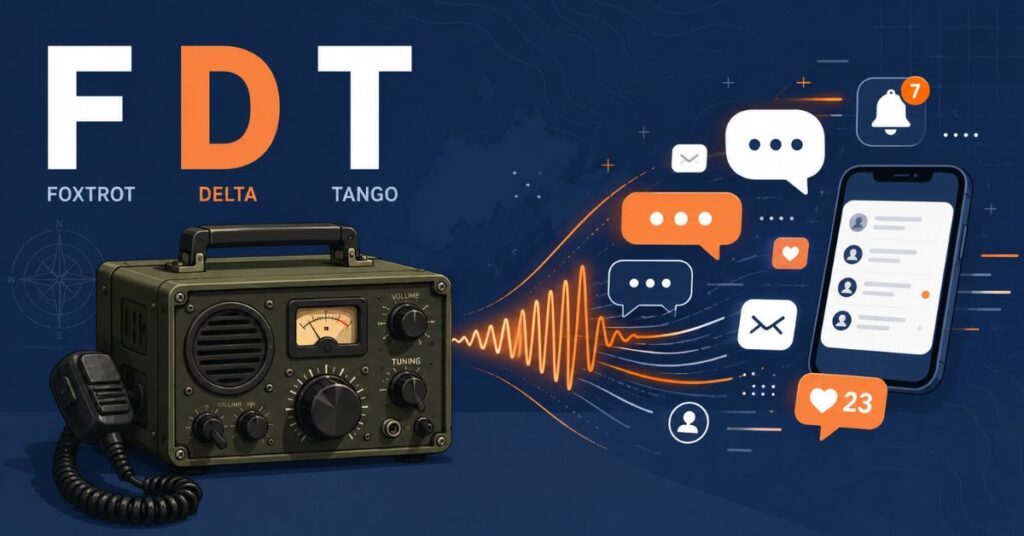
Foxtrot Delta Tango is the NATO phonetic alphabet’s way of spelling out three letters, F, D, and T, using words designed for radio clarity. Nothing hidden, nothing classified, just a system pilots and soldiers rely on daily.
Online, though, those same three words carry a much bigger punch. Type “Foxtrot Delta Tango” into any comment section, and you’re often watching someone slip a loaded political statement past a content filter, disguised as harmless military jargon.
That double life traces back to 2016, when the acronym FDT exploded through music, protest signs, and social feeds. Years later, it’s still spreading, reshaped by gamers, meme creators, and casual texters alike.
What Does Foxtrot Delta Tango Mean?
In its most literal sense, Foxtrot Delta Tango is just the NATO phonetic alphabet spelling out three letters: F, D, and T. That’s it. No hidden layer, no classified backstory. Pilots, soldiers, and radio operators use this exact system every day to avoid confusion over a crackly line.
But say those three letters out loud on the internet, and you’re almost always pointing at something else: FDT, widely recognized online as shorthand for “F*** Donald Trump.” The phrase took off in political commentary around the 2016 U.S. election and never really left. So when someone drops “Foxtrot Delta Tango” in a comment section today, they’re rarely talking about radio protocol. They’re making a statement, often a coded phrase dressed up to slide past a filter or a moderator.
That’s the tension at the heart of this whole topic. One version of the phrase is a technical tool. The other is internet slang with real political teeth. Context is everything, and by the end of this article, you’ll be able to tell the two apart instantly.
The NATO Phonetic Alphabet, Explained
Let’s start with the boring-but-important part, because you can’t understand the slang without understanding where it borrowed its clothes from.
The NATO phonetic alphabet, officially called the International Radiotelephony Spelling Alphabet, assigns a specific word to every letter of the English alphabet. Instead of saying “B” over a noisy radio channel and having someone hear “D,” you say “Bravo.” Instead of “M,” you say “Mike.” There’s no room for confusion, even when the signal is weak or the person on the other end has never met you.
This isn’t some obscure military secret, either. It’s public, standardized, and taught to:
- Airline pilots and air traffic controllers
- Military personnel across NATO member nations
- Emergency responders, including police and fire dispatch
- Amateur radio operators (“ham radio”)
- Maritime crews communicating over ship-to-ship radio
Every one of these groups depends on radio alphabet clarity because lives, schedules, or coordination can hinge on a single misheard letter. That’s the whole reason the system exists: to remove ambiguity from radio communication when stakes are high and audio quality is low.
Why the NATO Code Exists
Before this system was standardized in the 1950s, different countries and even different branches of the same military used their own competing phonetic systems. That created chaos during joint operations. Imagine a British pilot and an American ground controller each using a different set of code words for the same letters. A system meant to prevent confusion becomes the source of it instead.
NATO needed one universal, easy-to-pronounce set of code words that worked across languages and accents, including for non-native English speakers. Linguists actually tested candidate words against background noise, static, and heavy accents before settling on the final list. Words like “Foxtrot” and “Tango” weren’t chosen randomly; their syllable patterns stay distinct even when audio quality is poor, which matters enormously in emergency communication, where a single misheard syllable can send a response team to the wrong address entirely.
The result is the alphabet still used today, refined for maximum clarity and minimum ambiguity, whether you’re flying a plane over the Atlantic, coordinating a military radio transmission in a combat zone, or a dispatcher confirming a license plate number over a scratchy patrol car radio. It has survived largely unchanged for decades precisely because it works so reliably. And that reliability is exactly what later made it useful for something its creators never imagined: internet slang.
NATO Phonetic Alphabet Table
Here’s the full alphabet, since most people searching this topic want the complete list, not just three letters.
| Letter | Code Word | Letter | Code Word |
|---|---|---|---|
| A | Alpha | N | November |
| B | Bravo | O | Oscar |
| C | Charlie | P | Papa |
| D | Delta | Q | Quebec |
| E | Echo | R | Romeo |
| F | Foxtrot | S | Sierra |
| G | Golf | T | Tango |
| H | Hotel | U | Uniform |
| I | India | V | Victor |
| J | Juliett | W | Whiskey |
| K | Kilo | X | X-ray |
| L | Lima | Y | Yankee |
| M | Mike | Z | Zulu |
Notice that Foxtrot, Delta, and Tango correspond exactly to F, D, and T. That’s the entire mechanical explanation for how “Foxtrot Delta Tango” becomes “FDT.” No cipher, no decoding tool required. Just read the first letter of each word.
Where (FDT) Actually Comes From
This is the part most explainer articles skip, and it’s honestly the most important piece of the puzzle.
The slang meaning of FDT didn’t emerge randomly from internet chaos. It traces back to a specific, well-documented moment: rapper YG released a song titled “FDT” in 2016, during the U.S. presidential election season, featuring fellow artist Nipsey Hussle. The track became an anthem at protests and rallies that year, and the acronym spread fast through music, social media, and eventually protest signage.
From there, the phrase settled into everyday online slang. People kept using “FDT” long after the election cycle that birthed it, because it functioned as a compact, instantly recognizable piece of political commentary. Anyone who’d heard the song, seen the protest signs, or scrolled past enough tweets knew exactly what those three letters meant, no explanation needed.
What happened next is a pattern you see constantly in meme culture. Once a phrase becomes too recognizable, or too likely to get flagged by a platform’s content filters, people start disguising it. Spelling it out phonetically, “Foxtrot Delta Tango,” gave users a way to say the same thing while technically avoiding the literal letters or words that might trip an automated system. It’s a workaround dressed up as tactical slang, and it stuck.
What’s interesting is how long the phrase’s shelf life turned out to be. Most election-cycle slang fades within a few months once the news cycle moves on. FDT didn’t. It kept resurfacing during subsequent election years, during major political news events, and during unrelated cultural moments where someone wanted a quick, recognizable way to signal disapproval. That staying power is unusual. Ans it’s part of why the phrase is still searched and discussed years after the song that started it all.
A few factors explain the longevity:
- The phrase is short and memorable. Three letters are easy to remember, easy to type, and easy to say out loud, which lowers the barrier for anyone to adopt it.
- The phonetic version added a second life cycle. Once the direct acronym started getting flagged more consistently. The “Foxtrot Delta Tango” version gave the slang a fresh disguise, effectively restarting its usefulness.
- It became detached from its original song. Plenty of people who use the phrase today have never heard the YG track that started it. The acronym outgrew its source material and became a standalone piece of internet expression.
This is a pattern worth remembering any time you’re trying to understand a piece of web slang: origin and current usage aren’t always the same thing. A phrase can start in one very specific cultural moment and end it up living an entirely separate life once it’s absorbed into broader internet culture.
ALSO READ: SSA Meaning: Every Definition, Context, and Use Case Explained (2026)
Why People Spell It Out Phonetically Instead of Just Typing “FDT”
You might wonder why anyone bothers with three whole words when the abbreviation does the job in a fraction of the characters. There are a few real reasons.
Filter evasion. Many social platforms run automated moderation that scans for specific keywords, including certain political phrases tied to real public figures. Spelling the acronym out phonetically sidesteps a lot of these automated triggers. Because the system isn’t looking for “Foxtrot Delta Tango”. It is looking for the words or letters that are already trained to flag.
It reads as clever. There’s a performative element here too. Typing “FDT” is blunt. Typing “Foxtrot Delta Tango” makes the writer look like they know something, like they’re fluent in military jargon and repurposing it for a joke or a jab. That little flex matters more in online chat culture than people admit.
It builds in-group recognition. If you know what the phrase decodes to, you’re in on it. If you don’t, you just see three military-sounding words and move on. That built-in filter creates a sense of community among people who already share the underlying coded opinions, which is a big part of why the phrase spread so efficiently through online discussion spaces.
Foxtrot Delta Tango on Reddit and Social Media

Reddit slang has its own ecosystem, and Foxtrot Delta Tango fits into it comfortably. Because Reddit is organized around subreddit communities with wildly different rules and tolerances. The phrase shows up in different ways depending on where you’re reading it.
Political Threads
This is the phrase’s home turf. In threads about elections, policy, or current events, “Foxtrot Delta Tango” often appears as a one-line comment, sometimes upvoted heavily, sometimes downvoted into oblivion depending on the subreddit’s leanings. It functions as shorthand for a fully formed political opinion without the poster having to write a paragraph.
Moderation Filters
Some subreddits actively ban direct references to certain political phrases, especially anything perceived as targeted or inflammatory. Spelling the phrase out phonetically is a documented workaround people use to get their comment past automod or keyword-based moderation bots, at least until moderators catch on and start banning the phonetic version too.
Joke and Meme Threads
Not every use is political. On gaming subreddits or humor-focused communities, people sometimes throw “Foxtrot Delta Tango” into a thread purely as a joke, riffing on how tactical and serious it sounds compared to what it actually communicates. It’s the internet’s version of dramatic irony: dressing up a blunt statement in official-sounding language for comedic effect.
A typical exchange in a lighthearted meme thread might look something like this:
User A: My landlord just raised rent again lol User B: Foxtrot Delta Tango to that entire situation User A: honestly the most accurate response I’ve gotten all day
Nobody in that exchange is making a statement about a specific politician. They’re borrowing the phrase’s tone, blunt, mock-official, slightly absurd, and applying it to something completely unrelated. That flexibility is a big part of why the phrase spread beyond its original political meaning in the first place. Once a piece of coded language becomes recognizable enough, people start using it as a flavor of humor rather than a literal statement, and Reddit communities are especially good at accelerating that kind of drift.
It’s also worth noting how quickly moderators and subreddit culture adapt around these threads. A phrase that gets a laugh in one subreddit might get removed instantly in another. It is depending on how strict that community’s rules are around political content, even indirect or joking references. That inconsistency is exactly why the phonetic spelling keeps proving useful: it slides through some filters that a literal acronym wouldn’t.
FDT 8647: What the Number Combo Means
If you’ve spent time in political corners of the internet, you may have seen the phrase paired with numbers, most commonly “FDT 8647.” This isn’t random. It’s a compressed, two-part message:
- 86 is long-standing American slang meaning to get rid of, remove, or reject something (its origins trace back to diner and bar culture, where “86” meant an item was out of stock or a customer was cut off).
- 47 refers to the ordinal presidential numbering, marking a specific term in office.
Put together, “8647” reads as a numeric extension of the same sentiment behind FDT, compressed into a format that’s even harder for automated filters to catch than letters or words. It’s a good example of how coded language keeps evolving. As platforms get better at catching one version of a phrase, users shift to a new format, whether that’s phonetic spelling, numeric substitution, or some combination of both.
Non-Political, Everyday Uses of the Phrase
Here’s something the more clickbait-y explainers tend to gloss over: not every use of “Foxtrot Delta Tango” is political. In plenty of casual text chat and instant messaging contexts, people use it as a generic, dramatic way to say no,”I’m done,” or “hard pass,” completely detached from its political roots.
Picture this exchange:
Friend: Are we still doing the 6am hike tomorrow? You: Foxtrot Delta Tango. I’m sleeping in.
No politics involved. Just someone borrowing the phrase’s tactical, slightly theatrical tone to make a mundane refusal sound funnier than “no thanks” ever could.
In gaming communities, especially in voice chat during multiplayer sessions, players sometimes use “Foxtrot Delta Tango” as an inside joke or even a makeshift callsign, riffing on the fact that it sounds like a real military designation. In FPS games in particular, where players already communicate using shorthand and tactical language, tossing in a phonetic phrase like this blends right in, whether it’s meant seriously or as a bit.
Case Study: How Gaming Culture Helped the Phrase Spread
FPS games like the Call of Duty and Battlefield franchises trained a whole generation of players to think in phonetic terms without even realizing it. Squad callouts, map markers, and objective names frequently borrow from military naming conventions, so when a player hears “Foxtrot” or “Tango” in a match, it registers as completely normal, expected shorthand rather than anything unusual.
That familiarity created fertile ground for the slang version of the phrase to spread. Players already comfortable tossing around phonetic letters in voice chat picked up “Foxtrot Delta Tango” quickly, because it fit the existing vocabulary of the space. From there, it moved outward through:
- Clip-sharing platforms, where funny in-game voice chat moments get uploaded and captioned
- Streaming culture, where popular streamers repeating a phrase can introduce it to thousands of viewers in a single clip
- Discord servers built around specific games, where the phrase gets folded into server-specific inside jokes and eventually Discord emotes or bot commands
This is a common life cycle for tactical slang online. It rarely jumps straight from a niche context to mainstream use. Instead, it usually passes through gaming spaces first, picks up momentum through clips and streams, and only then filters into broader social platforms where a much wider audience encounters it for the first time, often with no idea it started as military-adjacent gamer shorthand.
Foxtrot Delta Tango in Military and Aviation Contexts
Strip away the internet slang entirely, and the phrase still has a completely legitimate, apolitical life in professional settings. In aviation communication, a pilot might read back coordinates or a call sign using the phonetic alphabet, and “Foxtrot Delta Tango” could simply be part of an aircraft’s identifier or a checkpoint designation, nothing more.
In military communication, phonetic spelling gets used constantly for radio commands, unit designations, and location callouts. A radio exchange might sound something like this:
“Checkpoint Foxtrot Delta Tango, radio check, over.” “Copy, checkpoint Foxtrot Delta Tango, radio is clear, over.”
There’s zero political content in an exchange like that. It’s just three letters, spoken clearly, doing exactly what the military alphabet was designed to do: eliminate ambiguity in tactical communication. The same logic applies to emergency communication, where dispatchers might spell out a street name, badge number, or case reference using the same system.
This professional usage matters for one big reason: it’s the reason the slang version works at all. If “Foxtrot Delta Tango” didn’t already sound legitimate and official, nobody would bother using it as a stand-in for anything else. The slang borrows its entire credibility from the fact that real pilots, real soldiers, and real dispatchers use this exact phrasing every single day for entirely practical reasons.
A few more everyday professional scenarios where you might genuinely hear phonetic spelling like this:
- A pilot confirming a runway designation or taxiway letter to air traffic control
- A ham radio operator identifying their call sign during a transmission, as required by regulation
- A police dispatcher spelling out a partial license plate over the radio during a pursuit
- A security team at a large event confirming a gate or checkpoint number over shared radios
None of these situations involve any hidden meaning whatsoever. They’re the mundane, functional backbone that the internet slang version quietly leans on for its sense of authority.
Common Misconceptions About Foxtrot Delta Tango
Because the phrase straddles two completely different worlds, professional and political, a lot of confusion tends to pile up around it. Let’s clear up the biggest ones.
It’s Not Secret Spy Language
Nothing about the NATO phonetic alphabet is classified. It’s published, publicly documented, and taught in basic training manuals and aviation textbooks. Anyone can look it up in about ten seconds. The “mystery” only exists for people encountering it for the first time.
It Doesn’t Always Mean Politics
As covered above, plenty of casual and gaming-related uses have nothing to do with any political figure at all. Assuming every instance is political will lead you to misread a lot of harmless jokes.
It’s Usually Not Aggressive
Even in its political usage, the tone tends to be more satirical or dismissive than genuinely threatening. It functions closer to a meme or a slogan than a direct confrontation, and most people using it are participating in a recognizable cultural bit rather than trying to provoke anyone directly.
Similar Coded Slang Terms
Foxtrot Delta Tango isn’t the only phrase built this way. Phonetic slang and filter-dodging substitutions show up across social platforms constantly. A few patterns worth knowing:
- Numeric substitutions, like the “8647” example above, replacing words with numbers that carry the same slang meaning
- Phonetic spelling of other acronyms, applying the same NATO-alphabet trick to different three- or four-letter abbreviations
- Letter spacing or symbol insertion, breaking up a flagged word with periods, spaces, or special characters to dodge keyword filters
The common thread across all of these is the same cat-and-mouse dynamic: platforms build filters, users build workarounds, and internet culture rewards whoever comes up with the cleverest disguise.
| Technique | How It Works | Common Use Case |
|---|---|---|
| Phonetic spelling | Spells out an acronym using the NATO alphabet or similar code words | Political shorthand, filter evasion |
| Numeric substitution | Replaces letters or words with numbers carrying an established slang meaning | Compressed political or coded messages |
| Character insertion | Adds spaces, periods, or symbols mid-word | Basic keyword filter evasion |
| Homophone swaps | Replaces a flagged word with a similar-sounding but unflagged word | Avoiding platform-specific banned terms |
Understanding this table helps explain why “Foxtrot Delta Tango” isn’t a one-off quirk. It’s one example of a much bigger, constantly shifting toolkit that internet users rely on to keep communicating the way they want, even as social platforms get more aggressive about automated moderation.
Foxtrot Delta Tango vs. Just Saying “Hard Pass”
It’s worth pausing on why people reach for a phrase like this instead of a simpler, already-established expression like “hard pass.” Both communicate refusal or rejection, but they land very differently.
“Hard pass” is plain, direct, and universally understood. It carries no extra baggage and works in almost any context, professional or casual. “Foxtrot Delta Tango,” on the other hand, is deliberately performative. It signals that the speaker is in on a specific cultural reference, whether that’s the political meaning or just the general tactical-sounding vibe of the phrase itself.
In casual, non-political texting, the two are often functionally interchangeable, just with a different tone. “Hard pass” is a shrug. “Foxtrot Delta Tango” is a wink. Which one someone reaches for usually comes down to how much personality, or how much of an inside joke, they want to inject into an otherwise simple “no.”
Is Foxtrot Delta Tango Still Popular in 2026?
Short answer: yes, though its usage has broadened. What started as a tightly political phrase now shows up across a wider range of online jokes, gaming banter, and casual messaging, alongside its original political usage, which remains active heading into election-adjacent news cycles. It’s a good example of a slang term that never fully died, it just picked up new audiences and new contexts along the way.
Here’s a quick platform-by-platform snapshot of how the phrase tends to surface:
| Platform | Common Usage |
|---|---|
| Political comment threads, filter evasion, meme replies | |
| TikTok | Captions, audio trends, comment section shorthand |
| Comment replies, story reactions, caption humor | |
| Discord | Gaming banter, inside jokes, voice chat callouts |
| Casual group chat use, mostly non-political refusals | |
| Snapchat | Quick captions, reaction-style responses |
Each platform has its own moderation strengths and blind spots, which partly explains why the phonetic version of the phrase keeps finding new life. Wherever a filter gets smarter, the phrasing shifts slightly to stay one step ahead.
Why Coded Slang Like This Keeps Catching On
Zoom out for a second, and Foxtrot Delta Tango is really just one example of a much broader phenomenon: coded, tactical-sounding language thriving in casual online chat. A few reasons this pattern keeps repeating across different eras and different platforms:
- It signals belonging. Understanding a coded phrase, whether it’s political slang, gaming shorthand, or a meme threads in-joke, marks you as part of a group that “gets it.” That sense of belonging is a powerful motivator for adopting and repeating slang.
- It softens harsh statements. Wrapping a blunt opinion in phonetic letters or a numeric code gives it a layer of distance. It can feel less confrontational to type “Foxtrot Delta Tango” than to spell out the full phrase, even though everyone involved knows exactly what’s being said.
- It rewards cleverness. Internet culture consistently favors the wittiest version of a message over the most direct one. A phonetic spelling feels clever in a way a blunt statement doesn’t, and clever content spreads faster.
- It adapts to moderation. As platforms tighten their filters, coded language evolves right alongside them. This isn’t unique to political slang either; it’s the same dynamic behind self-censoring spellings for all sorts of flagged words across social platforms.
None of this is particularly new. Slang has always evolved partly in response to social pressure or restriction, going back long before the internet existed. What’s different now is the speed. A phrase can go from a niche Discord server to a TikTok trend to a fully mainstream reference in a matter of weeks, sometimes days, thanks to how quickly content moves across social platforms today.
ALSO READ: RQ Meaning in Text Simple Guide for Beginners 2026
Quick Facts Summary
If you only remember a handful of things from this article, make it these:
- Literal meaning: “Foxtrot Delta Tango” spells out the letters F, D, and T using the NATO phonetic alphabet.
- Slang meaning: Widely recognized online as shorthand for “F*** Donald Trump,” most common in political commentary.
- Origin: Traces back to YG’s 2016 song “FDT,” released during the U.S. presidential election.
- Why the phonetic version exists: Primarily to dodge automated content filters and keyword moderation on social platforms.
- Non-political uses: Common in gaming communities and casual chat as a dramatic stand-in for “no” or “I’m done.”
- Professional use: Still a completely standard part of aviation communication and military radio protocol, with zero political meaning in that context.
- Related term: “FDT 8647” combines the acronym with numeric slang (86 = remove/reject, 47 = presidential numbering).
- Current status in 2026: Still active across Reddit, TikTok, Discord, and other social platforms, spanning both political and casual use.
At the end of the day, “Foxtrot Delta Tango” is a good reminder of how flexible language gets online. A system built for absolute clarity on a military radio channel got borrowed, twisted, and repurposed into something almost unrecognizable from its original intent, and somehow both versions are still in daily use, sitting right next to each other, depending entirely on who’s typing and where.
Conclusion
Foxtrot Delta Tango turned out to be simple after all. Three letters, borrowed from a radio code, dressed up with new meaning. Sometimes it’s political. Sometimes it’s just a joke. The context always tells you which one you’re looking at.
That’s the real charm of internet slang. A phrase like Foxtrot Delta Tango can live two lives at once, one official, one playful, and never get confused. Next time you spot it online, you won’t need to guess. You’ll already know exactly what’s being said.
FAQS
What does Foxtrot Delta Tango mean?
It spells out the letters F, D, and T using the NATO phonetic alphabet. Online, those letters are widely used as slang for “F*** Donald Trump.”
Where did the FDT slang come from?
It traces back to YG’s 2016 song “FDT,” released during the U.S. presidential election. The phrase spread through protests, social media, and eventually phonetic spelling.
Is Foxtrot Delta Tango always political?
No. Plenty of people use it casually to mean “no” or “hard pass,” especially in gaming chats and everyday texting, with zero political meaning attached.
What does FDT 8647 mean?
It combines FDT with “86” (slang for reject or remove) and “47” (a reference to presidential numbering), creating a compressed political message.
Is Foxtrot Delta Tango still used in 2026?
Yes. It’s still active on Reddit, TikTok, and Discord, both as political shorthand and as everyday slang for refusal or frustration.

Hi! I’m Jenson, the writer behind punslush.com. I craft clever puns and witty wordplay designed to entertain and inspire. Visit punslush.com for a good dose of humor and fun!