
dih meaning is internet slang, a phonetic stand-in for a word for male genitalia, born out of AAVE and popularized through algospeak — deliberate misspellings that dodge platform filters. It’s not a typo. It’s a workaround.
You’ve scrolled past it a hundred times without clocking it. A comment that’s just “dih energy 💀” under a fail video. A DM from your friend that makes zero sense until you get the joke.
The wild part? This tiny word carries almost no fixed meaning anymore. It shifts with tone, platform, and who’s typing it, and getting that wrong is easier than you’d think.
What “Dih” Actually Means (The Short Answer)
Here’s the direct answer, no dancing around it: dih meaning is a phonetic spelling that stands in for a slang word for male genitalia. That’s the literal root.
But here’s the part that trips people up — the way it actually gets used almost never matches that literal meaning. Nine times out of ten, nobody’s talking about anatomy. They’re using it as a reaction, a punchline, or a stand-in for “wow” or “rough” or “that’s wild.”
Think of it this way: the word started as a substitute for something explicit, and then it kept evolving until the substitute became its own thing. That’s not unusual. Language does this constantly. “Sick” doesn’t mean ill anymore in half the sentences it shows up in. “Salty” isn’t about food. dih meaning is just the newest entry in a long list of words that got a second life as internet slang.
If you only remember one thing from this whole article, remember this: context decides the meaning, not the dictionary definition. That’s true for almost every piece of modern slang, but it’s especially true here.
ALSO READ: Poison Tree Tattoo Meaning: Symbolism Explained
Where “Dih” Really Comes From
People love to credit TikTok for inventing slang. TikTok didn’t invent this one. It just gave it a megaphone.
The AAVE Roots
The word origin traces back to AAVE — African American Vernacular English — a dialect with its own grammar, rhythm, and vocabulary that has shaped American English for decades. A huge share of what gets labeled “TikTok slang” or “Gen Z expressions” actually started in Black communities and spread outward once it hit mainstream platforms. “Lit,” “shade,” “woke,” “finna” — all AAVE before they were hashtags.
Dih follows the same path. It existed as a pronunciation variant and a piece of vernacular before any app made it go viral. Knowing this matters, because it changes how you should think about using it. This isn’t a word that was born on an algorithm. It’s a word that got discovered by one.
The Algospeak Connection
Now here’s the mechanical reason it exploded in late 2024 specifically: algospeak.
Algospeak is the practice of deliberately misspelling or altering words so that automated content moderation systems don’t flag or remove a post. You’ve seen this everywhere without necessarily knowing the term for it:
| Original Word | Algospeak Version |
|---|---|
| dead / died | unalive |
| sex | seggs |
| dick | dih |
| kill | k*ll or unalive |
| suicide | grape (unrelated substitute, purely to dodge filters) |
Late 2024 is when TikTok tightened its content moderation around explicit language. Creators needed a way to keep making jokes and reaction videos without getting comments deleted or entire posts taken down. Dih fit the bill perfectly — close enough to the original word that everyone still got the joke, different enough that automated filters usually let it slide.
One TikToker’s meme referencing a professional athlete’s family went viral in December 2024 and is widely credited as an early spark for the term’s spread — a moment many people online criticized as genuinely offensive rather than just edgy. That’s worth knowing as part of the honest history here, even though it’s not something worth dwelling on or treating as a template. The mechanism — algospeak used for laughs and shock value — is the part that actually explains the word’s staying power. The specific meme is just one data point in a much bigger wave.
From there, it snowballed. Reaction videos, meme formats, and comment culture picked it up and ran, and by mid-2025 it had become one of the most recognizable pieces of viral slang on the platform.
Why This Matters for How You Use It
Knowing the slang origins isn’t just trivia. It’s the difference between using a word casually and using it in a way that reads as tone-deaf. Words with AAVE roots that get flattened into generic “internet speak” by people outside that culture often lose the nuance that made them work in the first place. More on that later.
A Quick Timeline: How Fast This Actually Spread
Slang doesn’t usually get a documented paper trail, but this one does, thanks to how closely meme-tracking communities followed it. Here’s roughly how the spread played out:
| Period | What Happened |
|---|---|
| Late 2024 | TikTok tightens moderation on explicit language; algospeak substitutes become more common across the platform |
| December 2024 | Early viral meme using the term racks up hundreds of thousands of views within two months |
| January 2025 | Multiple spinoff meme formats emerge, pushing the word into mainstream comment culture |
| Throughout 2025 | Sustained use on TikTok, well past the usual lifespan of a meme-driven term; spreads to Instagram Reels |
| Early–mid 2026 | Term shows up regularly enough that people start searching for a plain-English definition — which is a pretty reliable sign a piece of slang has crossed from “niche joke” into “actual vocabulary” |
That last point is worth sitting with for a second. Most viral slang dies fast because it’s tied to one specific meme format — once the format stops being funny, the words go with it. Dih didn’t really follow that pattern. It kept getting reused in new contexts (food reviews, fail videos, roast comments) long after the original meme trend had faded, which is usually the marker that separates a passing joke from a term that’s actually earned a place in modern slang.
How the Meaning Shifts Depending on Context
This is where most explainers fall short. They give you one definition and call it a day. But dih doesn’t behave like a normal word — it behaves like a mood.
Literal Use (Rare)
Sometimes people use it exactly as intended, as a censored version of the original explicit word. This is the least common use case online, mostly showing up in jokes that call attention to the word itself — think “what’s a dih 💀” as a comment under a video, poking fun at how often the term shows up out of nowhere.
Expressive / Reaction Use
This is the big one. On a video of someone doing something impressive, ridiculous, or unexpected, the top comment is often just “dih” by itself. No sentence, no explanation. It functions almost like punctuation — a stand-in for “wow,” “no way,” or “I can’t believe I just watched that.”
Roast / Insult Use
Paired with “move,” “energy,” or “behavior,” it turns into light criticism. “That’s a dih move” means someone did something a little foul, a little disrespectful, or just plain annoying — but usually in a joking, not-that-serious way.
Hype / Praise Use
Oddly enough, it also shows up as a compliment, especially in food content and general “this exceeded expectations” reactions. “That jerk chicken had dih energy” isn’t describing the food literally — it’s saying the food was unexpectedly, almost unreasonably good. It works the same way “bussin'” or “fire” does: exaggerated praise dressed up in a word that sounds like it shouldn’t be praise at all.
Here’s a quick reference table so the differences actually stick:
| Use Case | Example | Actual Meaning |
|---|---|---|
| Literal | “What’s a dih 😭” | Poking fun at the word itself |
| Reaction/punctuation | “dih” (standalone comment) | Wow / no way |
| Roast | “That’s a dih move” | Mildly foul or annoying behavior |
| Hype/praise | “This food had dih energy” | Unexpectedly amazing |
| Filler | “dih” (random Snapchat reply) | Basically nothing — just noise |
The throughline across every single one of these: tone and context decide the meaning far more than the word itself ever does.
The Other “DIH” You’ll See — Don’t Confuse Them
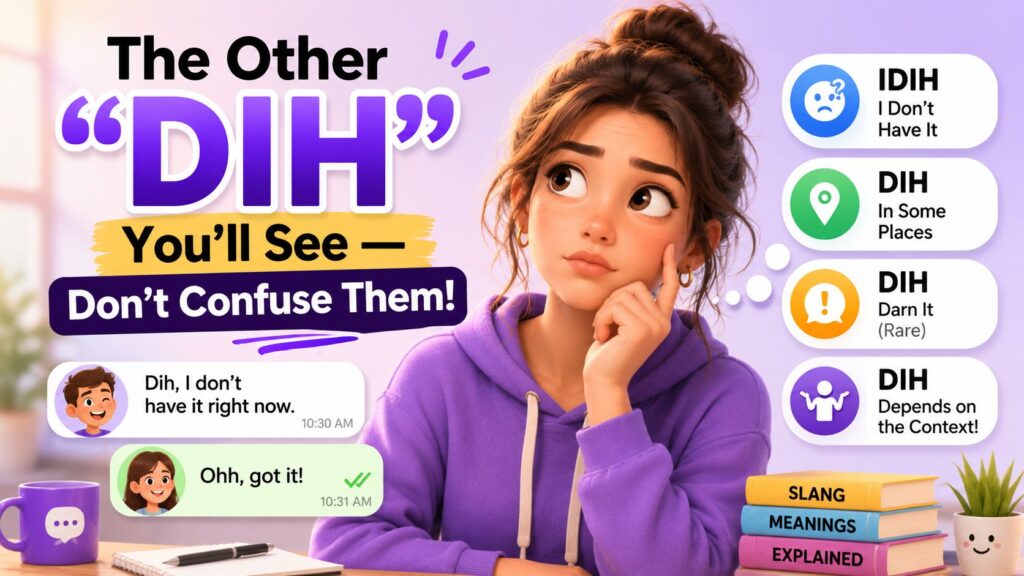
Here’s something almost every other explainer misses, and it’s a real source of confusion: there’s a second, completely unrelated “DIH” floating around, and mixing the two up leads to genuinely awkward misreadings.
The other DIH is an acronym standing for “Die in Hell.“ It shows up as a short, angry reply in heated exchanges, arguments, or gaming chats — and it carries none of the playful, punctuation-style energy of the slang version we’ve been talking about.
Here’s how to tell them apart in the wild:
- Slang version (lowercase-feel, expressive): stands alone, reacts to a video or post, usually paired with an emoji or used as filler. “dih 💀”
- Acronym version (hostile, directed): appears mid-argument, aimed at a specific person, meant to wound. “You’re actually the worst, DIH.”
If someone sends you “DIH” in the middle of a disagreement, that’s very likely the acronym, not the reaction word. If it shows up under a funny video with no other context, that’s almost certainly the slang version. Reading the surrounding conversation — not just the three letters themselves — is the only reliable way to know which one you’re looking at.
Where You’ll Actually Run Into It
Platform differences matter more with this word than with almost any other piece of slang, because moderation rules, audience age, and community norms vary so much from app to app.
TikTok
This is home base. Dih shows up constantly in comment sections, captions, and voiceovers, and TikTok is also where the word has had unusually long staying power. Most slang on the platform gets absorbed, used ironically, then abandoned within a matter of weeks. This one kept going strong through all of 2025, which suggests it’s filling an actual linguistic gap — a quick, flexible reaction word — rather than just riding a fifteen-minute trend cycle.
Instagram Comments
Instagram comments tend to pick up slang a few weeks after TikTok, once a term has already gone through a couple of rounds of TikTok irony. By the time it lands on mainstream Instagram posts and Reels, usage is slightly more curated — Instagram’s culture still leans a bit more toward aesthetics, so the word shows up more in captions and story replies than in chaotic comment threads.
Snapchat Messages
On Snapchat messages, context is basically dead already — streaks and random replies are the norm, so dih fits right in as filler. It often shows up attached to nothing in particular: a ceiling selfie, a blank reply to keep a streak alive, a one-word non-sequitur. It doesn’t carry much weight here; it’s closer to background noise than a real statement.
Discord Chat
Discord chat and gaming spaces tend to adopt slang later than TikTok or Instagram, and they use it more bluntly once they do. The tonal nuance that makes the word playful elsewhere often gets stripped away in gaming contexts, where it’s more likely to be used as blunt emphasis or even as a genuine insult during competitive moments.
Reddit Discussions
Reddit discussions are a different animal entirely — this is where the word gets picked apart rather than used. Threads about whether it’s ruining language, whether it’s appropriate, where it came from — that’s the Reddit experience. Meanwhile, in completely different threads, younger users are using the term ironically, partly because they know older users find it annoying. It’s less organic use and more meta-commentary about the word itself.
Here’s the pattern across every platform, summarized:
| Platform | Typical Use | Adoption Speed |
|---|---|---|
| TikTok | Comments, captions, reaction videos | Origin point, fastest |
| Reels captions, story replies | 2–4 weeks behind TikTok | |
| Snapchat | Filler, near-meaningless | Ongoing, low-stakes |
| Discord | Blunt emphasis, less nuance | Slower, later adoption |
| Debate and discussion, not organic use | Reactive, not originating |
Reading the Tone — Why the Same Word Lands Differently
Here’s the mess at the center of this whole topic: you can send the exact same three letters to two different people and get two completely opposite reactions.
Send “dih move” to your best friend right after they tell you a story about tripping in public, and they’ll probably laugh, send back a crying-laughing emoji, and move on with their day. Send that same phrase to someone you’re not particularly close with, and it can land completely differently — suddenly it doesn’t feel like a joke, it feels like an actual jab.
Why? Because slang like this relies almost entirely on shared context. Close friends have an established rapport where a word like this reads as affectionate teasing. Without that rapport, the same word loses its softness and just sounds like an insult with extra steps.
A simple rule of thumb that actually holds up: if you wouldn’t feel comfortable saying the literal word out loud to this person, don’t type the censored version to them either. The spelling changes. The underlying weight of the word usually doesn’t.
A quick case study in how this plays out: Picture two nearly identical scenarios. In the first, a college student posts a story about bombing a job interview, and their roommate replies “dih move, bro, we’re getting drinks tonight” — the reply is affectionate, the friendship absorbs the joke, and the whole exchange reads as supportive. In the second, that same phrase shows up as a public comment under a stranger’s video where they’re visibly upset about a mistake they made. Same three words. Completely different outcome. One softens a bad moment between people who already trust each other. The other adds insult to an already public embarrassment, aimed at someone who has no context for the joke and no relationship to cushion it. The word never changes. The relationship and the setting do all the work.
When Not to Use It
Some situations just aren’t worth the risk, and it’s not really about being offensive most of the time — it’s about audience behavior and whether the person on the other end will even understand what you mean.
- Talking to people outside the platform bubble. Parents, older relatives, coworkers unfamiliar with algospeak — using it here usually just creates confusion, not offense. The joke doesn’t land because the reference point isn’t shared.
- School or work environments. Changing the spelling doesn’t change what the word is standing in for. Institutions with rules against explicit language generally don’t care that you swapped one letter.
- Public comments on accounts you don’t control. A DM to a close friend is private. A comment on someone else’s public post is visible to their entire audience, including people who will judge the word choice completely out of context.
- Conversations with international audiences. In some parts of Southeast Asia, “dih” already carries an entirely different, unrelated meaning — it’s used to express disgust, disbelief, or mild annoyance. The TikTok slang meaning won’t translate, and the mismatch can cause real confusion.
- When you don’t know the word’s roots. Using AAVE-derived slang without any awareness of where it comes from tends to read as performative to people who do know the background — especially when it’s obvious someone picked it up from a meme explainer rather than actual exposure to the community it originated in.
Common Myths, Corrected
A lot of bad information circulates around this word. Here’s what actually holds up versus what doesn’t.
Myth: “It’s just a typo of ‘duh.'” Sometimes, sure — “dih I already knew that” is very likely a typo. But that’s the exception, not the rule. Most of the time, the spelling is intentional.
Myth: “It exists purely to dodge censorship.” Partially true, but incomplete. The algospeak angle explains why it spread so fast in late 2024, but for a lot of speakers it’s simply how the word is pronounced in their dialect — a stylistic choice that happens to also dodge filters, not a workaround invented from scratch.
Myth: “Only extremely online people use this.” That may have been true in early 2025. It isn’t anymore. The word has spread widely enough that casual scrollers who aren’t deep in meme culture recognize it now, even if they don’t use it themselves.
Myth: “It’s not gender-specific in who uses it.” Correct, actually — this one holds up. Usage isn’t limited by gender; the tone and framing might shift slightly (less crude humor, more calling out behavior in some circles), but the word itself isn’t exclusive to any one group of users.
Myth: “It has no meaning beyond the explicit one.” False, and this is one of the more interesting wrinkles. In some languages and dialects entirely unrelated to English internet slang, “dih” carries a completely different meaning tied to disgust or disbelief. The contextual meaning really does depend on who’s reading it and where they’re from.
Alternatives If You Want the Energy Without the Word
If dih feels like a bit much for your audience or your own comfort level, there’s no shortage of substitutes that carry similar energy without the same baggage.
- “No cap” — for emphasis and authenticity. (“That was fire, no cap.”)
- “Lowkey / highkey” — for calibrated intensity, softening or amplifying a statement.
- “Deadass” — for sincere emphasis, and it’s widely used well outside the communities it originated in, so it carries less risk of feeling out of place.
- “That’s an L” / “not the move” — for roasting a mistake without reaching for anything explicit at all.
These alternatives carry less cultural specificity than dih, which cuts both ways — they’re safer and more broadly understood, but they also don’t hit with quite the same punch in communities where the original term is already the norm. Pick based on your audience, not just the vibe you’re going for.
ALSO READ: NBS Meaning in Text: What It Really Means When Someone Sends
Why Slang Like This Keeps Evolving
It’s worth zooming out for a second, because dih isn’t really a one-off oddity — it’s a pretty clean example of how language evolution works in the age of algorithmic platforms.
Before social media, slang spread through physical proximity: schools, neighborhoods, radio, TV. It took months or years for a word to travel from one region to a national audience, and by the time it did, it had usually been softened and simplified along the way. Digital communication collapsed that timeline to days or even hours. A single video can put a word in front of millions of people before the person who coined it has even finished their coffee.
But the platforms themselves also shape which words survive. Content moderation systems scan for explicit language, so words that can dodge automated detection while still carrying their original punch have a built-in survival advantage. That’s not a coincidence — it’s basically online communities adapting to their environment the same way any group adapts to the constraints around it. “Unalive” survived for the same reason “dih” did. “Seggs” too. The pattern isn’t random; it’s a direct response to how these platforms police language.
There’s also a generational layer here worth naming honestly. Older social platforms like Facebook or even early Twitter didn’t reward this kind of rapid-fire, comment-driven slang the way TikTok’s format does. Short-form video with heavy comment interaction basically built a pressure cooker for online slang — quick reactions, competing for the funniest one-liner, everything measured in likes within minutes of posting. Dih thrived in exactly that environment because it’s short, flexible, and works as a reaction almost anywhere you drop it.
None of this means the word is guaranteed permanence. Most slang tied to a specific meme moment fades once the joke stops feeling fresh. But the mechanism behind it — vernacular roots, algorithmic pressure, comment-culture reinforcement — will keep producing new versions of the same phenomenon regardless of whether this particular word sticks around. If dih fades, something built the same way will very likely take its place.
FAQs
Is “dih” offensive?
It can be, depending on context and audience. Among friends who share the reference, it’s usually harmless; outside that circle, it can read as crude or confusing.
Is “dih” only used by Gen Z?
Mostly, yes, but it’s spread wide enough that casual scrollers who aren’t deep into TikTok culture now recognize it too.
Does “dih” mean the same thing on every platform?
No. It’s more ironic and chaotic on TikTok, more curated on Instagram, near-meaningless filler on Snapchat, and blunter with less nuance on Discord.
Is “DIH” (Die in Hell) the same as “dih” the slang term?
No, they’re two separate things that just happen to share letters. One’s an algospeak substitute word, the other’s a hostile acronym, and mixing them up causes real confusion.
Will “dih” still be around a year from now?
The specific meme formats will likely fade, but the underlying slang pattern (algospeak swapping in for censored words) has staying power, similar to how “unalive” stuck around.
conclusion
Dih meaning comes down to context more than definition. It started as AAVE-rooted algospeak, a way to dodge TikTok filters, and grew into something bigger: a reaction, a joke, a punctuation mark. The word itself barely matters anymore. Tone does.
So next time you see it, you’ll know what’s going on. Understanding dih meaning won’t make you fluent in Gen Z slang overnight. But it’ll stop you from feeling lost in the comments. And honestly, that’s most of the battle.