
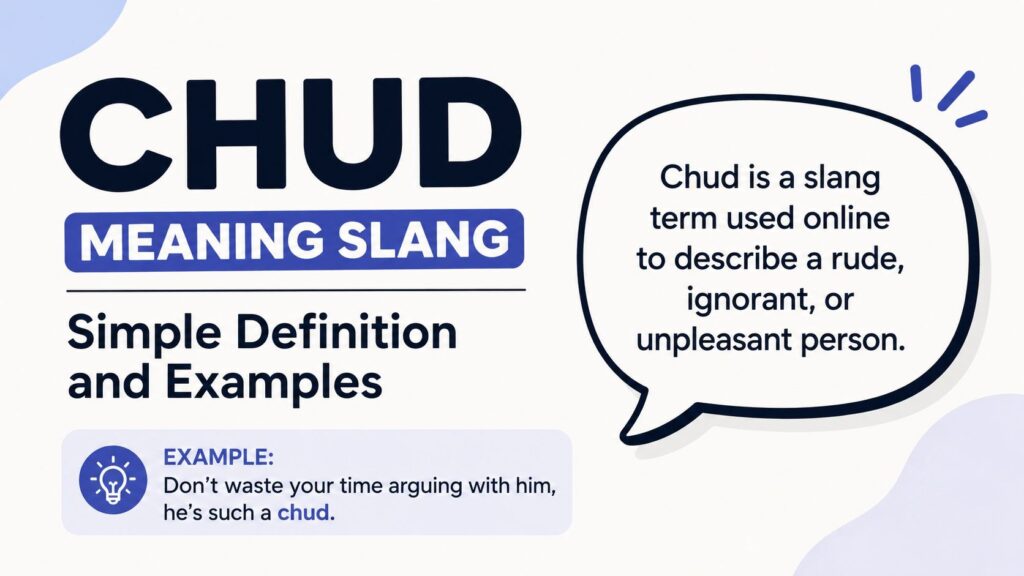
Chud meaning slang refers to a modern internet insult used to describe someone foolish, unpleasant, or holding far-right political views. The word traces back to a 1984 horror movie but now lives entirely online.
Here’s the twist: most people typing “chud” today have no clue it started as a monster from a sewer movie. That gap between origin and use is exactly what makes this slang term so fascinating.
This guide breaks down chud meaning slang in simple terms, covering its political roots, meme-fueled rise, and everyday casual use. You’ll walk away knowing exactly when it’s harmless fun and when it can spark real conflict online.
What Does “Chud” Actually Stand For?
Here’s something that surprises a lot of people: chud is technically an acronym. Its full form is C.H.U.D., which stands for Cannibalistic Humanoid Underground Dweller. That’s the original title of a 1984 horror film about mutated, flesh-eating creatures living in the sewers beneath New York City.
The movie itself isn’t especially remembered today, but the acronym stuck around in pop culture. It got a small boost in 2006 when it was referenced in Kevin Smith’s Clerks II, and from there it slowly drifted into general slang.
Here’s the important part, though: almost nobody using the word “chud” today is thinking about the movie. Ask someone who calls another person a chud on Twitter what the abbreviation stands for, and there’s a good chance they won’t know. The word has been fully absorbed into digital language as a standalone insult, completely separate from its acronym roots. This happens a lot in internet slang — a word starts as a reference to something specific, then the reference fades while the word itself takes on a life of its own.
| Fact | Detail |
|---|---|
| Expanded form | Cannibalistic Humanoid Underground Dweller |
| Source | 1984 horror film C.H.U.D. |
| Original meaning | Mutant sewer creature |
| Current meaning | Foolish, unpleasant, or reactionary person |
| Do people know the acronym today? | Rarely |
This is actually a pretty common pattern in internet slang. Plenty of words that started life as acronyms or references to specific media eventually shed that baggage entirely. Think about how few people saying “meh” or “yeet” could tell you where those words came from. Chud follows the same path: the original title of the film gave the word its shape, but the meaning people attach to it today has almost nothing to do with sewer-dwelling mutants. It’s a good reminder that slang meaning is rarely fixed. It’s shaped by whoever’s using the word at any given moment, not by whoever coined it decades earlier.
ALSO READ: Chopped Meaning Slang: The Real Story Behind the Word Everyone’s Using In 2k25
The Origin Story: From Horror Movie to Internet Insult
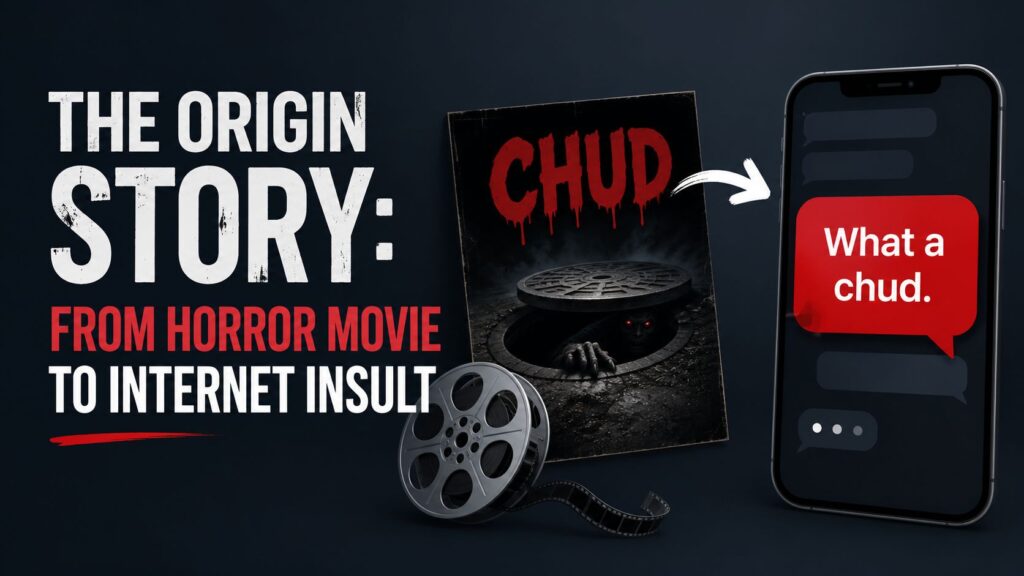
Understanding the term explanation behind chud means tracing its path through several decades of pop culture and internet discussions. It’s a longer journey than most slang words take, and that’s part of what makes it interesting.
1984 — The Movie
C.H.U.D. was a low-budget classic horror film about underground dwellers — mutated, cannibalistic creatures created by illegal toxic waste dumping beneath New York City. It wasn’t a blockbuster, but it built a small cult following over the years, the kind of movie horror fans reference to sound like they know their genre history.
Early 2000s — A Generic Insult
Long before chud had any political meaning, it floated around online forums and Usenet groups simply as a derogatory label for someone unattractive, unsuccessful, or generally unpleasant. Early web posts from the early-to-mid 2000s use it almost exactly the way you’d use “loser” or “jerk.” There was nothing political about it at that point — it was just a blunt insulting word.
2006 — Pop Culture Boost
Clerks II referenced the term, which reintroduced it to a slightly wider audience and helped keep the web slang version of the word alive rather than letting it die out with 1980s horror fans.
2010s — The Political Turn
This is where the word really changed shape. The podcast Chapo Trap House and its associated subreddit began using “chud” as shorthand for a specific type of online figure: someone with reactionary views, often unironically nostalgic for outdated social attitudes, frequently associated with far-right online spaces. From there, it spread rapidly across online platforms like Reddit and X.
2020s — Meme Culture Cements It
The rise of “Chud” a variant of the WHO meme character, gave the word a face. Chudjak is drawn with a receding chin, furrowed eyebrows, and thick glasses, deliberately designed to mock the stereotypical appearance of far-right message-board users. Once a word gets its own recognizable meme character, it tends to stick around in meme communities for years, and that’s exactly what happened here.
“The chud isn’t just an insult anymore, it’s a character people instantly recognize the moment they see the artwork.” — a common sentiment echoed across meme-tracking sites like Know Your Meme
What makes this timeline worth paying attention to is how each phase built directly on the last one instead of replacing it. The generic insult use from the early 2000s never really disappeared, it just got joined by a second, political meaning a decade later. That’s why you can’t fully understand modern usage of the word without knowing both halves of its history. Someone using chud today might be pulling from either tradition, or blending the two without even realizing it.
It’s also worth noting how much faster the later stages of this timeline moved compared to the earlier ones. The gap between the movie’s release and the word’s generic insult use spans almost two decades. The gap between that generic use and its political adoption is roughly ten years. But the jump from political adoption to full meme culture status, complete with its own character design, took only a few years. That acceleration says a lot about how quickly digital culture can now take a niche term and turn it into something millions of people recognize on sight.
What Does Chud Mean Today? Two Distinct Meanings
If you look this word up expecting a single tidy definition, you’ll be disappointed, because chud actually carries two separate meanings that are both still active in online chats today.
The Political Meaning
In political public discourse, chud usually refers to someone associated with far-right, reactionary, or ideological beliefs that lean toward nostalgia for older, less inclusive social norms. It’s almost always used by people criticizing that political position, not by people describing their own social opinions. You’ll see it most often attached to discussions about elections, culture-war topics, or controversial opinions shared on online platforms.
The Non-Political Meaning
Separately, and often overlapping in casual use, chud is simply a way to call someone foolish, socially awkward, unattractive, or a general nuisance — no political angle required.
Key takeaway: context tells you which meaning applies. A comment thread about elections uses the political sense. A group chat roasting a friend for tripping over nothing uses the casual sense.
There’s actually a useful way to test which meaning is in play: ask whether the insult could be swapped for a political label without changing the sentence’s meaning. “He’s such a chud for believing that conspiracy theory” clearly points to the political sense. “You’re such a chud for spilling coffee on yourself” has nothing to do with ideological beliefs at all. Running that quick mental substitution test takes the guesswork out of reading unfamiliar online chats, especially if you’re new to a particular community’s slang and don’t want to misread the tone of a conversation.
It’s also worth noting that these two meanings sometimes blend together in interesting ways. Someone might use the political sense of chud but apply it loosely to describe a person’s general demeanor rather than their actual voting record, almost like a shorthand stereotype. In these blended cases, the word carries a mix of both the political undertone and the general “unpleasant person” quality, which is part of why chud feels so slippery to pin down with a single definition.
Chud Meaning in Different Contexts
Slang rarely means the exact same thing everywhere it’s used, and chud is a great example of that. Here’s how it plays out across different corners of the internet.
Political and Online Arguments
This is the most common home for the political version of the word. During heated debates, especially ones involving controversial opinions or election-related topics, chud gets thrown around as a quick way to dismiss someone’s argument by attacking their perceived political identity rather than their point.
Gaming Communities
In gaming chats, multiplayer games, and game forums, chud often loses its political meaning entirely. Online gamers use it toward teammates who play poorly, make bad calls, or generally frustrate the team. Here, it functions closer to “noob” or “scrub,” just with a slightly more mocking edge.
Meme Culture
Thanks to the Chud character, chud lives a full second life purely as viral humor. People post Chudjak reaction images to represent overconfidence followed by failure, awkward social behavior, or exaggerated stubbornness. This use is less about insulting a real person and more about referencing a shared joke within digital culture.
Everyday Insults Among Friends
Among friends, chud can be almost affectionate. Calling a friend a chud for doing something embarrassing carries a joking tone, similar to calling someone a “dork” or “goofball,” just with more edge and internet flavor.
Social Media Commentary
On social media more broadly, chud often appears in quote-tweets, comment sections, and reaction threads as a fast way to signal disagreement or mockery without writing out a full argument. A single word does the job a whole paragraph might otherwise need to do, which is part of why it spreads so easily through online conversations where brevity matters. You’ll frequently see it attached to screenshots of someone’s post, functioning almost like a caption that tells other readers exactly how to feel about what they’re looking at.
Case Studies: Chud in Action Across Platforms
Looking at a few real-style scenarios side by side helps show just how differently this one word can land depending on where it shows up.
Case Study 1: A Political Subreddit Thread
A user posts a screenshot of a politician’s statement, and the top comment simply reads, “chud behavior.” Dozens of replies pile on with similar short comments. Here, chud functions almost like a badge, a quick signal to other commenters that this is the “correct” reaction to have, reinforcing group consensus rather than sparking genuine debate. This is a common pattern in public discourse online: a single loaded word can shut down further discussion because it frames the conversation before anyone else weighs in.
Case Study 2: A Gaming Discord Server
During a ranked match, a player makes a costly mistake, and a teammate types “chud move” in the team chat. No one takes it seriously. The match continues, and the phrase gets reused as a running joke for the rest of the session. In gaming communities, this kind of use rarely causes lasting offense because it’s understood as part of the competitive banter that comes with multiplayer games.
Case Study 3: A Workplace Slack Channel
An employee jokingly calls a coworker a chud in a casual, non-work Slack channel after they make a small mistake during a meeting. Even though it’s meant playfully, a manager who isn’t familiar with the term flags it as unprofessional. This is a useful reminder that slang carrying an edge in casual spaces doesn’t always translate safely into workplace communication, even when everyone involved understands it as harmless.
Case Study 4: A TikTok Explainer Video
A creator posts a short video breaking down the term explanation behind chud for viewers unfamiliar with it. Comments split into two camps: some viewers say the word is overused and losing its punch, while others argue it’s still an effective shorthand for describing a very specific kind of online behavior. This kind of split reaction is common with slang that’s been around long enough to reach a broader, less terminally-online audience.
Each of these examples reflects a different corner of digital culture, but they all point to the same underlying truth: the word chud carries almost no fixed weight on its own. Its impact depends entirely on the room it’s said in.
Is Chud Offensive?
Short answer: yes, generally. Chud is not a neutral or purely descriptive word — it’s built to sting. Whether it lands as harmless teasing or as a genuine verbal attack depends heavily on three things: who’s saying it, who they’re saying it to, and where the conversation is happening.
Calling a close friend a chud after they say something silly is very different from calling a stranger a chud during a political argument on X. The word itself doesn’t change, but the intent and impact absolutely do.
There’s also a generational and platform-based split worth mentioning. Younger users who mostly encounter chud through meme communities and TikTok tend to treat it as lower-stakes, closer to a punchline than a genuine attack. Users who encountered the word primarily through political online discussions on Reddit or X tend to read it as a much sharper pejorative, closer in weight to calling someone a bigot or an extremist. Neither reading is wrong, they’re just shaped by different corners of the internet, which is exactly why the same word can spark a laugh in one comment section and a heated reply in another.
If you’re ever unsure whether using the word will land as playful or hostile, a good rule of thumb is to consider whether you’d be comfortable saying the same thing to that person’s face, outside of the anonymity that online expression often provides. If the answer is no, it’s probably safer to leave chud out of the conversation entirely.
Tone Comparison
| Situation | Typical Tone | Likely Impact |
|---|---|---|
| Joking between close friends | Playful, affectionate | Low offense, mutual understanding |
| Political argument with a stranger | Hostile, dismissive | High offense, likely to escalate conflict |
| Gaming chat toward a teammate | Frustrated, competitive | Moderate offense, situational |
| Self-deprecating use (“I’m being such a chud”) | Humorous, self-aware | Not offensive, low stakes |
| Directed at a public figure or group | Dismissive, mocking | High offense, can spread widely |
Real Conversation Examples
Seeing the word in context makes it much easier to understand than a dictionary-style definition ever could.
Political or Argumentative
“Did you see what he posted about the election? Classic chud take.”
Gaming
“Bro why’d you push alone, that’s such a chud move.”
Casual, Between Friends
“You just walked into a glass door. You absolute chud.”
Self-Deprecating
“I forgot my own keys again, I’m being such a chud today.”
Notice how the tone shifts dramatically across these four examples, even though the word itself stays exactly the same. That flexibility is a big reason it’s stayed relevant in internet expression for so long.
Chud vs. Similar Slang Terms
Chud doesn’t exist in isolation. It sits alongside a small cluster of similar internet-born insults, and knowing how it differs from each one helps you use the right word for the right situation.
| Term | Core Meaning | Political? | Typical Tone |
|---|---|---|---|
| Chud | Foolish or reactionary person | Sometimes | Mocking, dismissive |
| Chad | Confident, successful, admired man | Rarely | Complimentary (often ironic) |
| Boomer | Older person, out of touch | Sometimes | Dismissive, generational |
| NPC | Person seen as lacking independent thought | Sometimes | Dismissive, robotic comparison |
| Troll | Someone deliberately provoking others online | No | Annoyed, accusatory |
Chud and Chad are often used as opposites in meme culture, with “chud” representing awkward failure and “Chad” representing effortless confidence. Chud and NPC overlap in political spaces, both used to suggest someone isn’t thinking critically, though NPC leans more toward “mindless” while chud leans more toward “unpleasant.”
When to Use It (and When Not To)
Contexts Where It’s Common
- Casual group chats with close friends
- Gaming communities and voice chat during multiplayer games
- Meme pages and meme communities built around political commentary
- Reddit threads, Discord servers, and TikTok comment sections
Contexts Where It Can Backfire
- Workplace communication or any business discussions
- Conversations with people you don’t know well
- Formal communication of any kind
- Any setting where office etiquette or professional norms apply
Using chud in professional conversations is almost never a good idea. It’s slang built for informal, often confrontational spaces, and it doesn’t translate well into settings that call for respectful conversations or civil discussion.
Safer Alternatives If You Want a Softer Word
If you want to express mild frustration or tease someone without reaching for chud, consider:
- “Goofball” or “dork” for lighthearted teasing
- “Out of touch” for describing someone’s outdated views without an insult attached
- “That’s a rough take” for disagreeing with an opinion during constructive dialogue
- Simply naming the specific behavior you disagree with, which tends to produce more thoughtful responses than a blanket insult
Why the Word Caught On
A few concrete reasons explain why chud spread so widely instead of fading out like most internet slang does within a year or two:
- It has a visual identity. The Chudjak meme gave the word a face, and images spread faster and stick around longer than text-only slang.
- It’s flexible. It works as a noun (“he’s such a chud”), an adjective (“that’s a chud take”), and even a verb-adjacent phrase in casual speech.
- It fills a specific gap. Before chud gained its political meaning, there wasn’t a single, widely recognized word for “reactionary online poster.” Chud filled that gap efficiently.
- It works self-deprecatingly. Unlike many insults, people are comfortable applying chud to themselves as a joke, which broadens its use far beyond pure insult territory.
- Meme culture keeps recycling it. New variations, like “GigaChud,” a mashup of “GigaChad” and “chud,” keep the term feeling current instead of stale.
- It travels well across platforms. A word born on Reddit and popularized through a podcast subreddit doesn’t usually make it onto TikTok and into everyday texting. Chud managed that jump, largely because meme images travel faster and further than the original text-based jokes that spawned them.
- It resists becoming outdated. Slang terms tied to a single trend or event tend to expire quickly. Because chud can describe a type of person or attitude rather than a single moment in internet history, it keeps finding new situations to attach itself to.
None of this happened by accident, exactly, but it also wasn’t engineered by any one person or group. It’s a pretty good example of how organic online expression works: a word gets picked up because it’s useful, gets reinforced because it’s funny or satisfying to say, and then keeps spreading because each new use reintroduces it to people who haven’t encountered it yet.
Common Misunderstandings
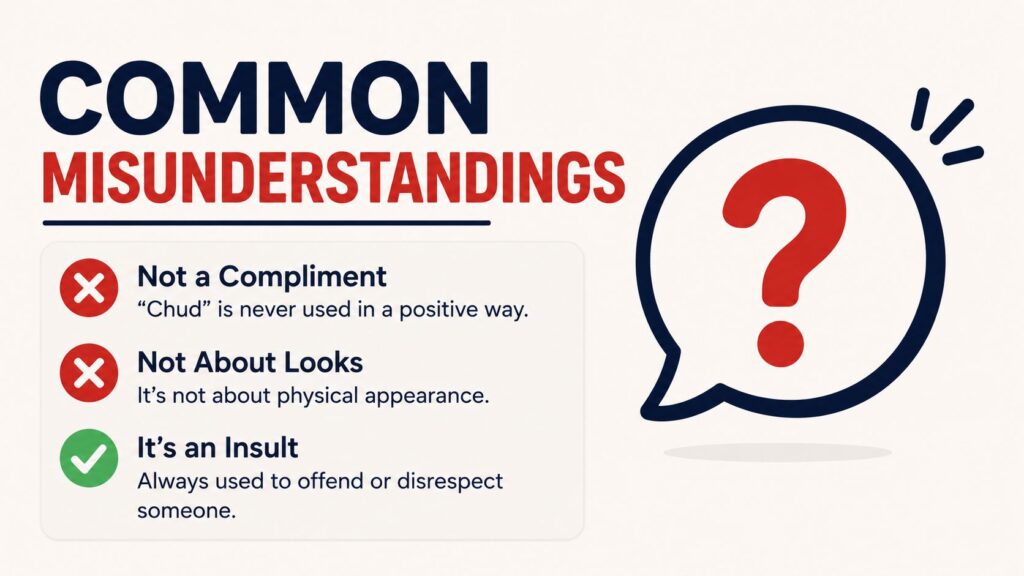
“It’s a Brand New Word”
Not true. The abbreviation and the underlying concept go back to 1984, and even the generic insult use predates its political meaning by roughly a decade. What feels new is really just the word’s most recent phase.
“It’s Always Political”
Also not true. Plenty of online chats, especially in gaming and casual friend groups, use chud with zero political meaning attached. Assuming every use is political will make you misread a lot of harmless jokes as hostile ones.
“Everyone Finds It Funny”
This one trips people up the most. While chud often gets used humorously in meme communities, it’s frequently intended and received as a genuine pejorative. Treating it as universally lighthearted can lead you to say something that actually upsets the person you’re talking to.
ALSO READ: NTM Meaning Slang: What It Really Means in Text, TikTok, and Online Chats
Regional and Platform Usage
Chud shows up most heavily on X (formerly Twitter) and Reddit, largely because both platforms host the political discussion communities where the word’s modern meaning took shape. TikTok has picked it up more recently, mostly through commentary and reaction videos explaining or debating the term itself, including creators dedicated to breaking down internet slang meaning for general audiences.
Discord servers, especially ones built around gaming or political commentary, use it heavily in real-time chat, where its meaning shifts quickly depending on the server’s specific community and inside jokes.
In terms of regional spread, the word originated and remains most common in American online terminology, though it has picked up steady use in the UK and other English-speaking countries as web communication continues to blur regional boundaries in digital conversations.
Non-English-speaking online communities have also started borrowing the word directly rather than translating it, which is fairly typical for internet-born slang that carries a strong meme association. When a word is tied to a specific image, like Chudjak, translating it into another language often loses the joke entirely, so communities tend to just adopt the English term as-is. This is part of why you’ll occasionally spot “chud” used as a loanword in non-English online chats, especially in communities that actively follow English-language meme culture.
Platform culture also shapes how harsh the word feels. A comment calling someone a chud on a meme page built around irony and exaggeration reads very differently than the same comment posted in a serious political discussion thread. Reading the room, in other words, matters just as much as the word choice itself.
FAQs
Is “chud” still widely used in 2026?
Yes — it remains common in political discussions on X and Reddit, and a New York Times explainer on the term ran as recently as April 2026, showing it’s still mainstream enough to need defining.
What does chud mean on TikTok right now?
Mostly the same insult, but TikTok in 2026 has leaned into explainer and reaction videos breaking down the term for people encountering it for the first time.
Is chud still primarily a political insult?
It’s split — Wikipedia’s entry (updated 2026) notes it’s mainly used by the left against the far-right, but also sometimes used by far-right users toward each other, plus a non-political “foolish person” sense that never went away.
Has the meaning shifted recently?
Not dramatically — the core definition (foolish, unpleasant, or reactionary) has held steady; what’s changed is more coverage and awareness of the term outside terminally-online spaces.
Is chud considered a slur in 2026?
No — it’s still classified as a general pejorative/insult, not a slur, since it targets political views or behavior rather than a protected characteristic.
conclusion
Chud meaning slang has come a long way from a 1984 horror movie. It started as a simple insult, then picked up a political twist online. Today, it shows up in memes, gaming chats, and heated debates alike. The word can be playful or harsh. It all depends on where and how you use it.
Understanding chud meaning slang helps you read the room better. Use it with friends, and it’s just a joke. Use it in a work chat, and it can backfire. Stay aware, stay respectful, and you’ll never misuse this tricky little word.

Hi! I’m Jenson, the writer behind punslush.com. I craft clever puns and witty wordplay designed to entertain and inspire. Visit punslush.com for a good dose of humor and fun!