
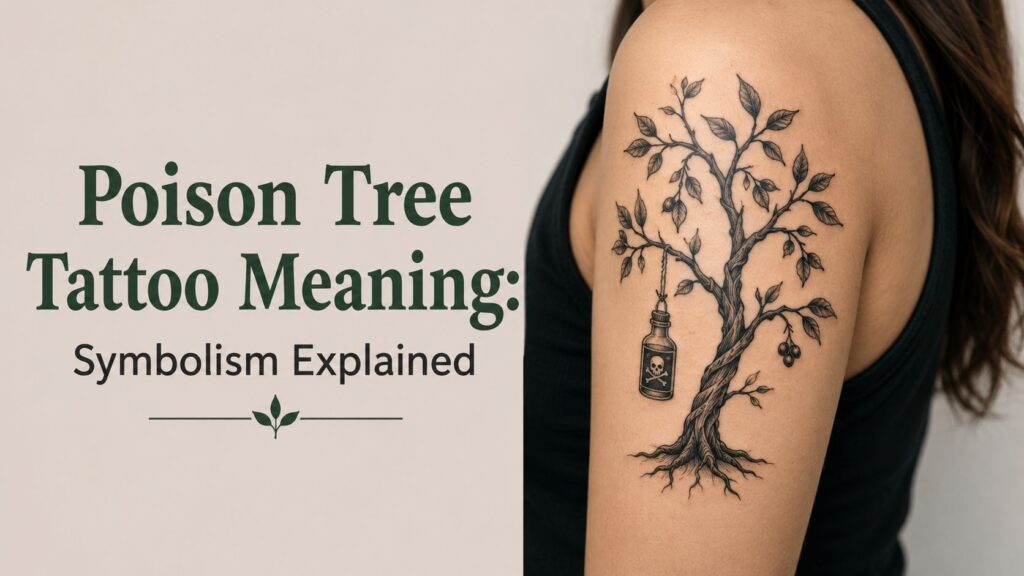
A poison tree tattoo meaning centers on one simple idea: anger that stays hidden doesn’t disappear, it grows. This tattoo draws from William Blake’s 1794 poem, where silence feeds resentment until it turns dangerous.
Picture smiling at someone while quietly hating what they did. That quiet bitterness, left alone, becomes something sharper than the original hurt. This tattoo captures that exact feeling in a single, striking image.
Beyond its literary roots, the poison tree tattoo meaning touches real emotions: broken trust, toxic relationships, and buried anger. It’s a design built on honesty, reminding wearers that silence often costs more than speaking up ever could.
What Does a Poison Tree Tattoo Really Mean?
At its core, a poison tree tattoo meaning centers on one idea: suppressed anger that’s been left to grow instead of being released.
Think about the difference between telling someone you’re upset and swallowing it instead. The first option, however uncomfortable, tends to clear the air. The second option doesn’t make the anger disappear — it just buries it somewhere dark, where it feeds on silence and quietly gets worse.
That’s the entire premise of the poison tree as a symbol. It’s not a tree that starts out poisonous. It becomes poisonous because of what’s poured into it: neglect, secrecy, and unresolved emotional conflict.
People choose this tattoo for a range of reasons, but they usually cluster around a few themes:
- Marking the end of a toxic relationship or friendship
- Processing anger they never got to express
- A reminder to communicate honestly instead of bottling things up
- An appreciation for classic literature and poetic symbolism
- A visual metaphor for personal transformation after a painful chapter
None of these meanings are mutually exclusive. In fact, most people who get this tattoo are working through two or three of them at once.
ALSO READ: NBS Meaning in Text: What It Really Means When Someone Sends
Poison Tree Tattoo Symbolism Explained
To really understand the poison tree tattoo symbolism, you have to separate it from generic “tree of life” tattoos, which usually represent growth, family, or interconnectedness. The poison tree is a deliberate inversion of that idea.
Here’s a simple comparison:
| Symbol | Common Meaning | Emotional Tone |
|---|---|---|
| Tree of Life | Growth, family, connection | Hopeful, grounding |
| Cherry Blossom Tree | Fleeting beauty, impermanence | Bittersweet |
| Dead Tree | Loss, mourning, endings | Somber |
| Poison Tree | Suppressed anger, hidden resentment, toxicity | Cautionary, introspective |
The poison tree stands apart because it’s not passive. A dead tree just… is dead. A poison tree is actively dangerous — it grew that way because something fed it. That distinction matters a lot when you’re picking a tattoo meant to represent something you lived through, not just something that happened to you.
Most versions of this tattoo lean into a few recurring visual details:
- A single glossy apple or fruit hanging among otherwise bare branches
- Twisted, thorny roots that suggest something buried and grown-over
- A stark contrast between light and dark shading, representing the split between how something looks and what it actually is
- Snakes or thorns woven through the branches, adding a layer of temptation or danger
Each of these details isn’t decorative — it’s doing symbolic work. Artists who understand the literary roots of the design tend to build the whole piece around that one shining, tempting piece of fruit. It’s the payoff of everything the tree has been quietly cultivating.
The Literary Meaning Behind the Poison Tree Tattoo
Here’s what a lot of generic tattoo-meaning articles get wrong: they treat the poison tree like a folk symbol that’s existed forever, floating around in the cultural ether. It hasn’t. This is a literary tattoo meaning with one very specific, very traceable origin.
The image comes directly from a poem — and if you’re getting this tattoo, you owe it to yourself to actually read that poem first.
Where the Symbol Comes From
The poison tree poem symbolism traces back to English Romantic poet William Blake, and it’s not some obscure reference. It’s one of the most widely taught poems in English literature classrooms.
Getting a tattoo based on a poem you’ve never read is a bit like getting a quote tattooed in a language you don’t speak. It might look good. But you’re missing the entire point.
William Blake’s “A Poison Tree” Tattoo Meaning
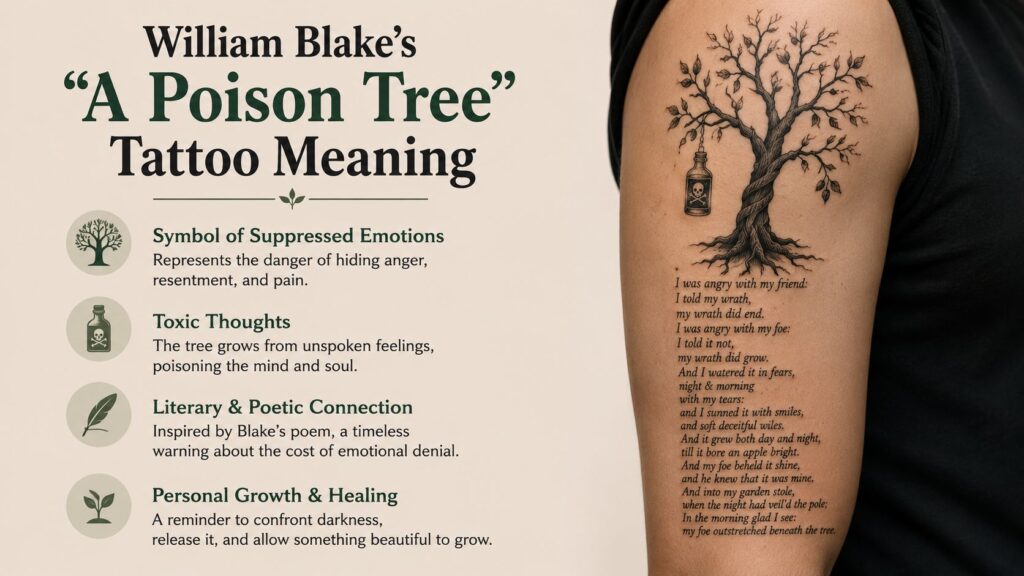
William Blake published “A Poison Tree” in 1794 as part of his collection Songs of Experience. The poem is short — just sixteen lines across four stanzas — but it packs an enormous amount of psychological insight into a small space.
Here’s the basic structure of the poem, paraphrased stanza by stanza:
- Stanza one sets up a contrast: the speaker gets angry with a friend, tells them, and the anger fades. Then the speaker gets angry with an enemy, stays silent, and the anger doesn’t go away — it grows.
- Stanza two describes how the speaker nurtures that silent anger the way you’d water a plant — with fears, tears, smiles, and deceit.
- Stanza three shows the anger literally bearing fruit: a “bright” and appealing apple that the enemy notices and covets.
- Stanza four ends with the enemy sneaking into the garden at night to steal the apple — and the speaker’s quiet satisfaction the next morning at finding their foe “outstretched beneath the tree.”
That last image is the gut-punch of the whole piece. The anger the speaker never voiced didn’t just sit there harmlessly. It grew into something that ultimately destroyed the person it was aimed at — and the speaker feels no guilt about it. That’s the twist most casual readers miss on a first pass.
What Makes This Poem So Widely Quoted
Blake wrote this as part of a matched set — Songs of Innocence and Songs of Experience — that explored the same themes from two different emotional states: childlike openness versus adult disillusionment. “A Poison Tree” belongs firmly to the “Experience” side. It’s cynical, sharp, and unflinching about how people actually behave when they’re hurt.
That’s part of why it resonates so strongly as tattoo material more than two centuries later. It doesn’t moralize. It doesn’t tell you that suppressing anger is wrong in some preachy way — it just shows you, plainly, what happens when you do it. The poem trusts you to draw your own conclusion.
ALSO READ: Dih Meaning: The Slang Everyone’s Using But No One Explains
What Does William Blake’s A Poison Tree Symbolize?
Breaking down the William Blake symbolism analysis piece by piece helps clarify exactly what each element of the tattoo is meant to represent.
| Poem Element | Symbolic Meaning |
|---|---|
| The tree itself | Cultivated, growing anger |
| Watering with tears and fears | Feeding resentment through avoidance and dishonesty |
| Watering with smiles and deceit | Masking true feelings behind a pleasant exterior |
| The bright apple | The visible, tempting result of hidden hostility |
| The enemy stealing the fruit | How suppressed conflict eventually causes real harm |
| The garden | The private, internal space where all of this unfolds |
A few specific ideas worth expanding on:
The garden as the self. Blake sets this whole drama in a private garden, not a public battlefield. That’s deliberate. The entire conflict takes place internally, hidden from view, which mirrors exactly how emotional suppression works in real life — quietly, invisibly, until it isn’t anymore.
The apple as bait, not just fruit. It’s not a coincidence that Blake chose an apple specifically, given the obvious echo of the Garden of Eden and the fruit of temptation in Genesis. More on that biblical connection later — but it’s worth noting here that Blake was almost certainly doing this on purpose.
The final image as moral ambiguity. Blake doesn’t punish the speaker for their hidden anger. If anything, the poem ends on a note of grim satisfaction. That’s what makes it feel so psychologically honest rather than like a simple morality tale — it acknowledges that suppressed anger can feel satisfying in the moment it finally does damage, even while showing you the cost of getting there.
Psychological Meaning of a Poison Tree Tattoo
Strip away the literary framing, and what you’re left with is a genuinely accurate depiction of how emotional suppression works in real psychology.
Mental health professionals have long recognized that unexpressed anger doesn’t simply vanish. It transforms — often into something more corrosive than the original feeling. This is where the poison tree tattoo meaning connects directly to hidden resentment psychology.
How Suppressed Anger Actually Behaves
Here’s roughly what tends to happen when anger gets bottled up instead of processed:
- It compounds. Small grievances stack on top of each other instead of resolving individually.
- It leaks out sideways. Instead of direct confrontation, suppressed anger often surfaces as passive aggression — sarcasm, coldness, subtle sabotage.
- It distorts perception. The longer resentment sits unspoken, the more the other person’s actions get filtered through that resentment, regardless of their actual intent.
- It eventually erupts. Whether that’s a blowup, a sudden cutoff, or — as in Blake’s poem — some form of quiet, delayed consequence.
Psychologists sometimes describe this pattern using the metaphor of a pressure valve. Anger expressed early is a small release. Anger suppressed for months or years builds pressure until something gives — and what gives is rarely proportional to the original slight.
Why the Tattoo Resonates as a Warning to Oneself
A lot of people who choose this design aren’t marking anger at someone else. They’re marking a lesson they learned about themselves — a reminder not to repeat the pattern.
“I got it after I realized I’d spent two years smiling at someone while quietly hating what they’d done. The tattoo isn’t about them. It’s about never doing that to myself again.”
That kind of framing shows up again and again in tattoo forums and shop consultations. The poison tree tattoo works less like a scar and more like a note-to-self: say it out loud next time.
This is also where the idea of personal transformation tattoo meaning comes in. For a lot of people, getting inked with this symbol marks the moment they stopped letting resentment quietly calcify and started choosing honesty instead — even when honesty is uncomfortable.
ALSO READ: Zesty Meaning: What Does “Zesty” Really Mean Today
Poison Tree Tattoo Meaning in Romantic Relationships
Romantic relationships are, understandably, one of the biggest contexts where this tattoo shows up. Few relationships generate more unspoken resentment than romantic ones, where people often avoid conflict specifically because they care about the other person and don’t want to “start something.”
The problem is that avoidance doesn’t protect the relationship. It just delays the reckoning.
Can a Poison Tree Tattoo Represent a Toxic Relationship?
Yes — and this is one of the most common reasons people cite when explaining their toxic relationship tattoo meaning.
A toxic relationship often follows a strikingly similar arc to Blake’s poem:
- Small resentments build (a broken promise, a dismissive comment, a pattern of neglect)
- Instead of addressing them, both people paper over the cracks with false smiles and forced normalcy
- Emotional toxicity accumulates beneath a surface that looks, to outsiders, perfectly fine
- Eventually, something breaks — an affair gets discovered, a fight goes too far, someone finally says the thing they’d been holding in for years
For people who’ve lived through that cycle, the poison tree becomes a strikingly literal metaphor. The tree isn’t the other person. It’s the relationship itself — something that started out fine and turned toxic because both people kept feeding it silence instead of honesty.
Common design choices for this specific meaning include:
- Two intertwined branches, one healthy and one withered, growing from the same trunk
- A single dead apple fallen at the base of the tree, symbolizing the relationship’s actual end
- Roots shaped like broken chains or hands, representing lost trust
Poison Tree Tattoo Meaning in Broken Friendships
Friendship betrayal cuts differently than romantic heartbreak, and a lot of people specifically choose this tattoo to mark a broken friendship rather than a romance.
There’s a particular kind of grief that comes from losing a friend you never officially “broke up” with — no clean ending, no dramatic fight, just a slow drift into emotional distance followed by silence. That ambiguous kind of relationship loss is exactly the territory Blake’s poem covers so well: anger that never got spoken, resentment that quietly grew, and an ending that arrived without ever being properly discussed.
A Short Case Study
Consider a composite example based on patterns seen across tattoo consultation stories: two friends who’d known each other since childhood drifted apart after one felt consistently overlooked whenever the other’s romantic relationships took priority. Neither ever raised it directly. The friendship just faded, replaced by polite distance at group gatherings.
Years later, one of them got a small poison tree tattooed on the inside of their forearm — not out of anger at the other person specifically, but as an acknowledgment that unresolved emotions, left unspoken, are what actually ended things. Not one dramatic event. Just years of quiet, uncommunicated resentment.
This kind of story is common enough that it’s worth naming directly: this tattoo isn’t always about a villain. Sometimes it’s about mutual silence.
Does a Poison Tree Tattoo Symbolize Anger and Revenge?
This is probably the most debated aspect of the anger and revenge symbolism tied to this tattoo, and it deserves an honest answer rather than a wishy-washy one.
Yes — Blake’s poem is genuinely about vengeance, not forgiveness. The speaker doesn’t grow past their anger. They cultivate it, and it works exactly as intended: it harms the person they were angry at. The final stanza doesn’t include remorse. It includes something closer to satisfaction.
That said, people who get this tattoo today generally fall into two camps:
| Interpretation | What It Represents |
|---|---|
| Cautionary reading | “This is what happens if I let resentment fester — I don’t want to become this.” |
| Vindicated reading | “I let my anger grow, and it ultimately proved me right about that person.” |
Both readings are valid, and honestly, both are common. The tattoo doesn’t force a single moral stance — it holds space for anger, bitterness, and vengeance without necessarily endorsing or condemning any of them. That moral ambiguity is a big part of why the symbol has stayed relevant for over two hundred years.
Spiritual and Biblical Meaning of a Poison Tree Tattoo
Beyond psychology and literature, there’s a strong current of spiritual and biblical meaning running through this tattoo, and it’s not a stretch — Blake himself was deeply engaged with biblical imagery throughout his work.
The Garden of Eden Connection
The parallels between “A Poison Tree” and the Garden of Eden story in Genesis are hard to miss:
- A tree bearing forbidden or dangerous fruit
- A tempting apple that leads to someone’s downfall
- A private garden as the setting for the entire drama
- A consequence that follows from taking what shouldn’t be taken
In Genesis, the fruit represents temptation and the cost of disobedience. In Blake’s poem, the fruit represents suppressed rage disguised as something desirable. Both stories use the same core image — an inviting fruit that leads to ruin — to explore very different but related ideas about human weakness.
For people drawn to biblical symbolism, this dual layer makes the tattoo feel richer than a purely secular reading would. It becomes a piece that speaks to both a specific literary source and a much older, more universal warning about temptation and consequence.
Moral and Spiritual Lessons
A few moral symbolism takeaways commonly associated with the design:
- Hidden sin (or hidden emotion) still grows, even when nobody’s watching
- What looks appealing on the outside (the “bright” apple) can carry real harm underneath
- Consequences tend to arrive eventually, even when they’re delayed
- Honesty and confession — speaking the truth rather than concealing it — is framed as the healthier path, precisely because the poem shows what happens when someone chooses the opposite
Some people also connect the tattoo to broader spiritual lessons about reconciliation — using the image as a personal reminder to seek resolution and honest conversation rather than letting conflicts quietly rot.
Small Poison Tree Tattoo Meaning and Minimalist Ideas
Not everyone wants a large, detailed piece, and the good news is that this symbolic tattoo translates well into minimalist formats.
A smaller version tends to strip the design down to its most essential elements:
- A single bare branch with one small fruit — quiet and easy to conceal
- A tiny thorned twig without the full tree, implying the same tension in fewer lines
- Fine-line linework rather than heavy shading, letting the shape speak for itself
- A minimalist tree silhouette with a single dot representing the fruit
Popular placements for smaller versions include:
- Inner forearm
- Behind the ear
- Ankle or wrist
- Ribcage (for a more private, personal piece)
Smaller pieces tend to suit people who want the meaning without the visual statement — this tattoo is often deeply personal, and plenty of people would rather it stay a quiet, private reminder than a conversation-starting centerpiece.
Poison Tree Tattoo Meaning for Men and Women
There’s no meaningful gender divide in how this design gets interpreted — the poison tree tattoo meaning stays consistent regardless of who’s wearing it. What does vary a bit is style preference, though even that’s more about individual taste than any strict pattern.
Some general (not universal) tendencies worth noting:
- Bolder, larger-scale pieces with heavier shading and thicker branches show up across all genders, often placed on the forearm, calf, or back
- Fine-line, botanical-style versions tend to be popular for smaller, more delicate placements
- Blackwork versions with high contrast are a common choice for anyone wanting the “hidden danger” aspect to feel visually striking
The meaning itself doesn’t shift. Anger, resentment, betrayal, and the consequences of suppression aren’t gendered experiences — everyone who’s ever bitten their tongue instead of speaking up understands exactly what this tattoo is getting at.
Why People Choose Poison Tree Tattoos
Pulling everything together, here are the most common, genuine reasons people choose this design:
- They love William Blake’s poetry and want a piece of literature-inspired tattoo art that means something beyond aesthetics
- They’re marking the end of a toxic relationship or friendship and want a symbol that captures the slow-burn nature of that ending
- They’re processing their own anger issues and want a permanent reminder to communicate rather than suppress
- They connect with the biblical undertones of temptation, hidden fruit, and consequence
- They want a tattoo that looks understated but carries real depth for anyone who takes the time to ask about it
What ties all of these together is a shared appreciation for poetic metaphor — the idea that a single, well-chosen image can hold years of lived experience in a way words alone sometimes can’t.
ALSO READ: Eno Meaning: Slang, Medical, Music & More Explained Simply
Is Poison Tree Tattoo Meaning About Revenge or Forgiveness?
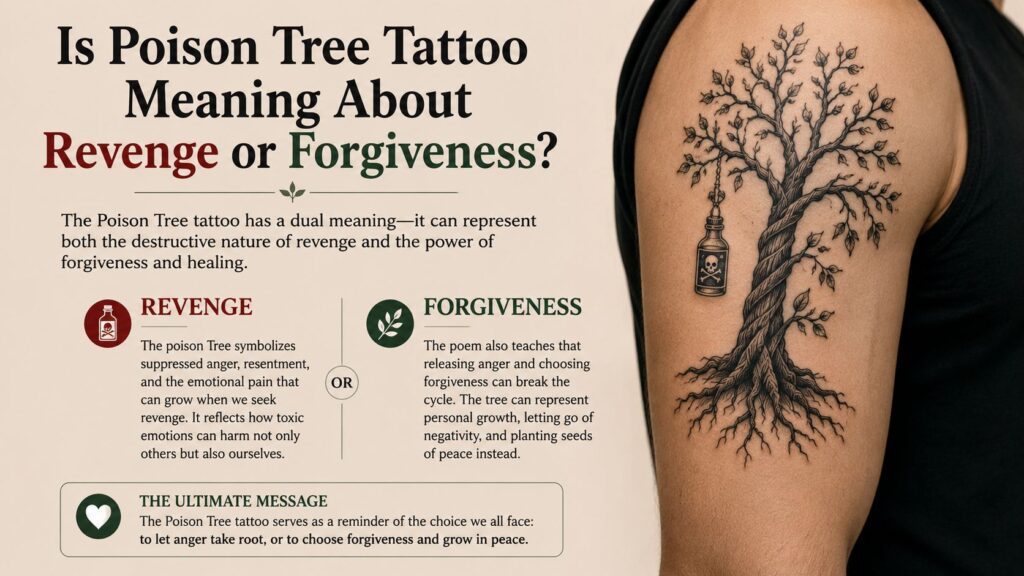
To close the loop honestly: the poem itself leans toward revenge, not forgiveness. Blake doesn’t offer his speaker redemption, and he doesn’t punish them either. The anger works exactly as cultivated, and the poem ends there — no resolution, no reconciliation, no lesson explicitly stated.
But the tattoo, as people actually wear it today, often carries a more layered meaning than the poem alone. Many people use this symbol specifically as a healing journey marker — not celebrating the revenge, but acknowledging the damage suppressed anger can do, and choosing a different path going forward. Others wear it more literally, as a nod to a moment when their quiet resentment turned out to be justified.
Both readings are legitimate. That flexibility — holding space for bitterness and resilience in the same image — is exactly why this two-hundred-year-old poem still finds its way onto skin today. It doesn’t tell you how to feel about your own anger. It just makes sure you’re honest with yourself about it.
Frequently Asked Questions
What does a poison tree tattoo mean?
It symbolizes suppressed anger that grows more harmful the longer it’s hidden, rather than expressed and released.
Is the poison tree tattoo based on a real poem?
Yes — it comes from William Blake’s 1794 poem “A Poison Tree,” published in Songs of Experience.
Does a poison tree tattoo mean revenge or forgiveness?
The poem itself leans toward revenge, not forgiveness — the speaker’s hidden anger ends up harming their enemy with no remorse shown.
Is a poison tree tattoo a good choice for a toxic relationship or breakup?
Yes, it’s a popular choice for marking the end of a toxic relationship or friendship, since the poem’s arc mirrors how hidden resentment quietly destroys trust.
Does the poison tree tattoo have a biblical meaning?
Many people connect it to the Garden of Eden — a tempting fruit that leads to consequences — since Blake’s imagery closely echoes that story.
conclusion
A poison tree tattoo meaning goes deeper than it looks. It stands for anger left unspoken, growing quietly over time. Blake’s poem warns us about this. If you carry hidden hurt, this tattoo speaks for you. It’s honest and simple, yet full of weight for anyone who’s lived it.
This tattoo is more than just ink. The poison tree tattoo meaning teaches a real lesson: speak up early. Silence turns small anger into something bigger and harder to fix. Choosing this design shows strength, not weakness. It’s a quiet reminder to heal, not hide, from what hurt you.

Hi! I’m Jenson, the writer behind punslush.com. I craft clever puns and witty wordplay designed to entertain and inspire. Visit punslush.com for a good dose of humor and fun!