
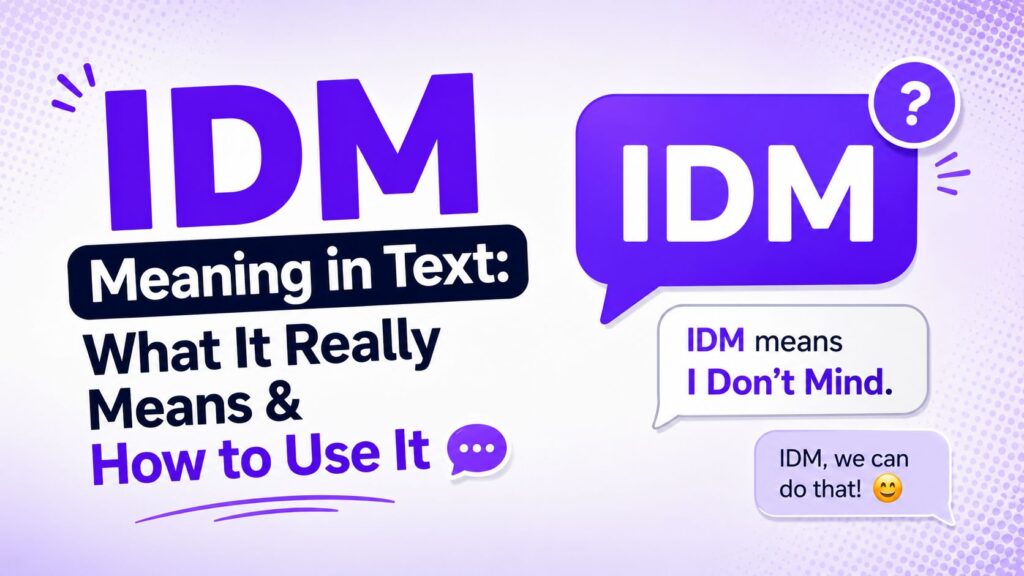
IDM meaning in text refers to “I Don’t Mind,” a casual texting abbreviation people use to show they’re flexible or have no strong preference about a decision. It’s a quick, breezy way to hand the choice over to someone else without overthinking things.
Picture this: a group chat full of friends arguing over dinner plans for ten straight minutes, and one simple “idm” instantly diffuses the chaos. That’s the quiet power this little acronym holds in everyday texting.
Beyond its core meaning, IDM also pops up in totally different worlds, like electronic music and download software, making context everything. Understanding when and how to use it correctly can make your messaging feel more natural, relaxed, and effortlessly in tune with modern digital language.
What Does IDM Mean? (Quick Answer)
In most casual conversations, IDM stands for “I Don’t Mind.” That’s it. That’s the whole thing.
It’s a flexible response people use when they genuinely don’t have a strong opinion about something. Maybe your friend asks where you want to eat, and you text back “idm” because, honestly, pizza or sushi both sound fine to you.
Here’s a quick example:
Sarah: Wanna watch a movie or just chill at home tonight? You: idm, whatever works for you
Simple, right? You’re being agreeable without overthinking it. This little three-letter combo saves you from typing out a whole sentence when a quick response will do the job just fine.
IDM Meaning Breakdown: Letter by Letter
Let’s break it down so it sticks in your memory:
| Letter | Stands For |
|---|---|
| I | I |
| D | Don’t |
| M | Mind |
Put it together and you get “I don’t mind,” which is basically a polite way of saying you’re okay with anything. It’s the texting equivalent of a shrug, except friendlier.
Why did this phrase get chopped down into an acronym anyway? Well, that brings us to a bit of history.
ALSO READ: What Does FML Mean in Text? and Online Meaning Explained 2026
Where Did IDM Come From?
Texting abbreviations didn’t just appear out of nowhere. Back in the early 2000s, phones had character limits on text messages, and typing on those tiny number-pad keyboards was a workout for your thumbs. People needed shortcuts, fast.
So SMS language was born out of pure necessity. Why type “I don’t mind” when “idm” gets the message across just as clearly? This was the era that gave us classics like “brb,” “lol,” and “ttyl,” and IDM fit right into that lineup.
Interestingly, the phrase “I don’t mind” itself has stronger roots in British and Commonwealth English. Americans tend to say “I don’t care” or “doesn’t matter to me,” while folks in the UK, Australia, and other English-speaking regions lean toward “I don’t mind” as their go-to phrase for indifference. That’s likely why IDM caught on faster in certain regions before spreading globally through mobile messaging and online platforms.
Once smartphones took over and messaging apps like WhatsApp, iMessage, and Discord became the norm, you’d think abbreviations would die out since we no longer have character limits. But they didn’t. Why? Because texting habits are about speed and tone, not just technical limitations. We like talking this way now. It feels natural.
When and Why People Use IDM
So when does IDM actually pop up in real conversations? Let’s look at a few everyday scenarios.
Choosing where to eat. This might be the single most common use case. Group chats deciding on dinner plans are basically a breeding ground for IDM responses.
Picking a movie or show. Streaming has given us too many options, and sometimes you just want someone else to choose.
Scheduling plans. “Should we meet at 6 or 7?” “idm, either works.”
Avoiding decision fatigue. Honestly, sometimes you’ve made fifty decisions already that day and you just don’t have it in you to pick a restaurant too.
Here’s a quick case study to illustrate this. A friend of mine runs a small group chat with five coworkers planning a weekly lunch. She told me that almost every single time someone asks “where should we go,” at least two people respond with “idm.” It’s become such a running joke in their group that they now call indecisive lunch planning “going full IDM.”
That’s the thing about this acronym: it’s less about laziness and more about genuinely not having a preference. There’s a difference, and we’ll get into that distinction a bit more later.
How to Use IDM in a Sentence
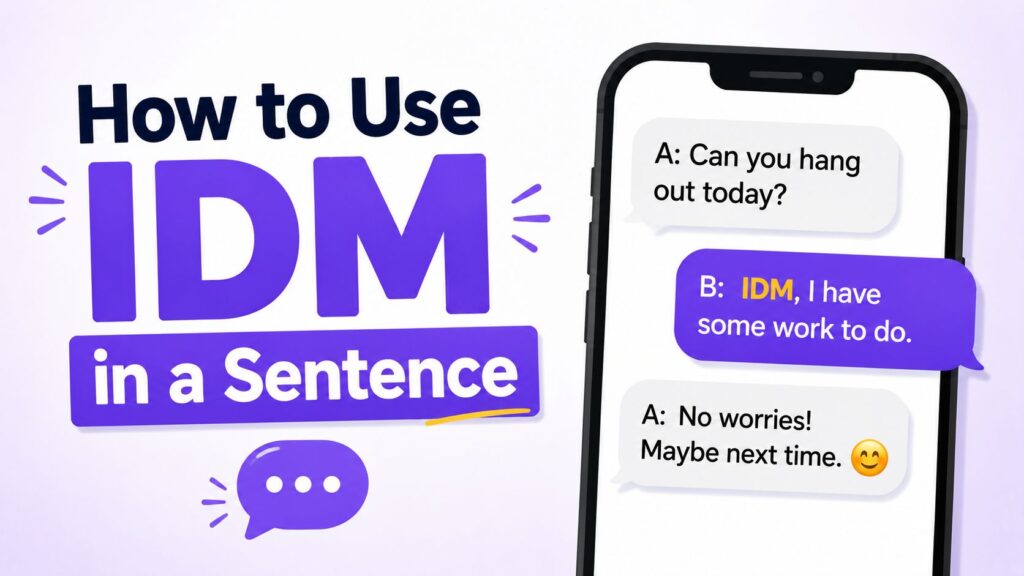
You can use IDM as a standalone reply or weave it into a full sentence. Both work depending on the casual messaging context.
Standalone usage:
“idm”
In a sentence:
“idm what we watch tonight, you pick”
On social media comments:
“idm either way, both options look great tbh”
Notice how it blends naturally into everyday texting. You wouldn’t typically capitalize it unless you’re emphasizing something, and punctuation tends to be minimal in casual chats. That said, context still matters. A period after “IDM.” can read as more definitive or even slightly blunt, while “idm lol” softens it up with a lighter tone.
What Tone Does IDM Carry?
This is where things get interesting. IDM isn’t just about the words, it’s about how it feels when someone reads it.
Generally, IDM carries a relaxed, easygoing vibe. It signals that you’re not stressed about the outcome and you trust the other person to make a good call. Think of it as handing over the decision-making baton with a smile.
But here’s the catch: tone can shift based on a few small details.
- “IDM” in all caps can sometimes feel more abrupt, almost like you’re shutting down the conversation.
- “idm lol” or “idm haha” softens things and keeps the mood light.
- A simple “idm” with no punctuation is pretty neutral and is by far the most common form you’ll see.
If you’re texting someone who doesn’t know you well, it’s worth being mindful that IDM, without any extra warmth attached, can occasionally come across as disinterested rather than genuinely flexible. A little emoji or follow-up question can go a long way in keeping things friendly.
Is IDM Formal or Informal?
Let’s be crystal clear here: IDM belongs strictly in informal conversations. This is chat language through and through, and it has no business showing up in professional emails, official memos, or business writing.
Why does this matter so much? Because using internet slang in formal communication can make you look unprofessional, even if that’s not your intention. Your boss probably doesn’t want to read “idm” when asking which time works for a client call.
Here’s a side-by-side comparison to drive the point home:
| Setting | Appropriate Phrase |
|---|---|
| Texting a friend | “idm” |
| Group chat with family | “idm, whatever’s easiest” |
| Email to your manager | “I’m flexible on the meeting time” |
| Workplace Slack message | “Either option works for me” |
| Official workplace communication | “I have no strong preference and am happy to defer to the team” |
As you can see, the meaning stays the same, but the delivery changes dramatically depending on the setting. When in doubt, spell it out in official language for anything work-related.
Other Meanings of IDM (Context Matters)
Here’s where a lot of confusion creeps in. IDM doesn’t always mean “I Don’t Mind.” It actually has two other major meanings depending on where you encounter it.
IDM in Music: Intelligent Dance Music
If you stumble across IDM in a music forum, on Spotify, or in a conversation about genres, it almost certainly refers to Intelligent Dance Music. This is an electronic music genre that emerged in the early 1990s, known for its complex, experimental music structures and ambient techno influences.
Artists like Aphex Twin, Boards of Canada, and Autechre are often credited with shaping the IDM genre. Unlike typical dance music made for clubs, IDM tends to be more cerebral, layered, and designed for active listening rather than dancing. It’s a distinct music style that has nothing to do with texting whatsoever.
IDM in Technology: Internet Download Manager
In the tech world, IDM commonly refers to Internet Download Manager, a popular download utility and download accelerator software used to speed up file downloads and manage them more efficiently. It’s essentially a file manager tool that’s been around since the early 2000s and remains widely used today for organizing and accelerating downloads from the web.
So if a friend in a tech forum says “I just installed IDM,” they’re definitely not telling you they don’t mind something. They’re talking about software.
Here’s a quick reference table to keep all three meanings straight:
| Context | IDM Meaning |
|---|---|
| Texting/casual chat | I Don’t Mind |
| Music genre discussions | Intelligent Dance Music |
| Tech/software discussions | Internet Download Manager |
Context really is everything with this acronym, so always pay attention to where the conversation is happening before assuming which definition applies.
IDM vs Similar Texting Abbreviations
IDM isn’t the only texting abbreviation that expresses indifference or uncertainty. Let’s compare it to a few close cousins.
| Acronym | Meaning | Tone Difference |
|---|---|---|
| IDM | I Don’t Mind | Agreeable, flexible, open to suggestions |
| IDC | I Don’t Care | Can feel more dismissive or apathetic |
| IDK | I Don’t Know | Expresses uncertainty, not necessarily indifference |
| NVM | Never Mind | Signals dropping the topic entirely |
The subtle difference between IDM and IDC is worth dwelling on for a second. “I don’t mind” still suggests engagement and willingness to go along with whatever’s decided. “I don’t care,” on the other hand, can sound colder, even if that’s not the intent behind it. As one frequent texter put it to me:
“IDC feels like I’m checked out of the conversation. IDM feels like I’m still part of it, just not picky.”
That’s a pretty accurate way to sum up the emotional difference between the two.
Can IDM Be Misread or Misunderstood?
Yes, and this happens more often than you’d think. Acronym confusion is a real issue, especially across generations or cultures where digital language norms differ.
Here are a few common scenarios where IDM gets misunderstood:
- Sounding dismissive in serious conversations. If someone asks “do you want to talk about what happened earlier?” and you reply “idm,” it can come across as avoidant rather than genuinely open.
- Generational gaps. Older relatives or coworkers unfamiliar with online abbreviations might not recognize IDM at all and could mistake it for a typo.
- Mixing up meanings. Someone deep into music culture might see “idm” in a casual context and briefly wonder if you’re talking about the genre.
The fix here is simple: read the room. If the topic feels emotionally weighty, skip the acronym and use full sentences instead. Save IDM for genuinely low-stakes decisions like dinner plans or movie picks.
How to Respond When Someone Texts You “IDM”
So your friend just said “idm.” Now what? Here’s how to handle it gracefully.
Make the decision for them.
“Cool, let’s do tacos then”
Offer a couple of choices.
“Okay, how about pizza or that new ramen place?”
Ask a follow-up question.
“Got it, any preference on timing though?”
The key here is recognizing that “idm” hands you the decision-making power. Don’t bounce it right back with “idm too” unless you genuinely also have no preference, otherwise you’ll end up in an endless loop of indecision (we’ve all been there).
ALSO READ: hn meaning in text Ultimate Guide Explained
Should You Use IDM in Your Texts?
Honestly, yes, but with a bit of strategy behind it.
Pros of using IDM:
- It’s quick and efficient for casual chats
- Shows you’re easygoing and agreeable
- Fits naturally into regular chats and group conversations
- Keeps the natural conversation flowing without overthinking small decisions
Cons of using IDM:
- Overusing it can make you seem indecisive
- Can feel dismissive if used carelessly in deeper conversations
- Doesn’t belong in formal writing or professional settings
A good rule of thumb: pair your IDM with a small follow-up. Something like “idm, but maybe Italian?” gives the other person a starting point while still keeping things flexible. This small habit makes your messaging habits feel more collaborative rather than passive.
Common Mistakes People Make With IDM
Let’s wrap up the practical side of things with a rundown of frequent slip-ups.
- Using it in professional emails or workplace messages. This is the biggest one. Save the acronym for friends and family.
- Overusing it instead of making a decision. If every single response is “idm,” conversations can stall out completely. Mix it up occasionally with an actual suggestion.
- Confusing it with the music or tech meaning. Always check context before assuming which definition applies.
- Sending it for emotionally sensitive topics. “Are we okay?” “idm” is not the move. Read the room.
- Forgetting tone can shift perception. A bare “IDM.” might read colder than intended. A little extra warmth, like “idm, totally up to you 😊,” keeps things friendly.
These communication mistakes are easy to avoid once you’re aware of them, and being mindful of context will help you use this acronym the right way every time.
Frequently Asked Questions
What does IDM mean in texting?
IDM stands for “I Don’t Mind,” used to show you’re flexible or have no strong preference in a conversation.
Is IDM the same as IDC?
Not exactly. IDM feels warmer and more agreeable, while IDC (“I don’t care”) can sound more detached or dismissive.
Can IDM mean something else besides “I don’t mind”?
Yes, in music circles it means Intelligent Dance Music, and in tech it often refers to Internet Download Manager software.
Is it okay to use IDM in work emails?
No, it’s strictly informal. Stick to phrases like “I’m flexible” or “Either option works” in professional settings.
Does IDM mean the same thing across all messaging apps?
Generally yes. Whether it’s WhatsApp, iMessage, or Instagram DMs, IDM almost always means “I don’t mind” in casual chats.
conclusion
Understanding IDM meaning in text really comes down to one simple idea: flexibility. It’s just a quick way to say “I don’t mind” without typing it all out. Use it with friends, in group chats, or casual messages. Just remember, it doesn’t belong in work emails or formal writing.
At its core, IDM meaning in text is all about making conversations easier. It saves time and keeps things friendly. Next time someone asks your preference, try it out yourself. Small acronyms like this make everyday texting feel more natural, relaxed, and fun for everyone involved.

Hi! I’m Jenson, the writer behind punslush.com. I craft clever puns and witty wordplay designed to entertain and inspire. Visit punslush.com for a good dose of humor and fun!