
BTW meaning in text comes down to one simple phrase: “by the way.” It’s a short abbreviation people use to add extra info, shift topics smoothly, or drop in a quick reminder without sounding blunt.
Here’s the fun part: this tiny three-letter word has survived decades of internet slang trends, outlasting flip phones, dial-up chatrooms, and a dozen texting fads. That staying power says something.
Today, BTW shows up in texts, Instagram captions, work chats, and casual emails alike. It’s flexible, easy to use, and instantly understood. Once you learn how it works, you’ll start noticing it everywhere, and using it with a lot more confidence yourself.
What Does BTW Mean in Text?
BTW stands for “By The Way.” That’s the short answer. It’s a conversational phrase used to introduce something extra — a thought, a question, or a piece of information that doesn’t quite fit the main topic but still feels worth mentioning.
Here’s the thing, though: BTW isn’t just a stand-in for three words. It carries a tone. When someone drops a BTW into a message, they’re signaling, “Hey, this next bit is a little off to the side, but I still want you to know it.” It softens the shift. Without it, jumping from one topic to another can feel abrupt, almost jarring. With it, the transition feels natural, even friendly.
Quick definition box:
BTW = By The Way. A texting abbreviation used to introduce additional information, a side note, or a topic change in a casual, low-pressure way.
You’ll mostly see it in casual chats and text messages, but it’s crept into social media, online posts, and yes, even some business emails — though that last one comes with caveats we’ll get into later.
A few quick facts to ground this:
- BTW is almost always written in lowercase in casual texting (btw), while capitalized versions (BTW) tend to show up in more visible or public writing, like captions or comments.
- It functions as a transition phrase, not a complete sentence on its own — it needs something to attach to.
- It’s classified as an initialism, not a true acronym, since you pronounce each letter (B-T-W) rather than saying it as one word.
ALSO READ: What Does HMU Mean? Simple Guide with Examples
Origin of BTW: Internet Slang History
Believe it or not, “by the way” itself is a phrase with real depth, not something invented by texting culture. According to the Oxford English Dictionary, the phrase “by the way” dates back centuries, originally used literally — as in, something you’d mention while traveling along a road, almost as an aside during a journey. Over time, it drifted into a figurative sense: a verbal aside during conversation, something you mention “along the way” of a bigger discussion.
So the phrase existed long before computers. What changed with digital communication was the compression.
Here’s how the shortening likely happened:
- Early Usenet and bulletin board days (1980s–90s): As people typed messages on slow connections and clunky keyboards, shorthand became a survival tactic. Every keystroke had a cost, literally and figuratively.
- IRC and instant messaging (1990s–2000s): Real-time chat demanded speed. Typing “by the way” in full felt sluggish when a conversation moved fast. BTW became standard chat language in IRC channels and early messengers like AIM and ICQ.
- SMS texting era (2000s): With character limits on SMS and clunky T9 keyboards, abbreviations like BTW, LOL, and BRB became essential texting slang, not just convenient shortcuts.
- Smartphone and social media era (2010s–present): Even with full keyboards and no character limits, BTW stuck around. It had become part of everyday online communication habits, not just a workaround for technical limits.
That’s a key point people miss: BTW didn’t survive because typing is still hard. It survived because it does something useful — it signals tone. It’s now a fixture of digital language, deeply embedded in how people communicate across social platforms, work tools, and personal messaging.
How BTW Is Used in Conversations
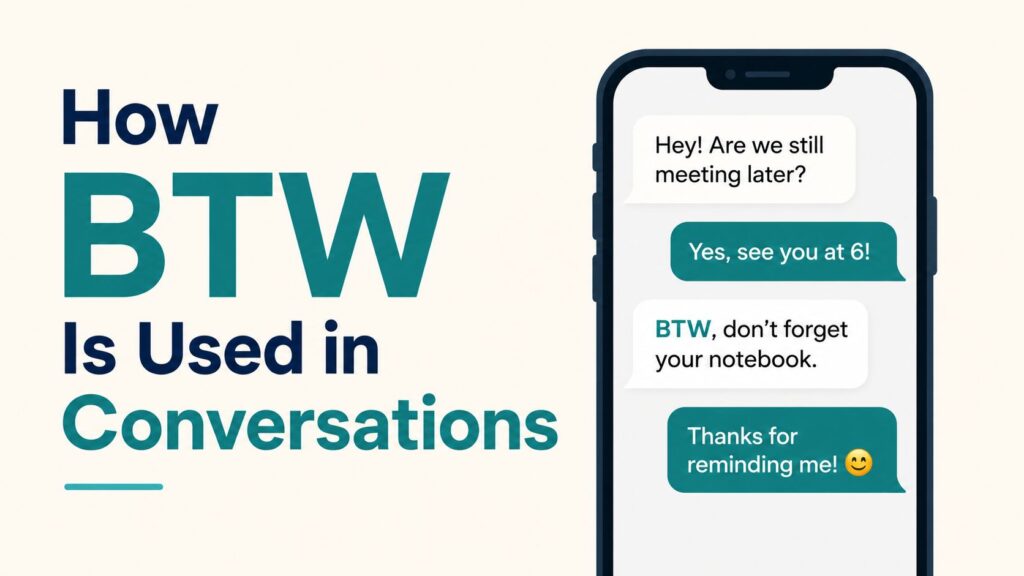
BTW isn’t a one-trick phrase. It flexes depending on what you’re trying to do in a conversation. Broadly, it serves three main functions.
Adding Extra Information
This is the most common use. You’re mid-conversation, and something extra pops into your head — not urgent, not the main point, but worth sharing.
Example:
“Yeah, I’ll be there around 7. Btw, I picked up extra snacks for the movie.”
Here, BTW introduces additional details that support the conversation without derailing it. It’s a small, friendly add-on — a side thought that enriches the exchange.
Changing Topic Smoothly
Sometimes you need to pivot the conversation entirely, and BTW acts as a bridge. Instead of an abrupt jump, it softens the shift.
Example:
“That restaurant was amazing. Btw, did you hear back from the job interview?”
Without the BTW, that topic change might feel a little disconnected. With it, the conversation flow stays smooth. This is where BTW functions almost like a verbal handshake between two unrelated ideas.
Reminder-Style Usage
BTW also works well when you want to jog someone’s memory about something they might forget, without sounding pushy or naggy.
Example:
“Have a good trip! Btw, don’t forget to water the plants.”
This softens what could otherwise sound like a demand. It reframes a reminder as a casual afterthought rather than an instruction, which keeps the tone light in friendly conversations.
Examples of BTW in Chat
To really understand how flexible this little abbreviation is, here’s a broader set of real-world style examples across different chat discussions:
| Context | Example Message |
|---|---|
| Texting a friend | “omw, be there in 10. btw bring your charger” |
| Group chat | “who’s cooking tonight? btw I’m allergic to shellfish just fyi” |
| Instagram DM | “loved your last post btw, where was that taken?” |
| Slack (casual team chat) | “pushed the fix. btw the staging server’s been slow today” |
| Dating app chat | “haha same! btw what’s your favorite coffee order?” |
| Family group text | “see you Sunday! btw mom wants everyone to bring a dish” |
Notice something across all of these? BTW consistently marks a shift into supplementary note territory — it’s never the main event of the message, always the supporting act.
Different Contexts of BTW Usage
Not all BTWs are created equal. Where you use it — and who’s reading it — changes how it lands.
- One-on-one texting: Extremely casual, almost invisible. Nobody blinks at “btw” in a private text.
- Group chats: Still casual, but BTW here often introduces info relevant to multiple people, so it can carry slightly more weight (like allergy info, logistics, etc.).
- Comment sections: Often used to add a tangential thought to a public post, sometimes to redirect a conversation.
- Captions on social media: Used to add context or a fun aside to an image or video.
- Professional chat tools: Used carefully — more on this below.
The common thread across all these contexts: BTW signals added context that the reader should know but that isn’t essential to the core message.
BTW in Social Media Communication
Social media is where BTW really shows its range. On platforms like Instagram, TikTok, and Twitter/X, BTW shows up constantly in captions, comments, and even video overlays.
Here’s how it plays out differently across platforms:
- Instagram: Often used in captions to add a quick fact or aside. “Sunset was unreal tonight 🌅 btw this spot is only a 10-min walk from downtown.”
- TikTok: Frequently appears in on-screen text or captions to deliver a punchline or extra tip after the main point of the video. “Here’s how I organize my closet… btw this took me 3 hours lol.”
- Twitter/X: Used to squeeze in a secondary thought within character limits, or to pivot a thread into a new but related idea.
A 2023 Pew Research study on teens and social media found that the vast majority of teenagers use messaging apps and social platforms daily, which explains why texting culture and platform-specific slang like BTW have merged so completely — young users move fluidly between SMS, DMs, and public posts, carrying the same chat acronyms across all of them (Pew Research Center).
What’s interesting is that BTW on public platforms often does more work than in private texts. In a caption, it’s not just a transition phrase — it can act as a hook, a way of teasing extra info that keeps a viewer reading or watching a little longer.
Common Mistakes People Make With BTW
Even something this simple gets misused constantly. Here are the mistakes worth avoiding:
- Burying important info. Dropping something genuinely significant right before ending a conversation, disguised as a casual afterthought. (“Anyway, gotta run. Btw I’m moving to another state next month.”) If it’s big news, it deserves its own moment, not a throwaway tag.
- Overusing it. When every other sentence starts with “btw,” it stops meaning anything. The whole point is that it flags something as extra — if everything is extra, nothing is.
- Using it in the wrong register. Dropping “btw” into a formal report or a first email to a new client can read as sloppy or overly casual, undermining communication quality.
- Confusing it with similar acronyms. BTW isn’t the same as FYI or ICYMI — mixing them up muddles your intent (more on this below).
- Assuming tone is obvious. Without punctuation or context, “btw” can occasionally come across as passive-aggressive, especially in tense conversations. (“btw you never answered my question.”) Read it back before sending.
BTW vs Similar Acronyms
People often lump BTW in with other web abbreviations, but each one carries a distinct job. Here’s a clear breakdown:
| Acronym | Full Meaning | Primary Function | Typical Tone |
|---|---|---|---|
| BTW | By The Way | Introduces a related but secondary thought | Casual, conversational |
| FYI | For Your Information | Shares info the recipient should know, often for practical reasons | Neutral, sometimes formal |
| ICYMI | In Case You Missed It | Re-shares or references something already posted/said | Informative, often public-facing |
| PS | Postscript | Adds a thought after a message/letter has technically ended | Slightly formal, often used in emails/letters |
The key distinction: BTW feels like something popping into your head mid-thought. FYI feels more like a heads-up, often with a practical reason behind it. ICYMI is almost always about referencing something that already existed. PS is structurally separate, tacked on after the “end” of a message.
Knowing the difference helps with message clarity — using the right one signals your intent more precisely, which matters more than people think in workplace messaging.
Is BTW Okay to Use at Work?
This is where things get genuinely important, not just fun trivia. The honest answer: it depends entirely on the platform and the relationship.
Where it’s fine:
- Internal Slack or Microsoft Teams messages with close teammates
- Casual, ongoing conversations with colleagues you talk to daily
- Quick internal notes that aren’t part of a formal record
Where to avoid it:
- Formal emails to clients, especially first-time contact
- Official reports, proposals, or contracts
- Any business communication that might be forwarded, archived, or referenced later
- Messages to senior leadership you don’t have a casual relationship with
Here’s a useful way to think about it: if the message could end up printed out, forwarded to someone outside the conversation, or referenced in a professional context down the line, skip the BTW. Professional writing generally favors clarity and formality over casual shorthand, even when the underlying idea is the same.
Suggested professional alternatives:
- “Additionally, …”
- “One more note — …”
- “Separately, I wanted to mention…”
- “On a related note…”
- “As a quick follow-up…”
These achieve the same function as BTW — introducing follow-up information — while staying appropriate for office chat, formal correspondence, or workplace correspondence where tone matters more.
Quick tip: If you’re unsure whether BTW fits, ask yourself: “Would I say this out loud to my boss in a meeting?” If the answer is no, it probably doesn’t belong in a formal email either.
Alternatives to BTW by Tone
Different situations call for different phrasing. Here’s a practical breakdown by tone and setting:
Casual alternatives (texting, close friends):
- “oh and…”
- “also…”
- “random but…”
- “side note…”
Formal alternatives (emails, official communication):
- “Additionally,”
- “In addition,”
- “I also wanted to mention…”
- “Separately,”
Spoken alternatives (in-person or verbal conversations):
- “Oh, that reminds me…”
- “Before I forget…”
- “One more thing…”
Written but semi-formal alternatives (professional but friendly newsletters, blog posts, internal memos):
- “On a related note…”
- “Worth mentioning:”
- “Quick add-on:”
Having a range of alternatives matters because relying on one transition phrase for every situation limits effective communication. Matching your language to your audience is half the battle in good writing.
Tone and Intent Behind BTW
Here’s something people rarely consider: the way you type BTW changes how it reads.
- btw (all lowercase) — feels casual, relaxed, low-stakes.
- Btw (capitalized first letter) — slightly more neutral, still casual but a touch more “typed properly.”
- BTW (all caps) — can come across as more emphatic or, depending on context, even a little intense, especially if the rest of the message is in lowercase.
- btw… (with ellipsis) — often signals hesitation or a slightly loaded follow-up, like the person isn’t sure how you’ll react.
- BTW!! (with exclamation) — reads as excited, urgent, or emphatic — often used for genuinely exciting news dressed up as an afterthought.
Punctuation and capitalization do real work in digital expressions like this. A single-word shift in formatting can change whether a message reads as breezy or as passive-aggressive. This is part of why texting has developed its own unwritten grammar — language usage in virtual conversations doesn’t map perfectly onto spoken or formally written English, and BTW is a great example of how much nuance a tiny abbreviation can carry.
ALSO READ: IIRC Meaning: What It Stands For and How to Use It Online in 2026
Why BTW Still Matters in 2026
You might wonder why an abbreviation from the dial-up era hasn’t faded out, especially with voice messages, emojis, and GIFs dominating so much of modern chat. The honest answer: BTW does something none of those replace. It’s a precise, universally understood way to soften a topic shift or flag something as secondary — no emoji fully replicates that function.
Communication trends over the last decade show that texting behavior keeps evolving toward brevity paired with tone-awareness. People aren’t just trying to type fewer characters anymore (most keyboards predict text instantly); they’re using shorthand deliberately, as a style choice, almost like punctuation for personality. BTW fits that shift perfectly — it’s less about saving time now and more about setting a conversational tone.
It also survives because it translates seamlessly across online communication channels. Whether you’re texting on SMS, messaging on Instagram, or chatting in team communication tools like Slack, BTW means the same thing everywhere. That consistency is rare in internet slang, where meanings often shift by platform or generation.
FAQs
Is BTW still commonly used in 2026, or is it fading out?
Yes, it’s still one of the most-used texting abbreviations, especially among Gen Z and millennials on messaging apps and social platforms.
Can BTW be used to start a text message?
Yes, it’s common to open with “btw” when you’re following up on an earlier conversation or adding a delayed thought.
Does BTW need a comma after it?
Not required, but many people add one for readability, e.g., “Btw, are you free tonight?”
Is BTW appropriate in customer service chats?
Generally no. Most brands stick to full phrasing like “Additionally” to maintain a professional, polished tone.
What’s the male/female usage difference for BTW, if any?
None. Usage is consistent across genders; it’s driven by context and relationship, not by who’s typing.
conclusion
BTW meaning in text is simple: it just means “by the way.” It’s a small word, but it does a big job. It softens topic changes. It adds extra info without sounding pushy. That’s why people use it so much in texts and chats.
Once you understand BTW meaning in text, you’ll notice it everywhere. Friends use it in casual chats. Some people even use it at work. Just remember: keep it casual, not formal. Save full phrases for emails and reports. Small choices like this make your writing feel clear and human.

Hi! I’m Jenson, the writer behind punslush.com. I craft clever puns and witty wordplay designed to entertain and inspire. Visit punslush.com for a good dose of humor and fun!